McCarthy Danielle M, Scott Grant N, Courtney D Mark, Czerniak Alyssa, Aldeen Amer Z, Gravenor Stephanie, Dresden Scott M
Northwestern University, Feinberg School of Medicine, Department of Emergency Medicine, Chicago, Illinois.
University of New Mexico, Department of Emergency Medicine, Albuquerque, New Mexico.
West J Emerg Med. 2017 Aug;18(5):928-936. doi: 10.5811/westjem.2017.5.34108. Epub 2017 Jul 14.
Emergency department (ED) patients' Internet search terms prior to arrival have not been well characterized. The objective of this analysis was to characterize the Internet search terms patients used prior to ED arrival and their relationship to final diagnoses.
We collected data via survey; participants listed Internet search terms used. Terms were classified into categories: symptom, specific diagnosis, treatment options, anatomy questions, processes of care/physicians, or "other." We categorized each discharge diagnosis as either symptom-based or formal diagnosis. The relationship between the search term and final diagnosis was assigned to one of four categories of search/diagnosis combinations (symptom search/symptom diagnosis, symptom search/formal diagnosis, diagnosis search/symptom diagnosis, diagnosis search/formal diagnosis), representing different "trajectories."
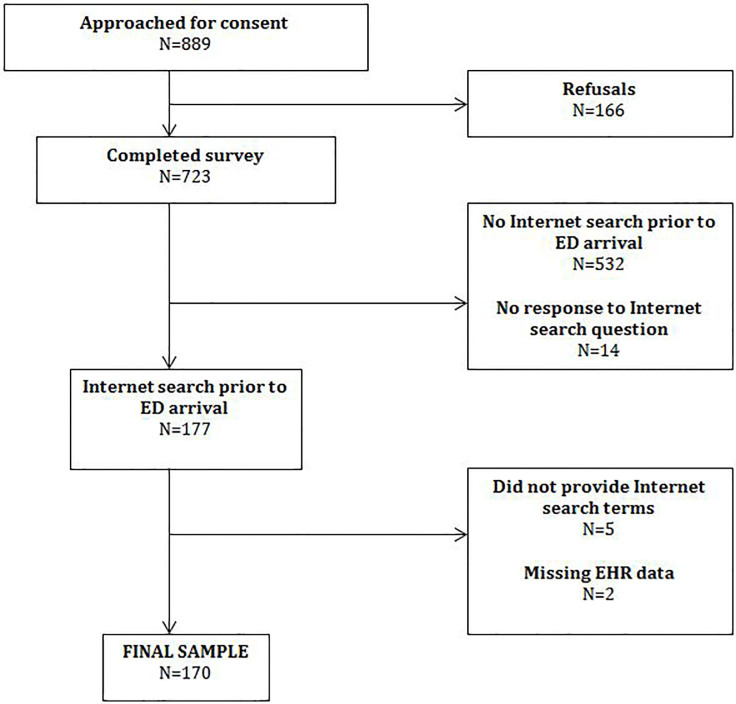
We approached 889 patients; 723 (81.3%) participated. Of these, 177 (24.5%) used the Internet prior to ED presentation; however, seven had incomplete data (N=170). Mean age was 47 years (standard deviation 18.2); 58.6% were female and 65.7% white. We found that 61.7% searched symptoms and 40.6% searched a specific diagnosis. Most patients received discharge diagnoses of equal specificity as their search terms (34% flat trajectory-symptoms and 34% flat trajectory-diagnosis). Ten percent searched for a diagnosis by name but received a symptom-based discharge diagnosis with less specificity. In contrast, 22% searched for a symptom and received a detailed diagnosis. Among those who searched for a diagnosis by name (n=69) only 29% received the diagnosis that they had searched.
The majority of patients used symptoms as the basis of their pre-ED presentation Internet search. When patients did search for specific diagnoses, only a minority searched for the diagnosis they eventually received.
急诊科(ED)患者在就诊前使用的互联网搜索词尚未得到充分描述。本分析的目的是描述患者在急诊科就诊前使用的互联网搜索词及其与最终诊断的关系。
我们通过调查收集数据;参与者列出使用过的互联网搜索词。搜索词被分类为以下类别:症状、特定诊断、治疗方案、解剖学问题、护理流程/医生或“其他”。我们将每个出院诊断分类为基于症状的诊断或正式诊断。搜索词与最终诊断之间的关系被归为四类搜索/诊断组合之一(症状搜索/症状诊断、症状搜索/正式诊断、诊断搜索/症状诊断、诊断搜索/正式诊断),代表不同的“轨迹”。
我们接触了889名患者;723名(81.3%)参与。其中,177名(24.5%)在急诊科就诊前使用了互联网;然而,7名数据不完整(N = 170)。平均年龄为47岁(标准差18.2);58.6%为女性,65.7%为白人。我们发现,61.7%的人搜索症状,40.6%的人搜索特定诊断。大多数患者出院诊断的特异性与他们的搜索词相同(34%为平坦轨迹 - 症状,34%为平坦轨迹 - 诊断)。10%的人按名称搜索诊断,但收到的是特异性较低的基于症状的出院诊断。相比之下,22%的人搜索症状并收到详细诊断。在按名称搜索诊断的人(n = 69)中,只有29%收到了他们搜索的诊断。
大多数患者将症状作为急诊科就诊前互联网搜索的基础。当患者确实搜索特定诊断时,只有少数人搜索到了他们最终得到的诊断。