Department of Pediatrics, Ajou University School of Medicine, Suwon, Korea.
Department of Pediatrics, Pusan National University School of Medicine, Busan, Korea.
J Korean Med Sci. 2017 Oct;32(10):1647-1656. doi: 10.3346/jkms.2017.32.10.1647.
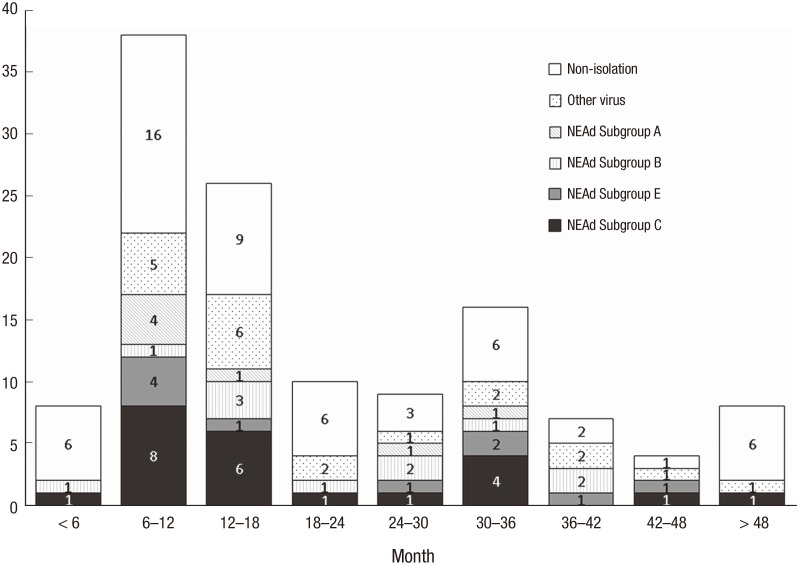
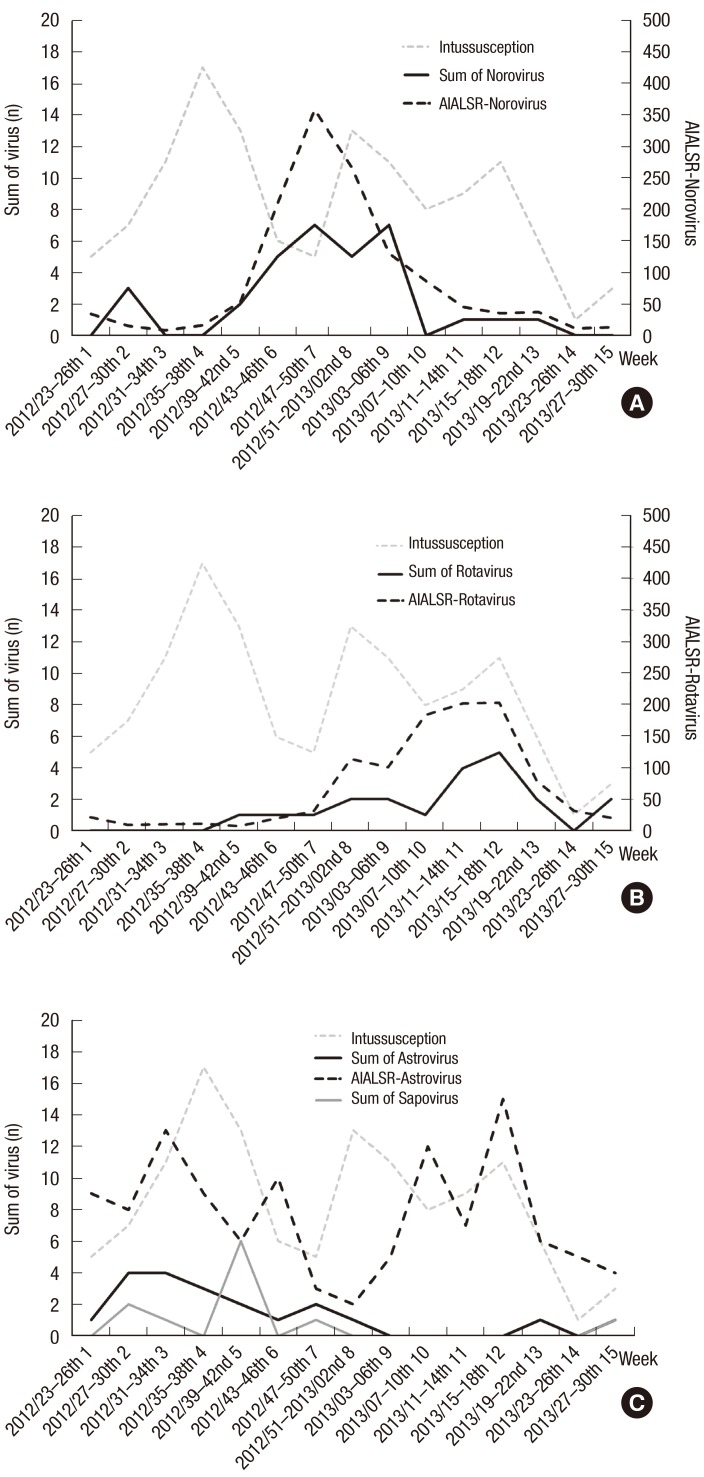
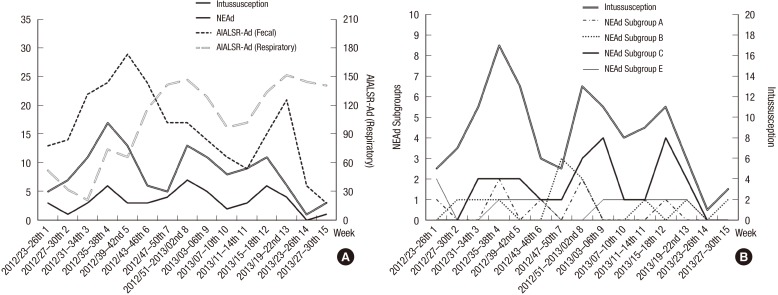
We investigated the adenoviral etiology and seasonal epidemic trends in intussusception and each adenoviral subgroup. Also we confirmed whether we can use the adenovirus data of Acute Infectious Agents Laboratory Surveillance Report (AIALSR) as an epidemic predictor of intussusception. Patients with intussusception (n = 126), < 5 years old, were enrolled and matched by age and sex with controls suffering acute gastroenteritis without intussusception (n = 106), all recruited at 8 centers. All fecal specimens were assayed for adenovirus, including subgroups A, B, C, E, and F, with reverse transcriptase-polymerase chain reaction (RT-PCR). Adenovirus was detected in 53 cases and 13 controls (P < 0.001). Nonenteric adenoviruses (NEAds) were detected in 51 cases and four controls (P < 0.001). We used Spearman's correlation analysis to analyze the incidence of intussusception and adenoviral epidemic trends, and compared them with fecal and respiratory adenoviral epidemic trends in the AIALSR. The trend of intussusception correlated with total NEAds (r = 0.635; P = 0.011), as did the fecal AIALSR adenovirus trends (r = 0.572; P = 0.026). Among the NEAd subgroups, subgroup C was dominant (P < 0.001), but subgroups B (P = 0.007) and E (P = 0.013) were also significant to intussusception. However, only subgroup C showed a significant epidemic correlation (r = 0.776; P = 0.001) with intussusception. Not respiratory but fecal AIALSR adenovirus trends correlated with the incidence of NEAds and intussusception. We suggest the possibility of using fecal AIALSR adenovirus data as an approximate epidemic predictor of intussusception.
我们研究了腺病毒病因和肠套叠的季节性流行趋势,以及每个腺病毒亚组。我们还证实了我们是否可以使用急性传染病病原体实验室监测报告(AIALSR)中的腺病毒数据作为肠套叠的流行预测指标。我们招募了 8 个中心的 126 名年龄<5 岁的肠套叠患者和 106 名年龄和性别匹配的无肠套叠急性胃肠炎对照,所有患者的粪便标本均采用逆转录-聚合酶链反应(RT-PCR)检测腺病毒,包括亚组 A、B、C、E 和 F。53 例患者和 13 例对照中检测到腺病毒(P<0.001)。51 例患者和 4 例对照中检测到非肠道腺病毒(NEAd)(P<0.001)。我们使用 Spearman 相关分析分析肠套叠的发病率和腺病毒的流行趋势,并将其与 AIALSR 中的粪便和呼吸道腺病毒流行趋势进行比较。肠套叠的趋势与总 NEAd 相关(r=0.635;P=0.011),AIALSR 粪便腺病毒趋势也相关(r=0.572;P=0.026)。在 NEAd 亚组中,C 亚组占主导地位(P<0.001),但 B 亚组(P=0.007)和 E 亚组(P=0.013)也与肠套叠显著相关。然而,只有 C 亚组与肠套叠呈显著的流行相关性(r=0.776;P=0.001)。与呼吸道无关,但 AIALSR 粪便腺病毒趋势与 NEAd 和肠套叠的发病率相关。我们建议使用 AIALSR 粪便腺病毒数据作为肠套叠流行的近似预测指标的可能性。