Department of Metabolism and Body Composition, Pennington Biomedical Research Center, Baton Rouge, LA, USA.
School of Electrical Engineering and Computer Science, Louisiana State University, Baton Rouge, LA, USA.
Eur J Clin Nutr. 2017 Nov;71(11):1329-1335. doi: 10.1038/ejcn.2017.142. Epub 2017 Sep 6.
BACKGROUND/OBJECTIVES: Recent advances have extended anthropometry beyond flexible tape measurements to automated three-dimensional optical devices that rapidly acquire hundreds of body surface dimensions. Three new devices were recently introduced that share in common inexpensive optical cameras. The design, and thus potential clinical applicability, of these systems differ substantially leading us to critically evaluate their accuracy and precision.
SUBJECTS/METHODS: 113 adult subjects completed evaluations by the three optical devices (KX-16 (16 stationary cameras), Proscanner (1 vertically oscillating camera), and Styku scanner (1 stationary camera)), air displacement plethysmography (ADP), dual-energy X-ray absorptiometry (DXA) and a flexible tape measure. Optical measurements were compared to reference method estimates that included results acquired by flexible tape, DXA and ADP.
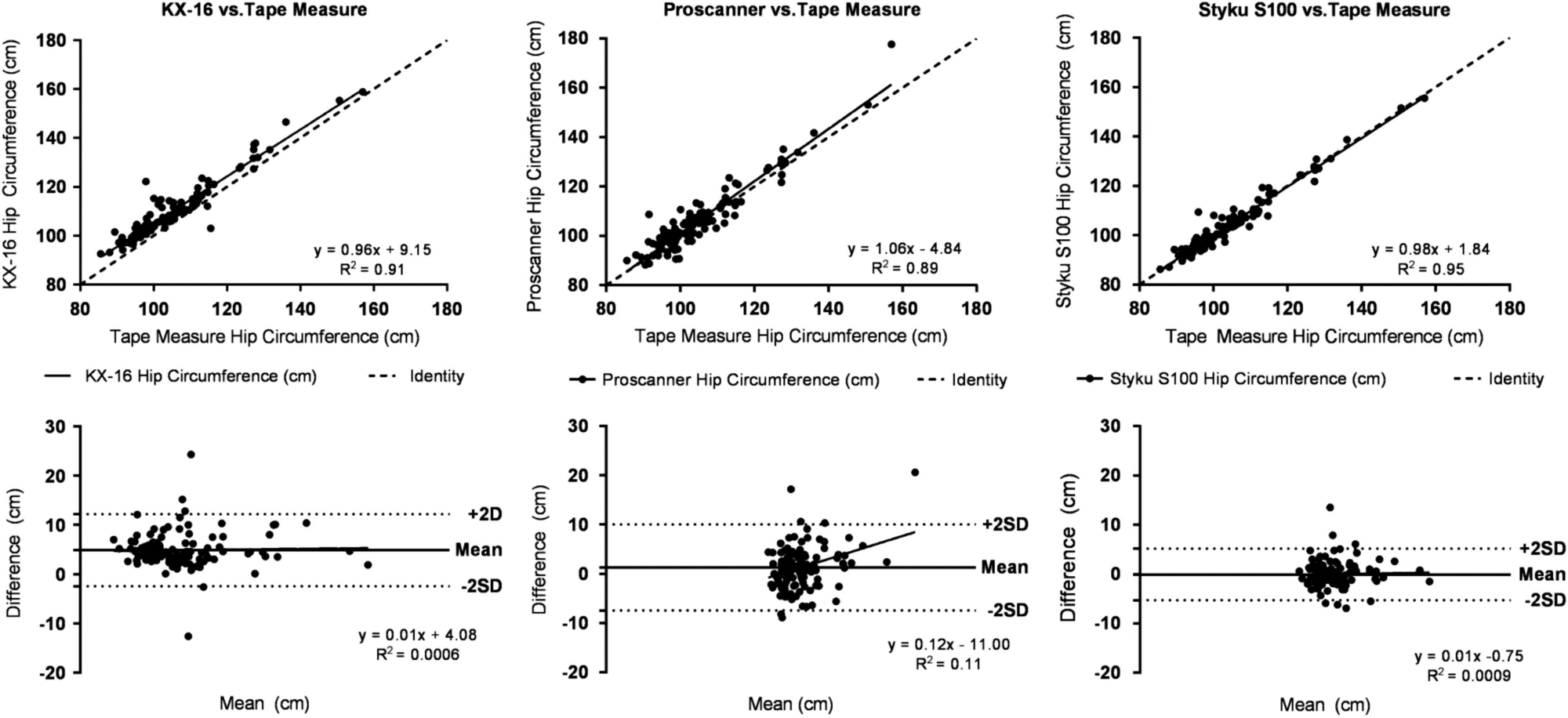
Optical devices provided respective circumference and regional volume estimates that overall were well-correlated with those obtained from flexible tape measurements (for example, hip circumference: R, 0.91, 0.90, 0.96 for the KX-16, Proscanner, and Styku scanner, respectively) and DXA (for example, trunk volume: R, 0.97, 0.97, and 0.98). Total body volumes measured by the optical devices were highly correlated with those from the ADP system (all Rs, 0.99). Coefficient of variations obtained from duplicate measurements (n, 55) were larger in optical than in reference measurements and significant (P<0.05) bias was present for some optical measurements relative to reference method estimates.
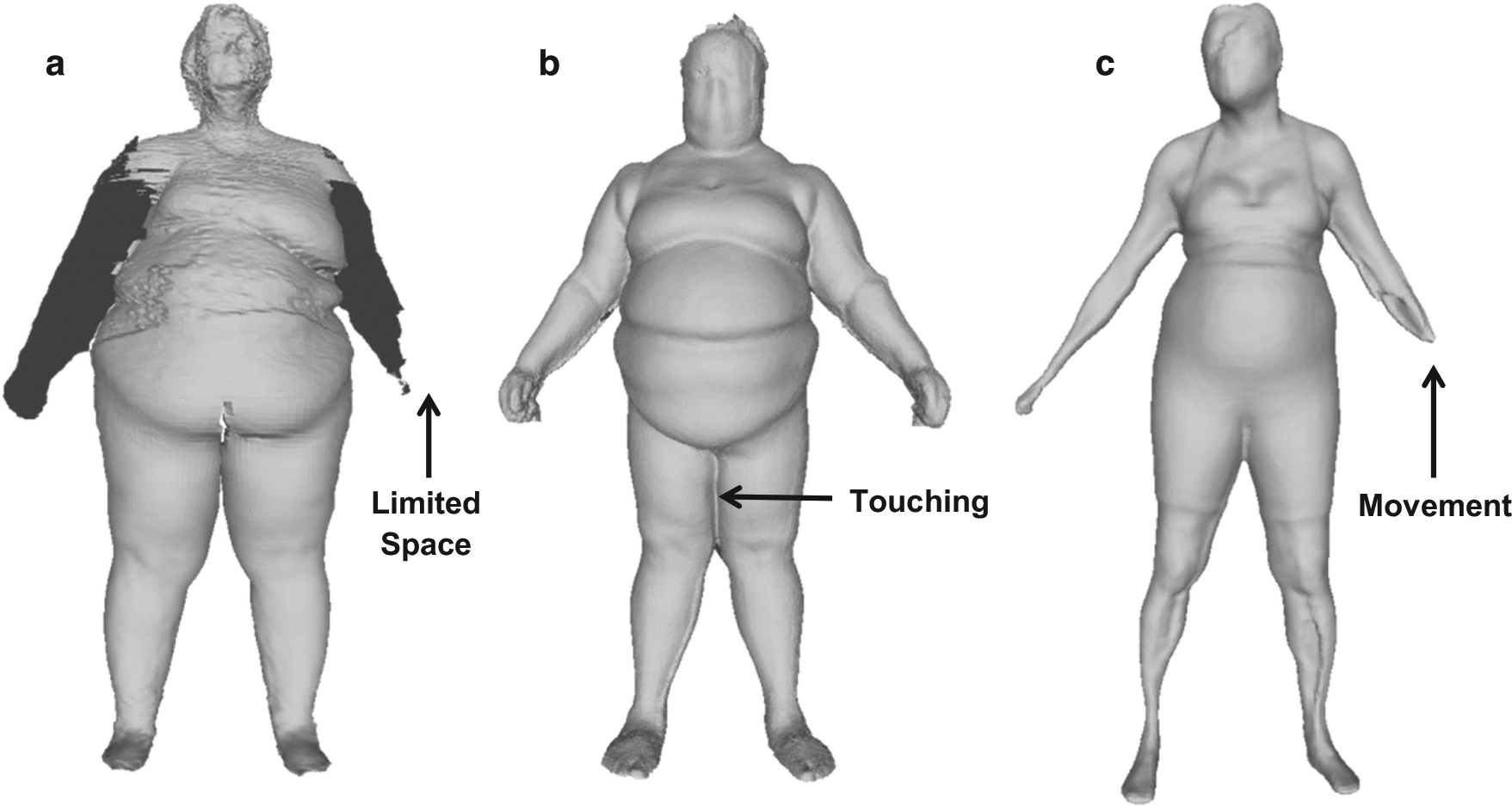
Overall, the evaluated optical imaging systems differing in design provided body surface measurements that compared favorably with corresponding reference methods. However, our evaluations uncovered system measurement limitations, such as discrepancies in landmarking, that with correction have the potential to improve future developed devices.
背景/目的:最近的进展将人体测量学从灵活的带测量扩展到了快速获取数百个体表尺寸的自动化三维光学设备。最近引入了三种新设备,它们共同具有廉价的光学相机。这些系统的设计,因此潜在的临床适用性,有很大的不同,这导致我们对其准确性和精密度进行了严格评估。
受试者/方法:113 名成年受试者通过三种光学设备(KX-16(16 个固定摄像头)、Proscanner(1 个垂直摆动摄像头)和 Styku 扫描仪(1 个固定摄像头))、空气置换体积描记法(ADP)、双能 X 射线吸收法(DXA)和柔性卷尺完成评估。将光学测量值与参考方法估计值进行比较,参考方法估计值包括通过柔性卷尺、DXA 和 ADP 获得的结果。
光学设备提供了各自的周长和区域体积估计值,总体上与通过柔性卷尺测量获得的结果(例如,臀围:KX-16、Proscanner 和 Styku 扫描仪的 R 值分别为 0.91、0.90 和 0.96)和 DXA(例如,躯干体积:R 值分别为 0.97、0.97 和 0.98)高度相关。光学设备测量的总体积与 ADP 系统的测量值高度相关(所有 R 值均为 0.99)。重复测量(n=55)获得的变异系数在光学测量中大于参考测量,并且一些光学测量相对于参考方法估计值存在显著(P<0.05)偏差。
总体而言,设计不同的评估光学成像系统提供的体表面积测量值与相应的参考方法相比具有优势。然而,我们的评估发现了系统测量的局限性,例如地标不一致,这些局限性通过纠正有可能改进未来开发的设备。