Granados Hector M, Draghi Andrew, Tsurutani Naomi, Wright Kyle, Fernandez Marina L, Sylvester Francisco A, Vella Anthony T
Department of Pediatrics, Texas Tech Health Science Center, El Paso, Texas, United States of America.
Department of Immunology, University of Connecticut Health Center, Farmington, Connecticut, United States of America.
PLoS One. 2017 Sep 6;12(9):e0183887. doi: 10.1371/journal.pone.0183887. eCollection 2017.
Programmed death cell 1 (PD-1) is an inhibitor of T cell activation and is also functionally linked to glycolysis. We hypothesized that PD-1 expression is defective in activated T cells from children with type 1 diabetes (T1D), resulting in abnormal T cell glucose metabolism.
In this pilot study, we enrolled children with new onset T1D within 2 weeks of diagnosis (T1D), unaffected siblings of T1D (SIBS), unaffected, unrelated children (CTRL), children with new onset, and untreated Crohn disease (CD). We repeated the assays 4-6 months post-diagnosis in T1D (T1D follow up). We analyzed anti-CD3/-CD28-stimulated peripheral blood mononuclear cells (PBMC) subsets for PD-1 expression by flow cytometry at baseline and after 24 h in culture. We measured cytokines in the culture medium by multiplex ELISA and glycolytic capacity with a flux analyzer.
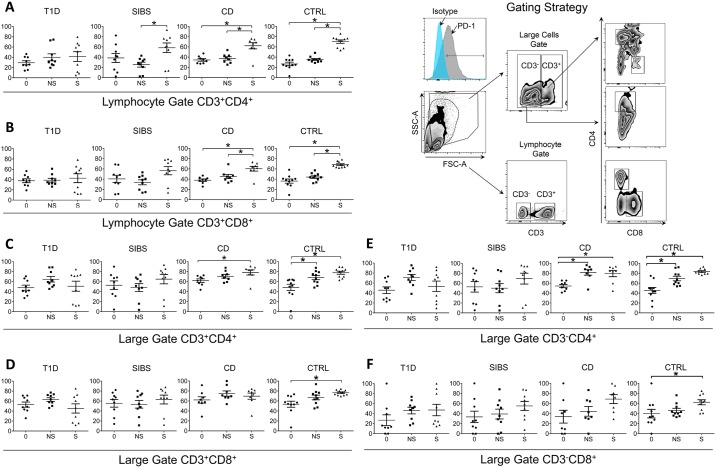
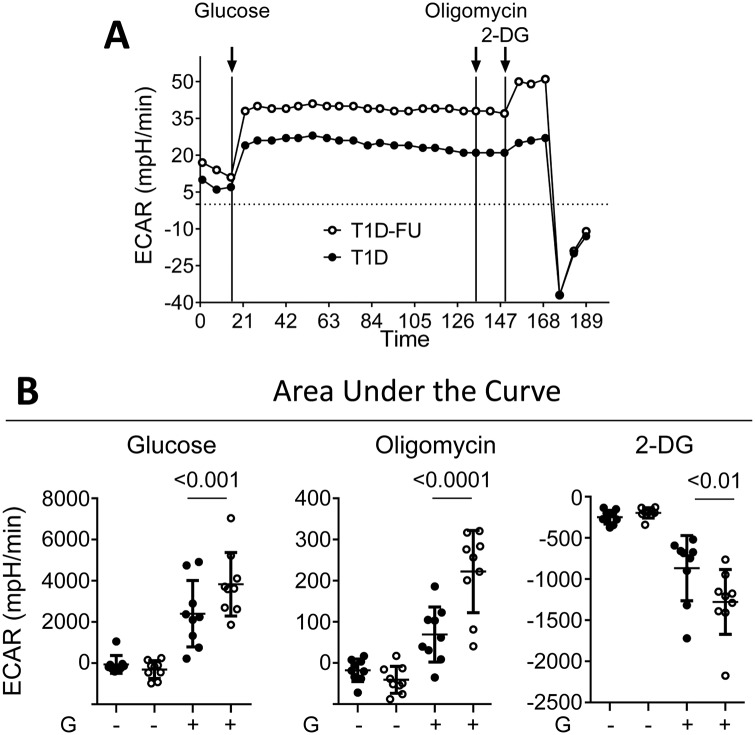
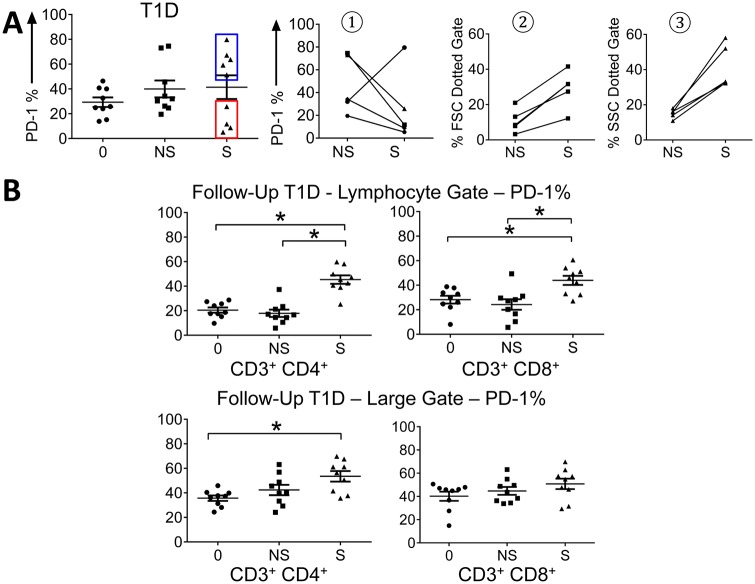
We enrolled 37 children. T cells derived from subjects with T1D had decreased PD-1 expression compared to the other study groups. However, in T1D follow-up T cells expressed PD-1 similarly to controls, but had no differences in PBMC cytokine production. Nonetheless, T1D follow up PBMCs had enhanced glycolytic capacity compared to T1D.
Activated T cells from T1D fail to upregulate PD-1 upon T-cell receptor stimulation, which may contribute to the pathogenesis of T1D. T1D follow up PBMC expression of PD-1 normalizes, together with a significant increase in glycolysis compared to T1D. Thus, insulin therapy in T1D children is associated with normal PD1 expression and heightened glycolytic capacity in PBMC.
程序性死亡细胞1(PD-1)是T细胞活化的抑制剂,且在功能上也与糖酵解相关。我们推测1型糖尿病(T1D)患儿活化T细胞中的PD-1表达存在缺陷,从而导致T细胞葡萄糖代谢异常。
在这项初步研究中,我们纳入了诊断后2周内新发病的T1D患儿(T1D组)、T1D未患病的同胞(SIBS组)、未患病的非亲属儿童(CTRL组)以及新发病且未接受治疗的克罗恩病(CD)患儿。我们在T1D组诊断后4 - 6个月重复进行检测(T1D随访)。我们通过流式细胞术分析了基线时以及培养24小时后抗CD3/ - CD28刺激的外周血单个核细胞(PBMC)亚群中PD-1的表达情况。我们通过多重ELISA检测培养基中的细胞因子,并使用通量分析仪测量糖酵解能力。
我们共纳入了37名儿童。与其他研究组相比,T1D组受试者来源的T细胞PD-1表达降低。然而,在T1D随访中,T细胞表达的PD-1与对照组相似,但PBMC细胞因子产生无差异。尽管如此,与T1D组相比,TID随访的PBMC糖酵解能力增强。
T1D患儿的活化T细胞在T细胞受体刺激后未能上调PD-1,这可能有助于T1D的发病机制。T1D随访时PBMC中PD-1的表达恢复正常,与T1D组相比糖酵解显著增加。因此,T1D患儿的胰岛素治疗与PBMC中正常的PD-1表达和增强的糖酵解能力相关。