Iwasaki Watal M, Innan Hideki
Department of Evolutionary Studies of Biosystems, SOKENDAI (Graduate University for Advanced Studies), Shonan Village, Hayama, 240-0193, Japan.
PLoS One. 2017 Sep 6;12(9):e0184229. doi: 10.1371/journal.pone.0184229. eCollection 2017.
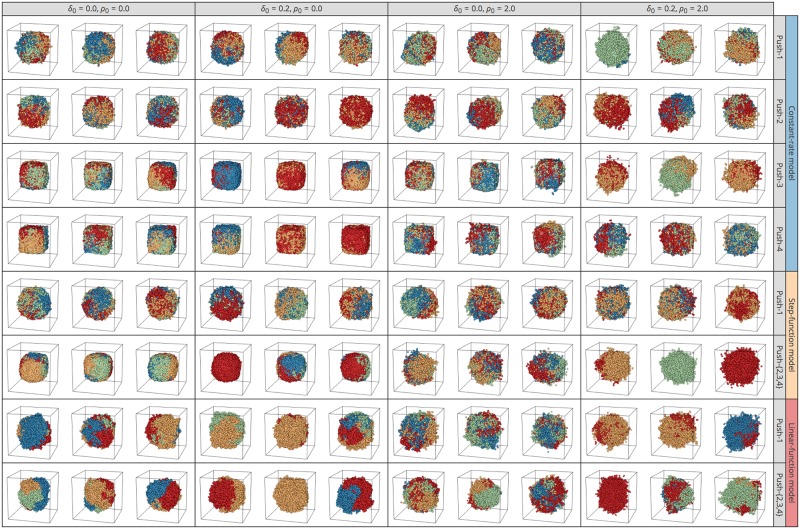
As cancer cell populations evolve, they accumulate a number of somatic mutations, resulting in heterogeneous subclones in the final tumor. Understanding the mechanisms that produce intratumor heterogeneity is important for selecting the best treatment. Although some studies have involved intratumor heterogeneity simulations, their model settings differed substantially. Thus, only limited conditions were explored in each. Herein, we developed a general framework for simulating intratumor heterogeneity patterns and a simulator (tumopp). Tumopp offers many setting options so that simulations can be carried out under various settings. Setting options include how the cell division rate is determined, how daughter cells are placed, and how driver mutations are treated. Furthermore, to account for the cell cycle, we introduced a gamma function for the waiting time involved in cell division. Tumopp also allows simulations in a hexagonal lattice, in addition to a regular lattice that has been used in previous simulation studies. A hexagonal lattice produces a more biologically reasonable space than a regular lattice. Using tumopp, we investigated how model settings affect the growth curve and intratumor heterogeneity pattern. It was found that, even under neutrality (with no driver mutations), tumopp produced dramatically variable patterns of intratumor heterogeneity and tumor morphology, from tumors in which cells with different genetic background are well intermixed to irregular shapes of tumors with a cluster of closely related cells. This result suggests a caveat in analyzing intratumor heterogeneity with simulations with limited settings, and tumopp will be useful to explore intratumor heterogeneity patterns in various conditions.
随着癌细胞群体的进化,它们会积累大量体细胞突变,导致最终肿瘤中出现异质性亚克隆。了解产生肿瘤内异质性的机制对于选择最佳治疗方法至关重要。尽管一些研究涉及肿瘤内异质性模拟,但其模型设置差异很大。因此,每项研究探索的条件都很有限。在此,我们开发了一个用于模拟肿瘤内异质性模式的通用框架和一个模拟器(tumopp)。Tumopp提供了许多设置选项,以便能够在各种设置下进行模拟。设置选项包括细胞分裂速率如何确定、子细胞如何放置以及驱动突变如何处理。此外,为了考虑细胞周期,我们为细胞分裂所涉及的等待时间引入了一个伽马函数。除了先前模拟研究中使用的规则晶格外,Tumopp还允许在六边形晶格中进行模拟。六边形晶格比规则晶格产生更符合生物学原理的空间。使用tumopp,我们研究了模型设置如何影响生长曲线和肿瘤内异质性模式。结果发现,即使在中性条件下(无驱动突变),tumopp也会产生显著不同的肿瘤内异质性模式和肿瘤形态,从具有不同遗传背景的细胞充分混合的肿瘤到具有一群密切相关细胞的不规则形状肿瘤。这一结果表明在使用有限设置的模拟分析肿瘤内异质性时需谨慎,而tumopp将有助于探索各种条件下的肿瘤内异质性模式。