Wright Rachel L, Brownless Simone Briony, Pratt David, Sackley Catherine M, Wing Alan M
School of Psychology, University of Birmingham, Birmingham, United Kingdom.
School of Sport, Exercise and Rehabilitation Sciences, University of Birmingham, Birmingham, United Kingdom.
Front Neurol. 2017 Aug 22;8:412. doi: 10.3389/fneur.2017.00412. eCollection 2017.
Hemiparesis after stroke typically results in a reduced walking speed, an asymmetrical gait pattern and a reduced ability to make gait adjustments. The purpose of this pilot study was to investigate the feasibility and preliminary efficacy of home-based training involving auditory cueing of stepping in place.
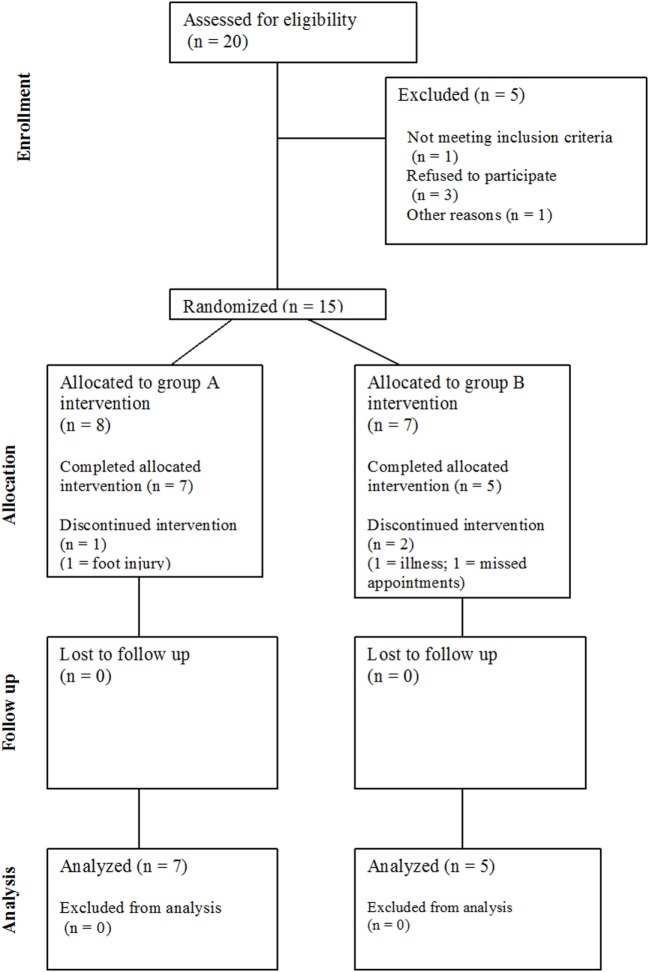
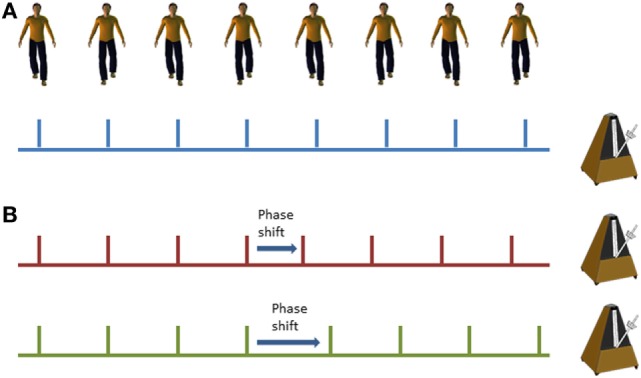
Twelve community-dwelling participants with chronic hemiparesis completed two 3-week blocks of home-based stepping to music overlaid with an auditory metronome. Tempo of the metronome was increased 5% each week. One 3-week block used a regular metronome, whereas the other 3-week block had phase shift perturbations randomly inserted to cue stepping adjustments.
All participants reported that they enjoyed training, with 75% completing all training blocks. No adverse events were reported. Walking speed, Timed Up and Go (TUG) time and Dynamic Gait Index (DGI) scores (median [inter-quartile range]) significantly improved between baseline (speed = 0.61 [0.32, 0.85] m⋅s; TUG = 20.0 [16.0, 39.9] s; DGI = 14.5 [11.3, 15.8]) and post stepping training (speed = 0.76 [0.39, 1.03] m⋅s; TUG = 16.3 [13.3, 35.1] s; DGI = 16.0 [14.0, 19.0]) and was maintained at follow-up (speed = 0.75 [0.41, 1.03] m⋅s; TUG = 16.5 [12.9, 34.1] s; DGI = 16.5 [13.5, 19.8]).
This pilot study suggests that auditory-cued stepping conducted at home was feasible and well-tolerated by participants post-stroke, with improvements in walking and functional mobility. No differences were detected between regular and phase-shift training with the metronome at each assessment point.
中风后偏瘫通常会导致步行速度降低、步态模式不对称以及进行步态调整的能力下降。这项初步研究的目的是调查基于家庭的原地踏步听觉提示训练的可行性和初步疗效。
12名患有慢性偏瘫的社区居住参与者完成了两个为期3周的基于家庭的跟着有节拍器声音的音乐踏步训练阶段。节拍器的节奏每周增加5%。其中一个为期3周的阶段使用常规节拍器,而另一个为期3周的阶段则随机插入相位偏移扰动来提示踏步调整。
所有参与者均表示喜欢训练,75%的参与者完成了所有训练阶段。未报告不良事件。步行速度、定时起立行走测试(TUG)时间和动态步态指数(DGI)评分(中位数[四分位间距])在基线(速度 = 0.61[0.32, 0.85]米·秒;TUG = 20.0[16.0, 39.9]秒;DGI = 14.5[11.3, 15.8])和踏步训练后(速度 = 0.76[0.39, 1.03]米·秒;TUG = 16.3[13.3, 35.1]秒;DGI = 16.0[14.0, 19.0])有显著改善,并在随访时保持(速度 = 0.75[0.41, 1.03]米·秒;TUG = 16.5[12.9, 34.1]秒;DGI = 16.5[13.5, 19.8])。
这项初步研究表明,中风后参与者在家中进行的听觉提示踏步训练是可行的且耐受性良好,步行和功能移动性均有改善。在每个评估点,常规节拍器训练和相位偏移节拍器训练之间未检测到差异。