Blonda Maria, Amoruso Antonella, Grasso Roberta, Di Francescantonio Valeria, Avolio Carlo
Department of Medical and Surgical Sciences, University of Foggia, Foggia, Italy.
Front Neurol. 2017 Aug 22;8:422. doi: 10.3389/fneur.2017.00422. eCollection 2017.
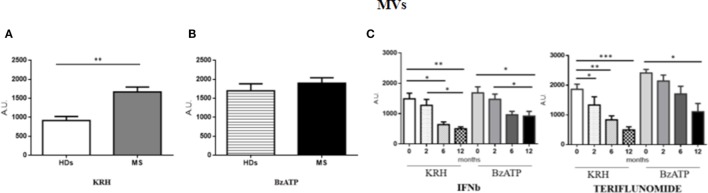
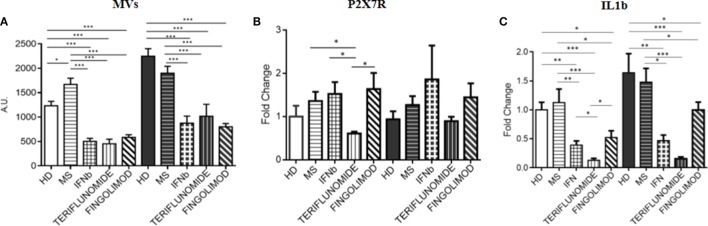
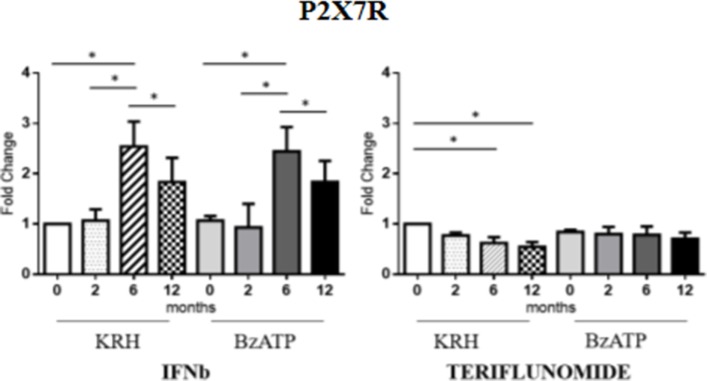
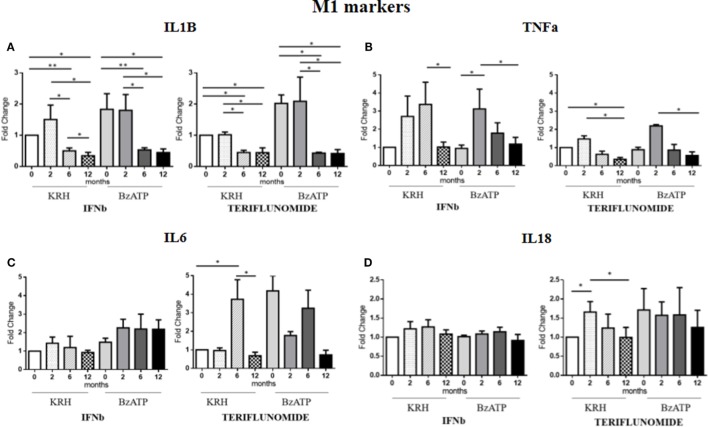
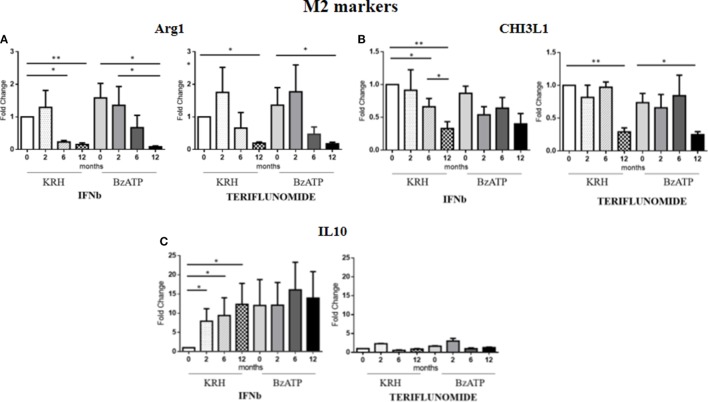
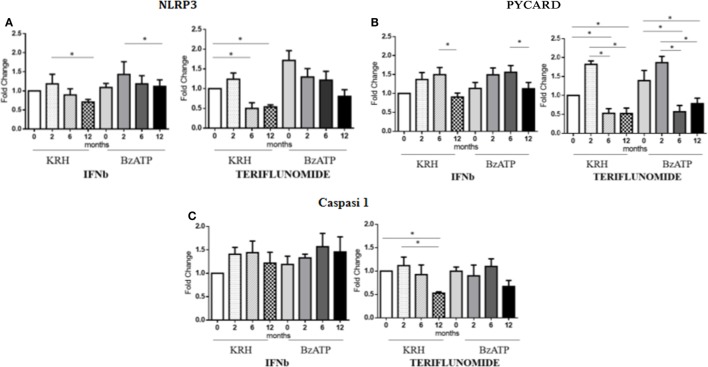
Microvesicles (MVs) are released by immune cells especially of the myeloid lineage upon stimulation with ATP on its cognate receptor P2X7, both in physiological and pathological conditions. In multiple sclerosis (MS) the role of MVs remains little investigated. We aimed to compare the release of MVs in peripheral blood monocytes from MS patients with healthy donors (HDs) and to see how current MS treatment may affect such a production. We also assessed the treatment effect on M1 and M2 monocyte polarization and on the inflammasome components. Spectrophotometric quantification was performed to compare monocyte-derived MVs from 20 untreated relapsing-remitting MS patients and 20 HDs and to evaluate the effect of different treatments. Subgroups of nine interferon-beta and of five teriflunomide-treated MS patients were evaluated at baseline and after 2, 6, and 12 months of treatment. Six MS patients taking Fingolimod, after switching from a first-line therapy, were included in the study and analyzed only at 12 months of treatment. MVs analysis revealed that monocytes from MS patients produced vesicles in higher amounts than controls. All treatments reduced vesicle production but only teriflunomide was associated with a downregulation of purinergic P2X7 receptor and inflammasome components expression. The therapies modulated mRNA expression of both M1 and M2 monocyte markers. Our results, suggesting new molecular targets for drugs currently used in MS, may potentially provide useful novel evidence to approach the disease.
微泡(MVs)由免疫细胞尤其是髓系细胞在生理和病理条件下受到ATP刺激后,通过其同源受体P2X7释放。在多发性硬化症(MS)中,MVs的作用仍鲜少被研究。我们旨在比较MS患者外周血单核细胞与健康供者(HDs)中MVs的释放情况,并观察当前的MS治疗如何影响这种产生。我们还评估了治疗对M1和M2单核细胞极化以及炎性小体成分的影响。进行分光光度法定量以比较20例未经治疗的复发缓解型MS患者和20例HDs的单核细胞来源的MVs,并评估不同治疗的效果。对9例接受干扰素-β治疗和5例接受特立氟胺治疗的MS患者亚组在基线以及治疗2、6和12个月后进行评估。6例从一线治疗转换而来后服用芬戈莫德的MS患者被纳入研究,仅在治疗12个月时进行分析。MVs分析显示,MS患者的单核细胞产生的微泡数量高于对照组。所有治疗均减少了微泡产生,但只有特立氟胺与嘌呤能P2X7受体和炎性小体成分表达的下调有关。这些疗法调节了M1和M2单核细胞标志物的mRNA表达。我们的结果提示了目前用于MS的药物的新分子靶点,可能为治疗该疾病提供有用的新证据。