Wainstein Marco V, Mossmann Márcio, Araujo Gustavo N, Gonçalves Sandro C, Gravina Gabriela L, Sangalli Marlei, Veadrigo Francine, Matte Roselene, Reich Rejane, Costa Fernanda G, Andrades Michael, da Silva Antônio Marcos V, Bertoluci Marcello C
Programa de Pós-Graduação em Medicina: Cardiologia, Universidade Federal do Rio Grande do Sul, Porto Alegre, Brazil.
Serviço de Cardiologia do, Hospital de Clínicas de Porto Alegre, Porto Alegre, Brazil.
Diabetol Metab Syndr. 2017 Sep 6;9:67. doi: 10.1186/s13098-017-0266-5. eCollection 2017.
Interleukin-6 (IL-6) plays a central role in atherosclerosis and inflammation. It may improve risk prediction in patients at intermediate cardiovascular risk.
To analyze the impact of serum IL-6 in predicting early angiographic coronary artery disease in patients at intermediate cardiovascular risk with chest pain.
In a cross-sectional study, patients referred for coronary angiography due to suspected coronary artery disease (CAD) were included. Coronary artery disease was defined as the presence of at least 30% stenosis in one or more coronary artery. Severity of CAD was classified by the anatomic burden score. Performance of serum IL-6 assay was compared with ACC/AHA atherosclerotic cardiovascular disease (ASCVD) risk score and hs-CRP through receiver operating characteristic (ROC) curves.
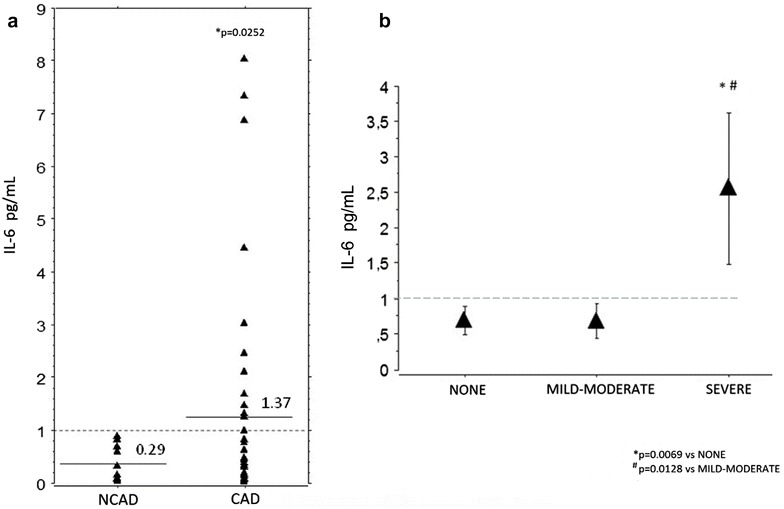
We have included 48 patients with a mean 10-year ASCVD risk of 10.0 ± 6.8%. The prevalence of CAD was 72.9%. The presence of CAD was associated with higher mean levels of IL-6 (p = 0.025). Patients with CAD had significantly more overweight than subjects without CAD. In 27% of patients, IL-6 was >1.0 pg/mL and 100% of these patients had CAD, while only 64% in those with IL-6 <1.0 pg/mL, corresponding to a positive predictive value of 100% (p = 0.015). The area under the receiver operating characteristic (ROC) curve of IL-6, hs-CRP and ASCVD were respectively 0.72, 0.60 and 0.54. Intermediate risk patients with IL-6 >1.0 pg/mL were further reclassified into ASCVD high risk due to the presence of coronary lesions.
In intermediate risk patients referred for coronary angiography, a serum IL-6 level above 1 pg/mL is predictive of significant CAD. IL-6 determination may be useful to reclassify ASCVD intermediate risk patients into higher risk categories.
白细胞介素-6(IL-6)在动脉粥样硬化和炎症中起核心作用。它可能改善心血管疾病中度风险患者的风险预测。
分析血清IL-6对有胸痛症状的心血管疾病中度风险患者早期冠状动脉造影显示的冠心病的预测作用。
在一项横断面研究中,纳入因疑似冠状动脉疾病(CAD)而接受冠状动脉造影的患者。冠状动脉疾病定义为一条或多条冠状动脉存在至少30%的狭窄。CAD的严重程度通过解剖负荷评分进行分类。通过受试者工作特征(ROC)曲线比较血清IL-6检测与美国心脏病学会/美国心脏协会(ACC/AHA)动脉粥样硬化性心血管疾病(ASCVD)风险评分及高敏C反应蛋白(hs-CRP)的表现。
我们纳入了48例患者,其平均10年ASCVD风险为10.0±6.8%。CAD的患病率为72.9%。CAD的存在与IL-6的平均水平较高相关(p = 0.025)。CAD患者的超重情况明显多于无CAD的受试者。在27%的患者中,IL-6>1.0 pg/mL,这些患者中有100%患有CAD,而IL-6<1.0 pg/mL的患者中只有64%患有CAD,阳性预测值为100%(p = 0.015)。IL-6、hs-CRP和ASCVD的受试者工作特征(ROC)曲线下面积分别为0.72、0.60和0.54。由于存在冠状动脉病变,IL-6>1.0 pg/mL的中度风险患者被进一步重新分类为ASCVD高风险患者。
在因冠状动脉造影而转诊的中度风险患者中,血清IL-6水平高于1 pg/mL可预测显著的CAD。测定IL-6可能有助于将ASCVD中度风险患者重新分类为更高风险类别。