Saito Kota, Maeda Miharu, Katada Toshiaki
Department of Physiological Chemistry, Graduate School of Pharmaceutical Sciences, University of TokyoTokyo, Japan.
Front Cell Dev Biol. 2017 Aug 23;5:75. doi: 10.3389/fcell.2017.00075. eCollection 2017.
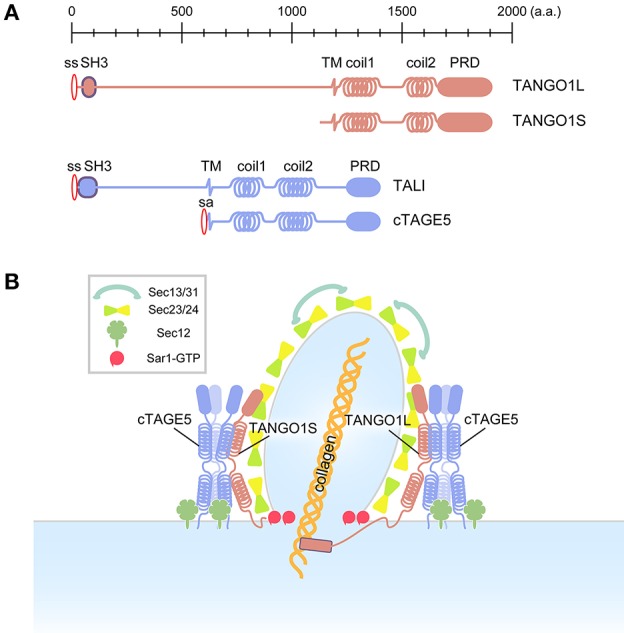
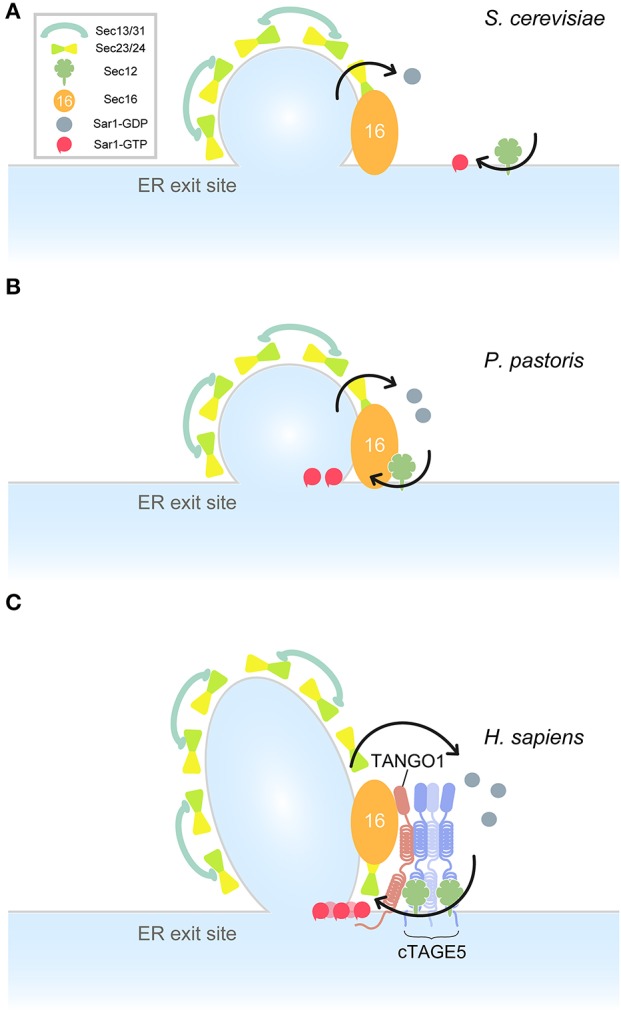
Proteins synthesized within the endoplasmic reticulum (ER) are transported to the Golgi via coat protein complex II (COPII)-coated vesicles. The formation of COPII-coated vesicles is regulated by the GTPase cycle of Sar1. Activated Sar1 is recruited to ER membranes and forms a pre-budding complex with cargoes and the inner-coat complex. The outer-coat complex then stimulates Sar1 inactivation and completes vesicle formation. The mechanisms of forming transport carriers are well-conserved among species; however, in mammalian cells, several cargo molecules such as collagen, and chylomicrons are too large to be accommodated in conventional COPII-coated vesicles. Thus, special cargo-receptor complexes are required for their export from the ER. cTAGE5/TANGO1 complexes and their isoforms have been identified as cargo receptors for these macromolecules. Recent reports suggest that the cTAGE5/TANGO1 complex interacts with the GEF and the GAP of Sar1 and tightly regulates its GTPase cycle to accomplish large cargo secretion.
在内质网(ER)中合成的蛋白质通过包被蛋白复合物II(COPII)包被的囊泡运输到高尔基体。COPII包被囊泡的形成受Sar1的GTP酶循环调控。活化的Sar1被招募到内质网膜上,并与货物和内包被复合物形成一个芽前复合物。然后外包被复合物刺激Sar1失活并完成囊泡形成。形成运输载体的机制在物种间高度保守;然而,在哺乳动物细胞中,一些货物分子,如胶原蛋白和乳糜微粒太大,无法容纳在传统的COPII包被囊泡中。因此,它们从内质网输出需要特殊的货物受体复合物。cTAGE5/TANGO1复合物及其异构体已被确定为这些大分子的货物受体。最近的报告表明,cTAGE5/TANGO1复合物与Sar1的鸟嘌呤核苷酸交换因子(GEF)和GTP酶激活蛋白(GAP)相互作用,并严格调节其GTP酶循环以完成大型货物的分泌。