Department of Psychological & Brain Sciences, University of Massachusetts, Amherst.
Department of Psychological & Brain Sciences, University of California, Santa Barbara.
Am Psychol. 2017 Sep;72(6):531-542. doi: 10.1037/amp0000129.
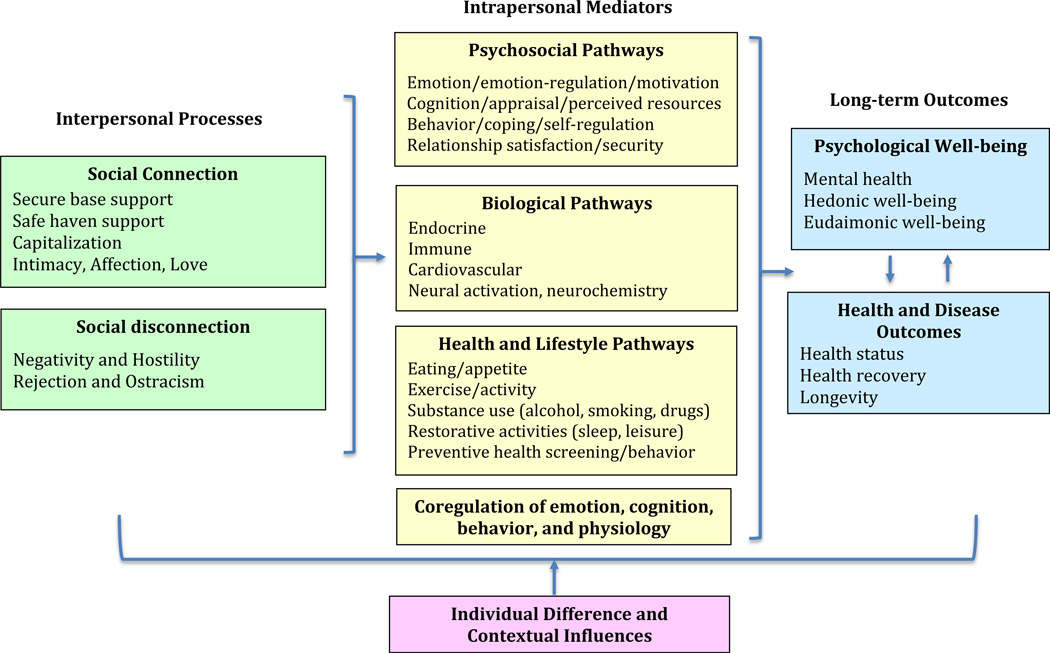
Close relationships play a vital role in human health, but much remains to be learned about specific mechanisms of action and potential avenues for intervention. This article provides an evaluation of research on close relationships processes relevant to health, drawing on themes from major relationship science theories to present a broad conceptual framework for understanding the interpersonal processes and intrapersonal pathways linking relationships to health and disease outcomes. The analysis reveals that both social connection and social disconnection broadly shape biological responses and behaviors that are consequential for health. Furthermore, emerging work offers insights into the types of social dynamics that are most consequential for health, and the potential pathways through which they operate. Following from this analysis, the authors suggest several research priorities to facilitate the translation of discoveries from relationship science into relationship-based interventions and public health initiatives. These priorities include developing finer grained theoretical models to guide research, the systematic investigation of potential mediating pathways such as dyadic influences on health behavior and physiological coregulation, and taking into account individual differences and contextual factors such as attachment style, gender, socioeconomic status, and culture. In addition, a pressing need exists for laboratory and field research to determine which types of interventions are both practical and effective. (PsycINFO Database Record
亲密关系在人类健康中起着至关重要的作用,但关于作用机制和潜在干预途径的具体信息还有待进一步研究。本文评估了与健康相关的亲密关系过程研究,借鉴了主要关系科学理论的主题,为理解人际关系过程和将人际关系与健康和疾病结果联系起来的内在途径提供了一个广泛的概念框架。分析表明,社会联系和社会脱节都广泛地塑造了对健康有影响的生物反应和行为。此外,新兴的研究工作深入探讨了对健康最具影响力的社会动态类型,以及它们运作的潜在途径。基于这一分析,作者提出了一些研究重点,以促进将关系科学的发现转化为基于关系的干预措施和公共卫生倡议。这些重点包括开发更精细的理论模型来指导研究,系统地研究潜在的中介途径,如对健康行为和生理共调节的二元影响,以及考虑个体差异和情境因素,如依恋风格、性别、社会经济地位和文化。此外,迫切需要进行实验室和现场研究,以确定哪些类型的干预措施既实用又有效。