Goods Brittany A, Hernandez Amanda L, Lowther Daniel E, Lucca Liliana E, Lerner Benjamin A, Gunel Murat, Raddassi Khadir, Coric Vlad, Hafler David A, Love J Christopher
Departments of Biological Engineering and Chemical Engineering, Koch Institute for Integrative Cancer Research, Massachusetts Institute of Technology, Cambridge, Massachusetts, United States of America.
Departments of Neurology and Immunobiology, Yale School of Medicine, New Haven, Connecticut, United States of America.
PLoS One. 2017 Sep 7;12(9):e0181538. doi: 10.1371/journal.pone.0181538. eCollection 2017.
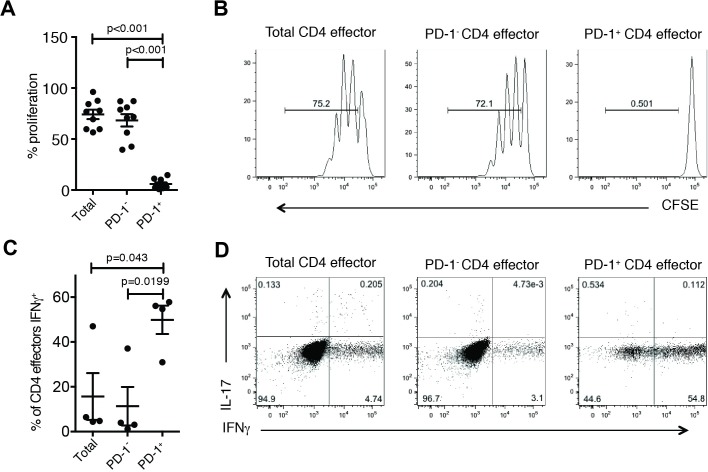
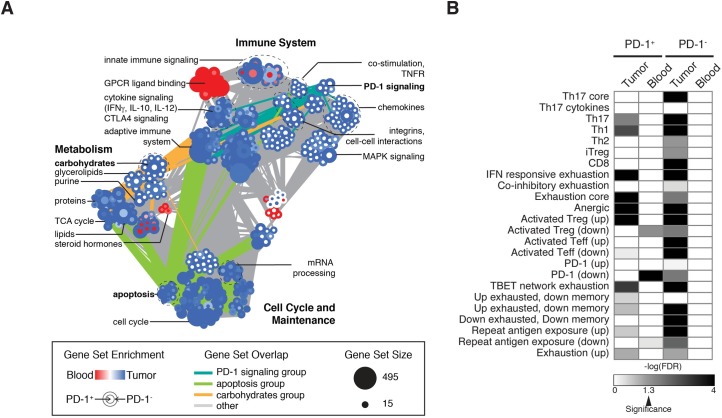
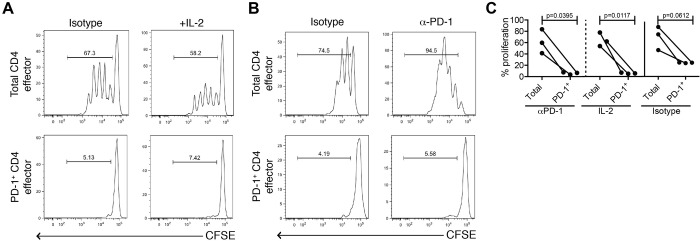
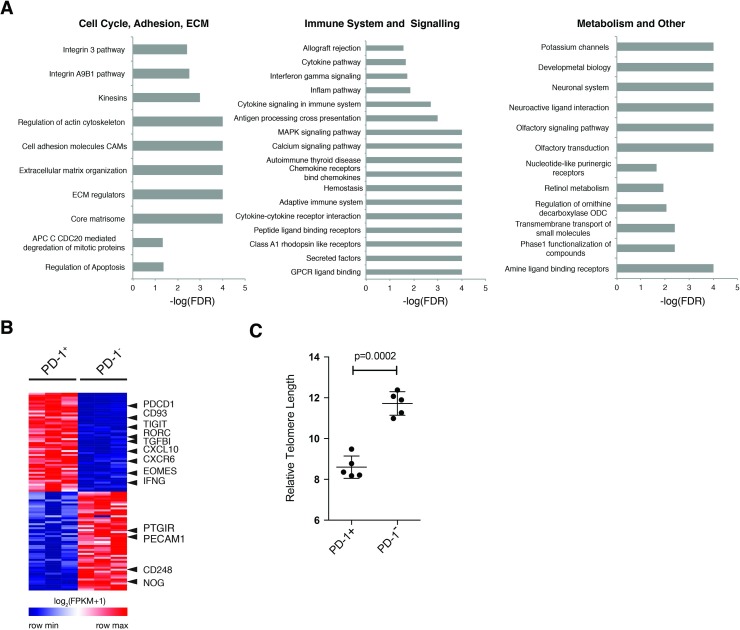
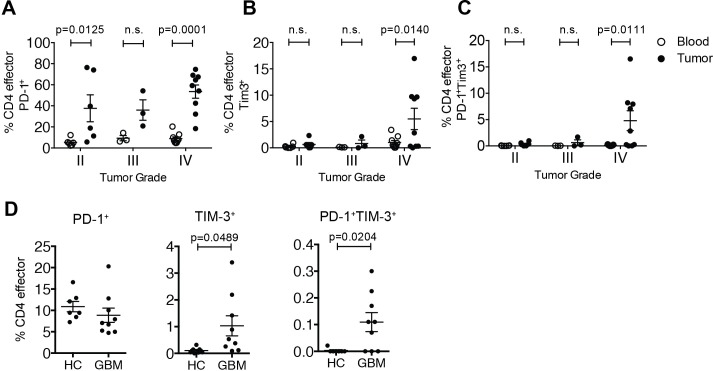
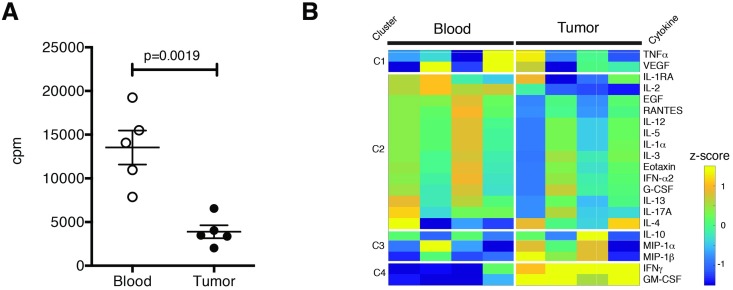
Immune checkpoint inhibitors targeting programmed cell death protein 1 (PD-1) have been highly successful in the treatment of cancer. While PD-1 expression has been widely investigated, its role in CD4+ effector T cells in the setting of health and cancer remains unclear, particularly in the setting of glioblastoma multiforme (GBM), the most aggressive and common form of brain cancer. We examined the functional and molecular features of PD-1+CD4+CD25-CD127+Foxp3-effector cells in healthy subjects and in patients with GBM. In healthy subjects, we found that PD-1+CD4+ effector cells are dysfunctional: they do not proliferate but can secrete large quantities of IFNγ. Strikingly, blocking antibodies against PD-1 did not rescue proliferation. RNA-sequencing revealed features of exhaustion in PD-1+ CD4 effectors. In the context of GBM, tumors were enriched in PD-1+ CD4+ effectors that were similarly dysfunctional and unable to proliferate. Furthermore, we found enrichment of PD-1+TIM-3+ CD4+ effectors in tumors, suggesting that co-blockade of PD-1 and TIM-3 in GBM may be therapeutically beneficial. RNA-sequencing of blood and tumors from GBM patients revealed distinct differences between CD4+ effectors from both compartments with enrichment in multiple gene sets from tumor infiltrating PD-1-CD4+ effectors cells. Enrichment of these gene sets in tumor suggests a more metabolically active cell state with signaling through other co-receptors. PD-1 expression on CD4 cells identifies a dysfunctional subset refractory to rescue with PD-1 blocking antibodies, suggesting that the influence of immune checkpoint inhibitors may involve recovery of function in the PD-1-CD4+ T cell compartment. Additionally, co-blockade of PD-1 and TIM-3 in GBM may be therapeutically beneficial.
靶向程序性细胞死亡蛋白1(PD-1)的免疫检查点抑制剂在癌症治疗中取得了巨大成功。虽然PD-1的表达已得到广泛研究,但其在健康和癌症背景下CD4+效应T细胞中的作用仍不清楚,尤其是在多形性胶质母细胞瘤(GBM)这种最具侵袭性和常见的脑癌背景下。我们研究了健康受试者和GBM患者中PD-1+CD4+CD25-CD127+Foxp3-效应细胞的功能和分子特征。在健康受试者中,我们发现PD-1+CD4+效应细胞功能失调:它们不增殖,但能分泌大量干扰素γ。令人惊讶的是,抗PD-1阻断抗体并不能挽救其增殖。RNA测序揭示了PD-1+CD4效应细胞中的耗竭特征。在GBM背景下,肿瘤中富含同样功能失调且无法增殖的PD-1+CD4+效应细胞。此外,我们发现肿瘤中PD-1+TIM-3+CD4+效应细胞增多,这表明在GBM中联合阻断PD-1和TIM-3可能具有治疗益处。对GBM患者血液和肿瘤的RNA测序揭示了两个区室中CD4+效应细胞之间的明显差异,肿瘤浸润性PD-1-CD4+效应细胞的多个基因集在肿瘤中富集。这些基因集在肿瘤中的富集表明细胞状态具有更高的代谢活性,并通过其他共受体进行信号传导。CD4细胞上的PD-1表达确定了一个对PD-1阻断抗体挽救无效的功能失调亚群,这表明免疫检查点抑制剂的影响可能涉及PD-1-CD4+T细胞区室功能的恢复。此外,在GBM中联合阻断PD-1和TIM-3可能具有治疗益处。