Chen Lei L, Zhu Jing, Schumacher Jonathan, Wei Chongjuan, Ramdas Latha, Prieto Victor G, Jimenez Arnie, Velasco Marco A, Tripp Sheryl R, Andtbacka Robert H I, Gouw Launce, Rodgers George M, Zhang Liansheng, Chan Benjamin K, Cassidy Pamela B, Benjamin Robert S, Leachman Sancy A, Frazier Marsha L
Department of Sarcoma, University of Texas M D Anderson Cancer Center, Houston, Texas, United States of America.
Department of Epidemiology, University of Texas M D Anderson Cancer Center, Houston, Texas, United States of America.
PLoS One. 2017 Sep 7;12(9):e0184154. doi: 10.1371/journal.pone.0184154. eCollection 2017.
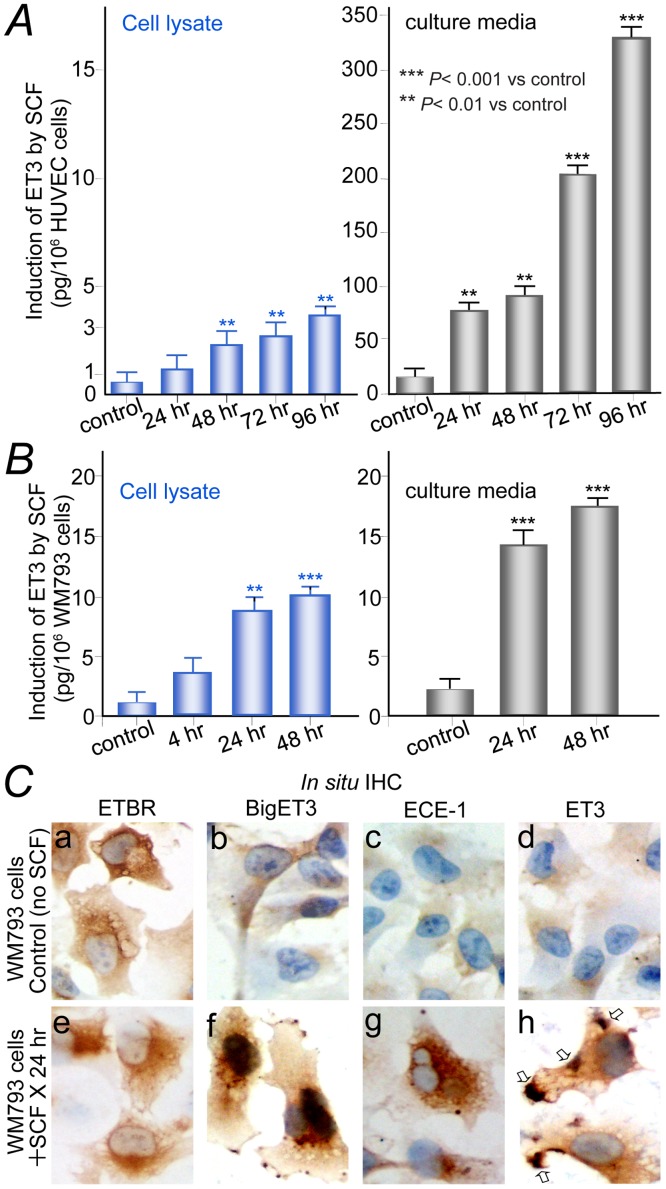
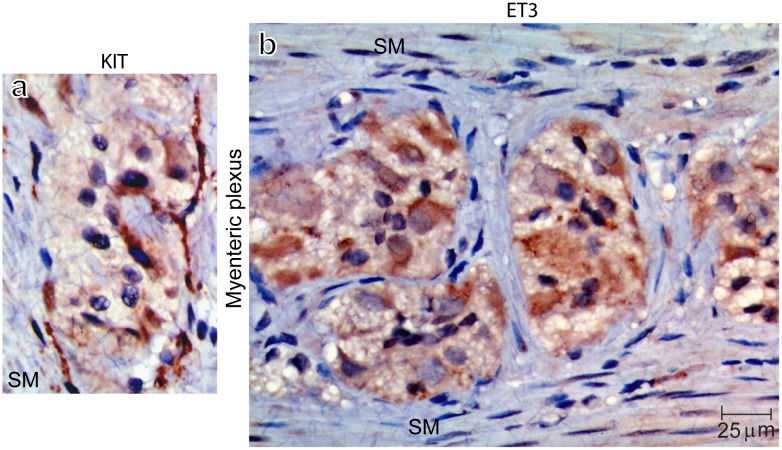
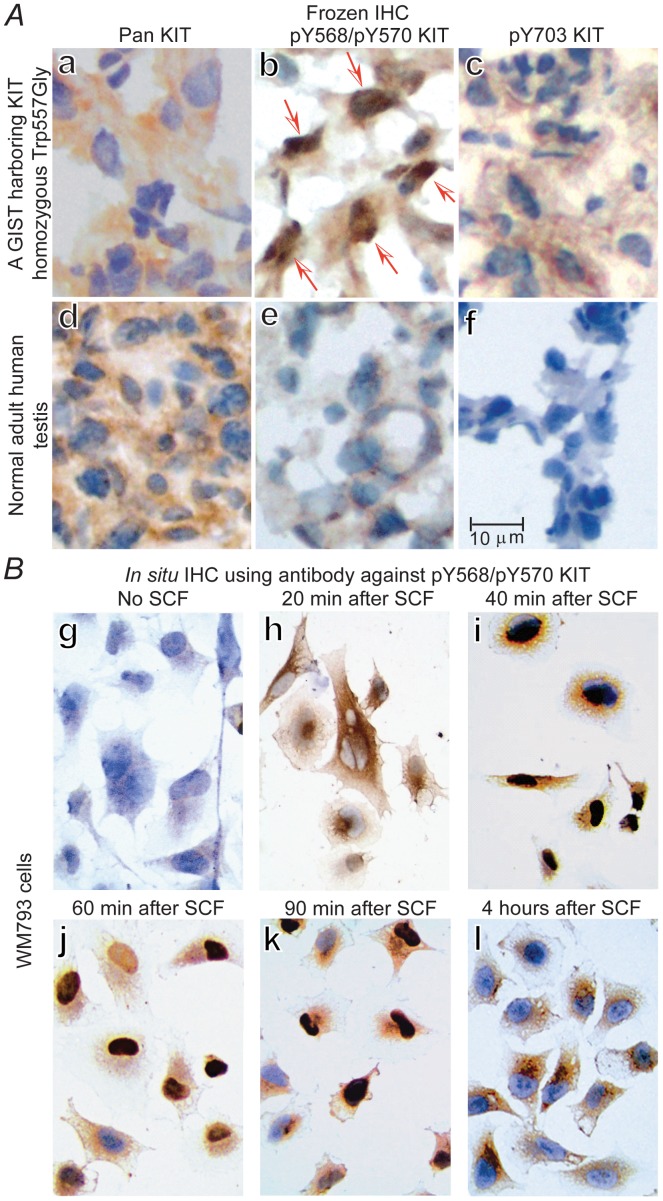
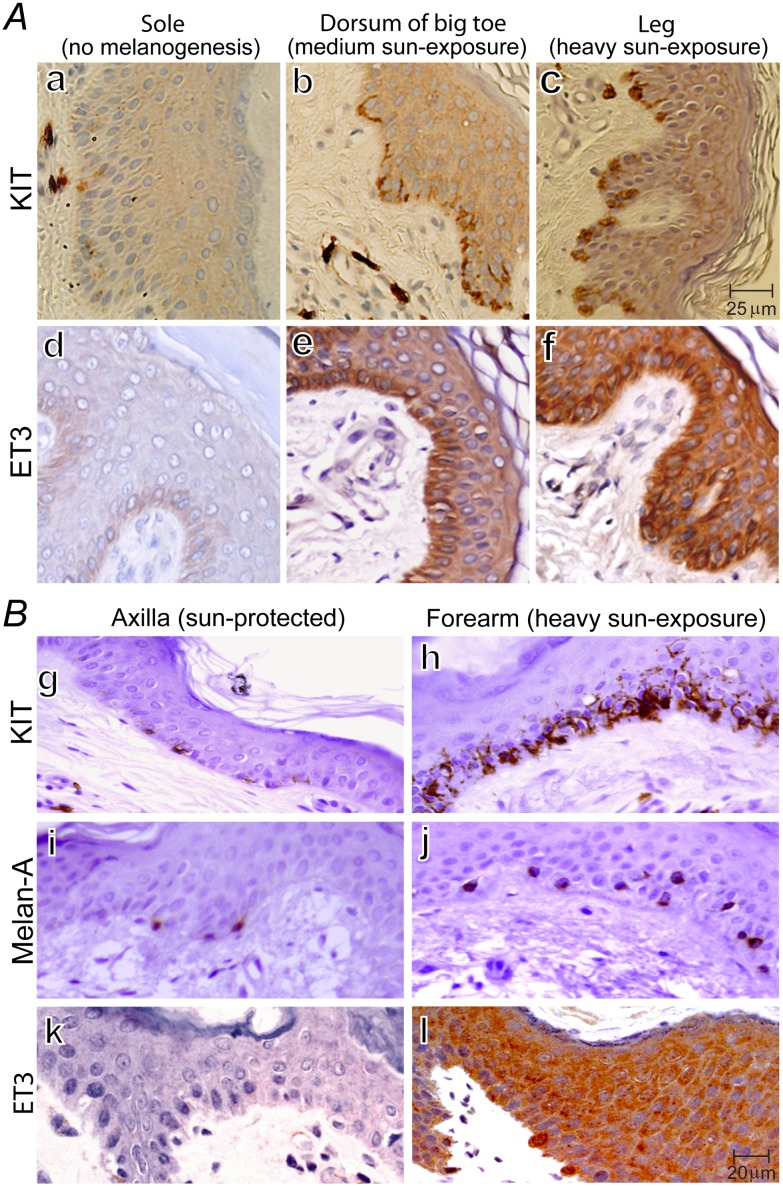
We demonstrate that SCF-KIT signaling induces synthesis and secretion of endothelin-3 (ET3) in human umbilical vein endothelial cells and melanoma cells in vitro, gastrointestinal stromal tumors, human sun-exposed skin, and myenteric plexus of human colon post-fasting in vivo. This is the first report of a physiological mechanism of ET3 induction. Integrating our finding with supporting data from literature leads us to discover a previously unreported pathway of nitric oxide (NO) generation derived from physiological endothelial NO synthase (eNOS) or neuronal NOS (nNOS) activation (referred to as the KIT-ET3-NO pathway). It involves: (1) SCF-expressing cells communicate with neighboring KIT-expressing cells directly or indirectly (cleaved soluble SCF). (2) SCF-KIT signaling induces timely local ET3 synthesis and secretion. (3) ET3 binds to ETBR on both sides of intercellular space. (4) ET3-binding-initiated-ETBR activation increases cytosolic Ca2+, activates cell-specific eNOS or nNOS. (5) Temporally- and spatially-precise NO generation. NO diffuses into neighboring cells, thus acts in both SCF- and KIT-expressing cells. (6) NO modulates diverse cell-specific functions by NO/cGMP pathway, controlling transcriptional factors, or other mechanisms. We demonstrate the critical physiological role of the KIT-ET3-NO pathway in fulfilling high demand (exceeding basal level) of endothelium-dependent NO generation for coping with atherosclerosis, pregnancy, and aging. The KIT-ET3-NO pathway most likely also play critical roles in other cell functions that involve dual requirement of SCF-KIT signaling and NO. New strategies (e.g. enhancing the KIT-ET3-NO pathway) to harness the benefit of endogenous eNOS and nNOS activation and precise NO generation for correcting pathophysiology and restoring functions warrant investigation.
我们证明,在体外人脐静脉内皮细胞和黑色素瘤细胞、胃肠道间质瘤、人体暴露于阳光下的皮肤以及体内禁食后的人结肠肌间神经丛中,干细胞因子-原癌基因c-KIT信号传导可诱导内皮素-3(ET3)的合成与分泌。这是关于ET3诱导生理机制的首次报道。将我们的研究结果与文献中的支持数据相结合,使我们发现了一条先前未报道的由生理性内皮型一氧化氮合酶(eNOS)或神经元型一氧化氮合酶(nNOS)激活产生一氧化氮(NO)的途径(称为KIT-ET3-NO途径)。它包括:(1)表达干细胞因子(SCF)的细胞直接或间接(裂解的可溶性SCF)与相邻表达c-KIT的细胞进行通讯。(2)SCF-KIT信号传导诱导适时的局部ET3合成与分泌。(3)ET3与细胞间空间两侧的ETBR结合。(4)ET3结合引发的ETBR激活增加胞质Ca2+,激活细胞特异性eNOS或nNOS。(5)在时间和空间上精确产生NO。NO扩散到相邻细胞中,从而在表达SCF和c-KIT的细胞中均发挥作用。(6)NO通过NO/环鸟苷酸(cGMP)途径、控制转录因子或其他机制调节多种细胞特异性功能。我们证明了KIT-ET3-NO途径在满足应对动脉粥样硬化、妊娠和衰老对内皮依赖性NO产生的高需求(超过基础水平)方面的关键生理作用。KIT-ET3-NO途径很可能在涉及SCF-KIT信号传导和NO双重需求的其他细胞功能中也发挥关键作用。利用内源性eNOS和nNOS激活以及精确产生NO的益处来纠正病理生理学和恢复功能的新策略(例如增强KIT-ET3-NO途径)值得研究。