Foulis Stephen A, Jones Stephanie L, van Emmerik Richard E, Kent Jane A
Department of Kinesiology, University of Massachusetts, Amherst, Massachusetts, United States of America.
PLoS One. 2017 Sep 7;12(9):e0183483. doi: 10.1371/journal.pone.0183483. eCollection 2017.
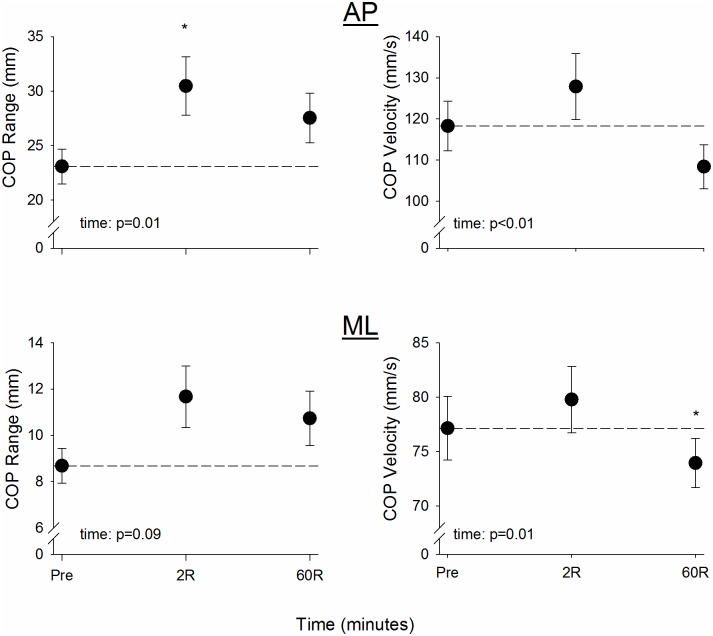
Low muscle power, particularly at high velocities, has been linked to poor physical function in older adults. Any loss in muscle power following fatiguing exercise or daily activities could impact physical function and postural control until power has fully recovered. To test the overall hypothesis that a common task such as walking can result in prolonged power loss and decreased physical function and balance, 17 healthy older (66-81 years) women completed a 32-min walking test (32MWT) designed to induce neuromuscular fatigue, followed by 60min of recovery (60R). Fatigue and recovery of knee extensor muscle power (3 velocities) were quantified by dynamometry. Function was quantified by chair rise time and postural control by measures of center of pressure (COP) range (mm) and velocity (mm·s-1) during quiet stance. Power declined at all velocities by 8-13% 2min following the 32MWT (p≤0.02) and remained depressed by 8-26% at 60R (p≤0.04). Postural control decreased following the 32MWT, indicated by increased COP range in the anterior-posterior (AP, p<0.01) direction and a trend in the medial-lateral (ML) direction (p = 0.09), and returned to baseline by 60R (p≥0.10). COP velocity was unchanged immediately following the 32MWT, but at 60R was lower in ML (p = 0.03) and tended to be reduced in AP (p = 0.07). Changes in high-velocity power (270°·s-1) were associated with altered postural control (p = 0.02) and chair rise performance (p≤0.03). These results provide evidence of long-duration neuromuscular changes following fatigue in healthy older women that may place them at increased risk for functional deficits during everyday mobility tasks.
肌肉力量低下,尤其是在高速运动时,与老年人身体功能不佳有关。疲劳运动或日常活动后肌肉力量的任何损失都可能影响身体功能和姿势控制,直到力量完全恢复。为了验证一个普遍的假设,即像行走这样的常见任务会导致力量长期损失、身体功能下降和平衡能力降低,17名健康的老年(66 - 81岁)女性完成了一项32分钟的步行测试(32MWT),该测试旨在诱发神经肌肉疲劳,随后进行60分钟的恢复(60R)。通过测力法对膝关节伸肌力量(3种速度)的疲劳和恢复情况进行量化。功能通过从椅子上起身的时间进行量化,姿势控制通过安静站立时压力中心(COP)范围(毫米)和速度(毫米·秒⁻¹)的测量来评估。在32MWT后2分钟,所有速度下的力量均下降了8 - 13%(p≤0.02),在60R时仍下降了8 - 26%(p≤0.04)。32MWT后姿势控制下降,表现为前后(AP,p<0.01)方向的COP范围增加以及内外侧(ML)方向有增加趋势(p = 0.09),到60R时恢复到基线水平(p≥0.10)。32MWT后COP速度即刻未改变,但在60R时,ML方向较低(p = 0.03),AP方向有降低趋势(p = 0.07)。高速力量(270°·秒⁻¹)的变化与姿势控制改变(p = 0.02)和从椅子上起身的表现(p≤0.03)相关。这些结果提供了证据,表明健康老年女性在疲劳后会出现长时间的神经肌肉变化,这可能使她们在日常活动任务中出现功能缺陷的风险增加。