Hill Mathew William, Hosseini Edyah-Ariella, McLellan Abbie, Price Michael James, Lord Stephen Ronald, Kay Anthony David
Centre for Sport, Exercise and Life Sciences, Coventry University, Coventry, United Kingdom.
Falls, Balance and Injury Research Centre, Neuroscience Research Australia, University of New South Wales, Sydney, NSW, Australia.
Front Physiol. 2020 Oct 21;11:544559. doi: 10.3389/fphys.2020.544559. eCollection 2020.
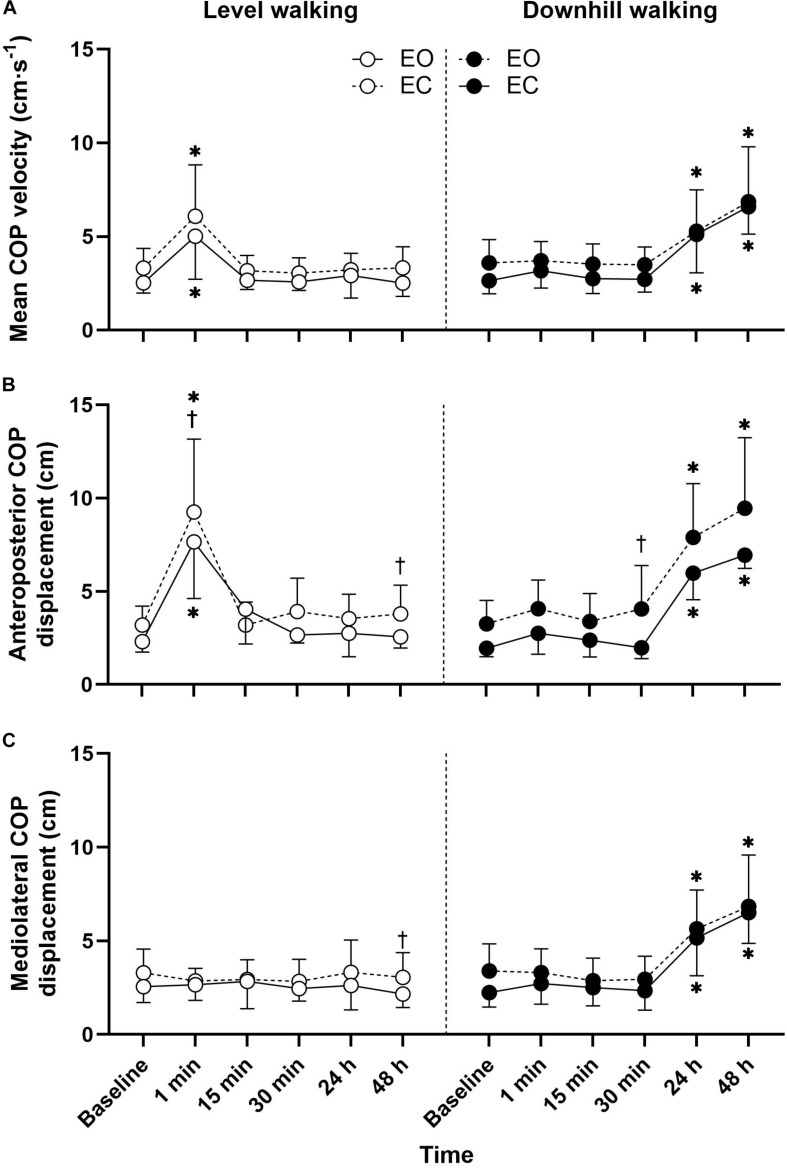
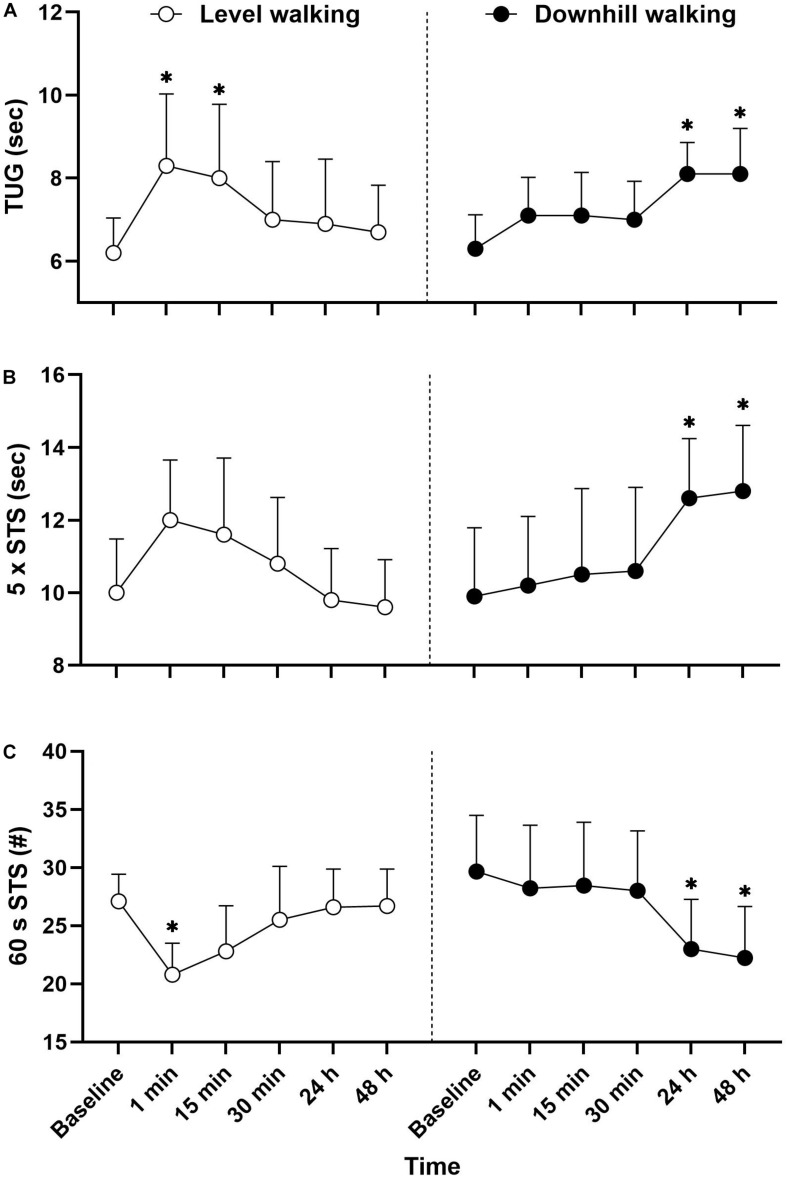
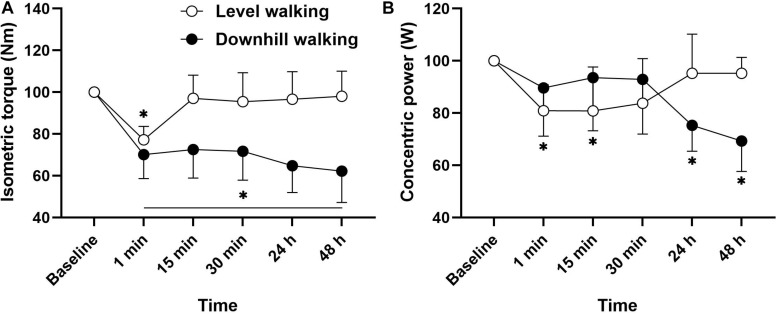
Transient symptoms of muscle damage emanating from unaccustomed eccentric exercise can adversely affect muscle function and potentially increase the risk of falling for several days. Therefore, the aims of the present study were to investigate the shorter- and longer-lasting temporal characteristics of muscle fatigue and damage induced by level (i.e., concentrically biased contractions) or downhill (i.e., eccentrically biased contractions) walking on postural, physical, and muscular functions in older people. Nineteen participants were matched in pairs for sex, age and self-selected walking speed and allocated to a level ( = 10, age = 72.3 ± 2.9 years) or downhill ( = 9, age = 72.1 ± 2.2 years) walking group. Postural sway, muscle torque and power, physical function (5× and 60 s sit-to-stand; STS), and mobility (Timed-Up-and-Go; TUG) were evaluated at baseline (pre-exercise), 1 min, 15 min, 30 min, 24 h, and 48 h after 30 min of level (0% gradient) or downhill (-10% gradient) walking on a treadmill. Following downhill walking, postural sway (+66 to 256%), TUG (+29%), 60 s STS (+29%), five times STS (-25%) and concentric power (-33%) did not change at 1-30 min post exercise, but were significantly different ( < 0.05) at 24 and48 h post-exercise when compared to baseline ( < 0.05). Muscle torque decreased immediately after downhill walking and remained impaired at 48 h post-exercise (-27 to -38%). Immediately following level walking there was an increase in postural sway (+52 to +98%), slower TUG performance (+29%), fewer STS cycles in 60 s (-23%), slower time to reach five STS cycles (+20%) and impaired muscle torque (-23%) and power (-19%) which returned to baseline 30-min after exercise cessation ( > 0.05). These findings have established for the first time distinct impairment profiles between concentric and eccentric exercise. Muscle damage emanating from eccentrically biased exercise can lead to muscle weakness, postural instability and impaired physical function persisting for several days, possibly endangering older adult's safety during activities of daily living by increasing the risk of falls.
不习惯的离心运动引发的肌肉损伤短暂症状可能会对肌肉功能产生不利影响,并有可能在数天内增加跌倒风险。因此,本研究的目的是调查在老年人中,水平(即向心收缩为主的收缩)或下坡(即离心收缩为主的收缩)行走对姿势、身体和肌肉功能所诱导的肌肉疲劳和损伤的短期和长期时间特征。19名参与者按性别、年龄和自我选择的步行速度进行配对,并被分配到水平行走组(n = 10,年龄 = 72.3 ± 2.9岁)或下坡行走组(n = 9,年龄 = 72.1 ± 2.2岁)。在跑步机上进行30分钟水平(0%坡度)或下坡(-10%坡度)行走前(基线)、运动后1分钟、15分钟、30分钟、24小时和48小时,评估姿势摆动、肌肉扭矩和功率、身体功能(5次和60秒坐立试验;STS)以及移动能力(计时起立行走试验;TUG)。下坡行走后,运动后1 - 30分钟时姿势摆动(+66%至256%)、TUG(+29%)、60秒STS(+29%)、5次STS(-25%)和向心功率(-33%)没有变化,但与基线相比,运动后24小时和48小时时有显著差异(P < 0.05)。下坡行走后肌肉扭矩立即下降,并在运动后48小时仍受损(-27%至-38%)。水平行走后立即出现姿势摆动增加(+52%至+98%)、TUG表现变慢(+29%)、60秒内STS循环次数减少(-23%)、达到5次STS循环的时间变慢(+20%)以及肌肉扭矩(-23%)和功率(-19%)受损,这些在运动停止30分钟后恢复到基线水平(P > 0.05)。这些发现首次确立了向心运动和离心运动之间不同的损伤特征。离心收缩为主的运动引发的肌肉损伤可导致肌肉无力、姿势不稳和身体功能受损持续数天,可能会因增加跌倒风险而危及老年人在日常生活活动中的安全。