Romøren Maria, Gjelstad Svein, Lindbæk Morten
Department of Administration Vestfold Hospital Trust, Tønsberg, Norway.
Department of General Practice Institute of Health and Society, University of Oslo, Blindern, Oslo, Norway.
PLoS One. 2017 Sep 7;12(9):e0182619. doi: 10.1371/journal.pone.0182619. eCollection 2017.
Hospitalization is potentially detrimental to nursing home patients and resource demanding for the specialist health care. This study assessed if a brief training program in administrating intravenous fluids and antibiotics in nursing homes could reduce hospital transfers and ensure high quality care locally.
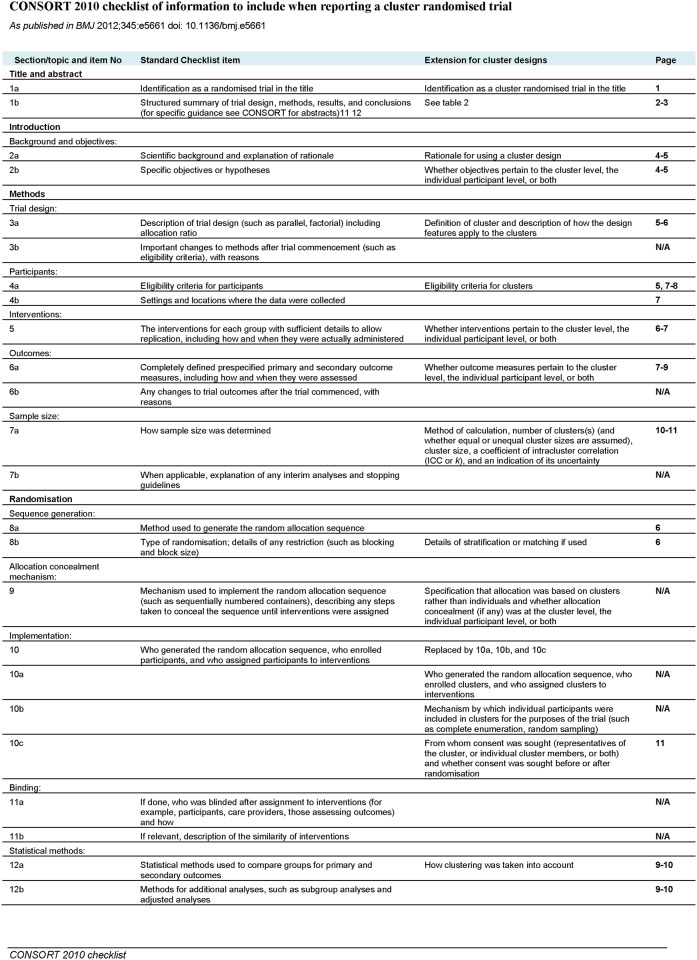
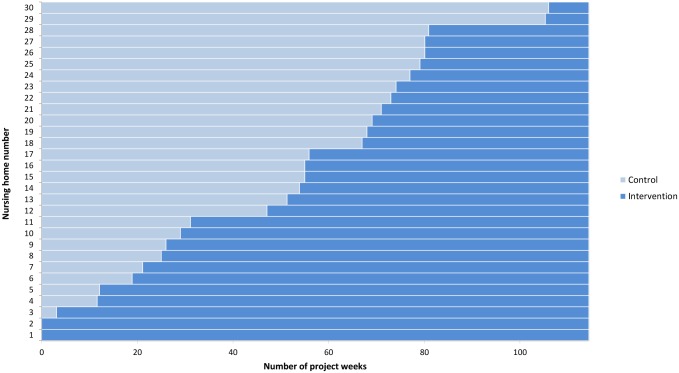
A pragmatic and modified cluster randomized stepped-wedge trial with randomization on nursing home level.
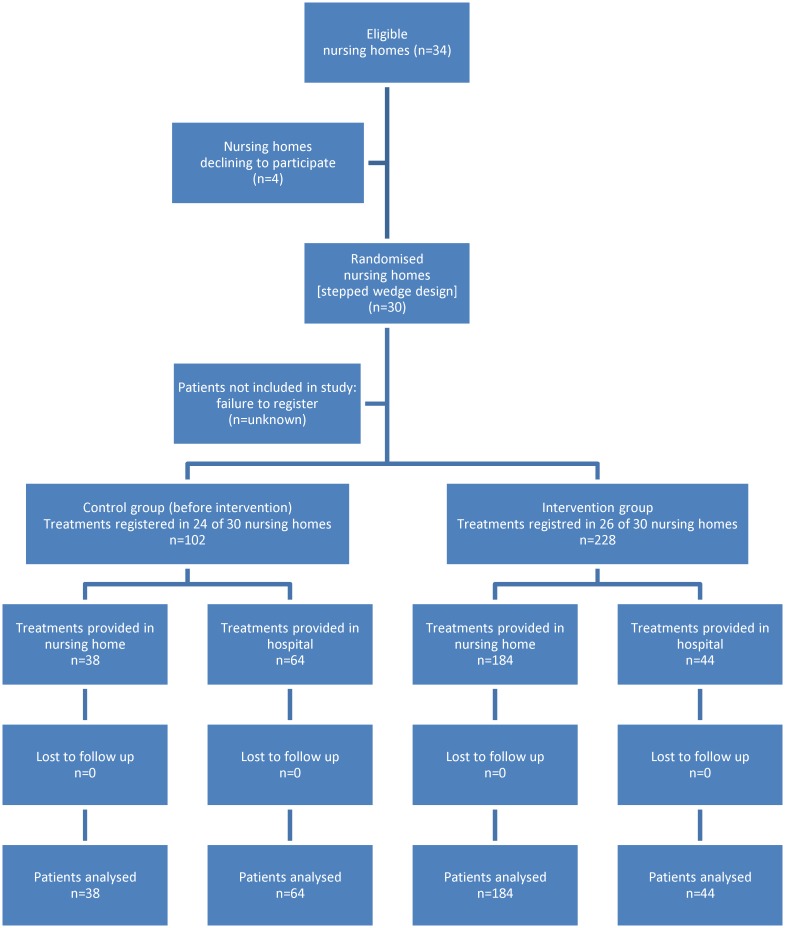
330 cases in 296 nursing home residents from 30 nursing homes were included. Cases were patients provided intravenous antibiotics or intravenous fluids, in nursing home or hospital. Primary outcome was localization of treatment, secondary outcomes were number of days treated, days of hospitalization among admitted patients, type of antibiotics used and 30-day mortality.
The nursing homes sequentially received a one-day educational program for the health workers including theory and practical training in intravenous treatment of dehydration and infection, run by two skilled nurses. After completing the training program, the nursing homes had competence to provide intravenous treatment locally.
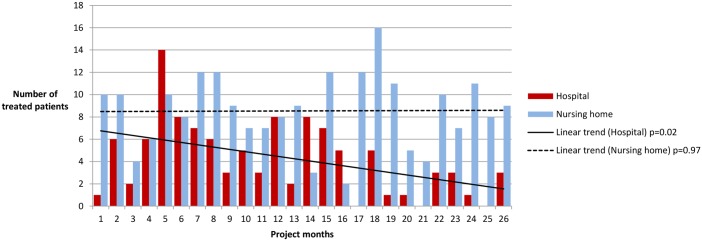
The intervention had a highly significant effect on treatment in nursing homes (OR 8.35, 2.08 to 33.6; P<0.01, or RR 2.23, 1.48 to 2.56). The number treated in nursing homes was stable over time; the number treated in hospital gradually decreased (chi square for trend P< 0.001). Among patients receiving intravenous antibiotics in the nursing homes, 50 (46%) died within 30 days, compared to 30 (36%) treated in the hospital (P = 0.19). Among patients receiving intravenous fluids locally, 21 (19%) died within 30 days, compared to 2 (8%) in the hospital group (P = 0.34). Mortality was associated with reduced consciousness and elevated c-reactive protein.
A brief educational program delivered to nursing home personnel was feasible and effective in reducing acute hospital admissions from nursing homes for treatment of dehydration and infections.
住院治疗可能对养老院患者有害,且对专科医疗保健资源需求较大。本研究评估了一项针对养老院工作人员进行静脉输液和抗生素管理的简短培训计划是否能减少患者转院至医院,并确保当地提供高质量护理。
一项实用的、经过改良的整群随机阶梯楔形试验,在养老院层面进行随机分组。
纳入了来自30家养老院的296名养老院居民中的330例病例。病例为在养老院或医院接受静脉抗生素治疗或静脉输液的患者。主要结局是治疗地点,次要结局包括治疗天数、入院患者的住院天数、使用的抗生素类型以及30天死亡率。
养老院依次为医护人员接受为期一天的教育计划,内容包括脱水和感染的静脉治疗的理论和实践培训,由两名经验丰富的护士授课。完成培训计划后,养老院有能力在当地提供静脉治疗。
该干预措施对养老院的治疗有非常显著的效果(比值比8.35,2.08至33.6;P<0.01,或相对危险度2.23,1.48至2.56)。在养老院接受治疗的人数随时间保持稳定;在医院接受治疗的人数逐渐减少(趋势的卡方检验P<0.001)。在养老院接受静脉抗生素治疗的患者中,50例(46%)在30天内死亡,而在医院接受治疗的为30例(36%)(P = 0.19)。在当地接受静脉输液的患者中,21例(19%)在30天内死亡,而医院组为2例(8%)(P = 0.34)。死亡率与意识减退和C反应蛋白升高有关。
为养老院工作人员提供的简短教育计划在减少养老院因脱水和感染而急性入院治疗方面是可行且有效的。