Section of Neonatal Medicine, Department of Medicine, Imperial College London, London, UK.
Imperial Clinical Trials Unit, School of Public Health, Imperial College London, London, UK.
Arch Dis Child Fetal Neonatal Ed. 2018 May;103(3):F208-F215. doi: 10.1136/archdischild-2017-312748. Epub 2017 Sep 7.
To analyse survival trends and regional variation for very preterm infants admitted to neonatal care.
All neonatal units in England.
Infants born at 22-31 weeksgestational age (GA) over 2008-2014 and admitted to neonatal care; published data for admitted infants 22-25 weeks GA in 1995 and 2006, and for live births at 22-31 weeks GA in 2013.
We obtained data from the National Neonatal Research Database. We used logistic regression to model survival probability with birth weight, GA, sex, antenatal steroid exposure and multiple birth included in the risk adjustment model and calculated annualpercentage change (APC) for trends using joinpoint regression. We evaluated survival over a 20-year period for infants <26 weeks' GA using additional published data from the EPICure studies.
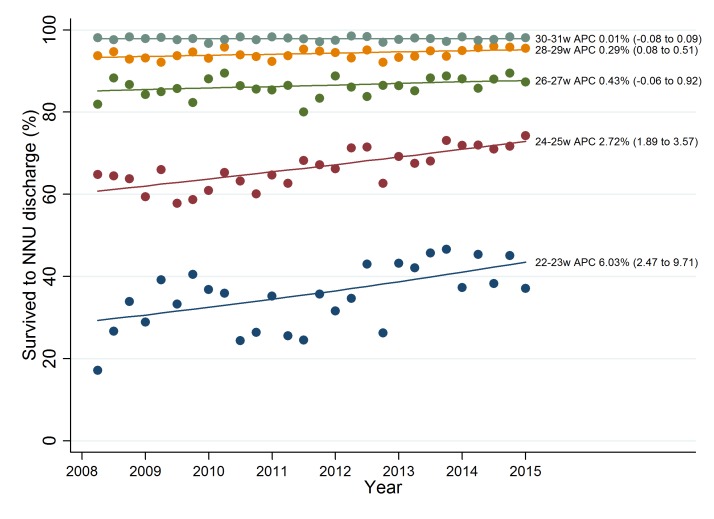
We identified 50 112 eligible infants. There was an increase in survival over 2008-2014 (2008: 88.0%; 2014: 91.3%; adjusted APC 0.46% (95% CI 0.30 to 0.62) p<0.001). The greatest improvement was at 22-23 weeks (APC 6.03% (95% CI 2.47 to 3.53) p=0.002). Improvement largely occurred in London and South of England (APC: London 1.26% (95% CI 0.60 to 1.96); South of England 1.09% (95% CI 0.36 to 1.82); Midlands and East of England 0.15% (95% CI -0.56 to 0.86); and North of England 0.26% (95% CI -0.54 to 1.07)). Survival at the earliest gestations improved at a similar rate over 1995-2014 (22-25 weeks, APC 2.73% (95% CI 2.35 to 3.12), p value for change=0.25).
Continued national improvement in the survival of very preterm admissions masks important regional variation. Timely assessment of preterm survival is feasible using electronic records.
分析入住新生儿病房的极早产儿的生存趋势和区域差异。
英格兰所有新生儿病房。
2008 年至 2014 年间,胎龄 22-31 周出生并入住新生儿病房的婴儿;1995 年和 2006 年公布的胎龄 22-25 周入院婴儿数据,以及 2013 年胎龄 22-31 周活产儿数据。
我们从国家新生儿研究数据库获得数据。我们使用逻辑回归模型来预测出生体重、胎龄、性别、产前类固醇暴露和多胎等因素对生存概率的影响,并使用 Joinpoint 回归计算趋势的年百分比变化(APC)。我们使用 EPICure 研究的额外公布数据评估了胎龄<26 周的婴儿在 20 年内的生存情况。
我们确定了 50112 名符合条件的婴儿。2008 年至 2014 年间,生存率有所提高(2008 年:88.0%;2014 年:91.3%;调整 APC 0.46%(95%CI 0.30 至 0.62),p<0.001)。最大的改善发生在 22-23 周(APC 6.03%(95%CI 2.47 至 3.53),p=0.002)。改善主要发生在伦敦和英格兰南部(APC:伦敦 1.26%(95%CI 0.60 至 1.96);英格兰南部 1.09%(95%CI 0.36 至 1.82);英格兰中部和东部 0.15%(95%CI -0.56 至 0.86);英格兰北部 0.26%(95%CI -0.54 至 1.07))。在整个胎龄范围内,生存状况在 1995-2014 年间也以相似的速度得到改善(22-25 周,APC 2.73%(95%CI 2.35 至 3.12),p 值为 0.25)。
极早产儿入院生存率的持续全国性提高掩盖了重要的区域差异。使用电子记录可以及时评估早产儿的生存率。