Department of Psychology and the Center of Neural Basis of Cognition, Carnegie Mellon University, Pittsburgh, Pennsylvania, United States.
Sci Rep. 2017 Sep 8;7(1):11034. doi: 10.1038/s41598-017-11406-7.
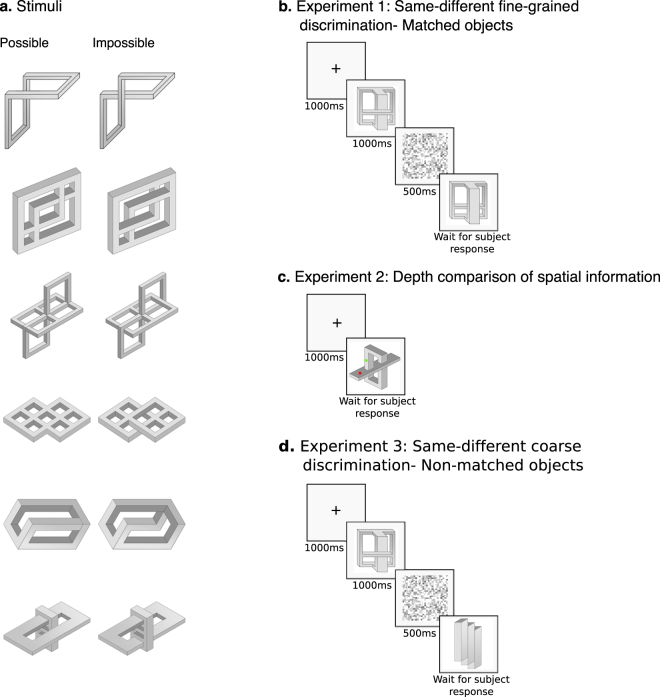
Deriving a 3D structural representation of an object from its 2D input is one of the great challenges for the visual system and yet, this type of representation is critical for the successful recognition of and interaction with objects. Perhaps reflecting the importance of this computation, infants have some sensitivity to 3D structural information, and this sensitivity is, at least, partially preserved in the elderly population. To map precisely the life-span trajectory of this key visual computation, in a series of experiments, we compared the performance of observers from ages 4 to 86 years on displays of objects that either obey or violate possible 3D structure. The major findings indicate that the ability to derive fine-grained 3D object representations emerges after a prolonged developmental trajectory and is contingent on the explicit processing of depth information even in late childhood. In contrast, the sensitivity to object 3D structure remains stable even through late adulthood despite the overall reduction in perceptual competence. Together, these results uncover the developmental process of an important perceptual skill, revealing that the initial, coarse sensitivity to 3D information is refined, automatized and retained over the lifespan.
从二维输入中推导出物体的三维结构表示是视觉系统面临的重大挑战之一,但这种表示对于成功识别和与物体交互至关重要。也许是反映了这种计算的重要性,婴儿对三维结构信息有一定的敏感性,而且这种敏感性在老年人中至少部分保留下来。为了精确描绘这一关键视觉计算的寿命轨迹,在一系列实验中,我们比较了年龄在 4 至 86 岁的观察者在显示符合或违反可能的三维结构的物体时的表现。主要发现表明,即使在儿童后期,精细的三维物体表示能力的出现也需要经过长时间的发展轨迹,并且依赖于对深度信息的明确处理。相比之下,即使在整个感知能力下降的情况下,对物体三维结构的敏感性在成年后期仍然保持稳定。这些结果揭示了一项重要感知技能的发展过程,表明对三维信息的初始、粗略敏感性在整个生命周期中得到了细化、自动化和保留。