Naser Paul V, Kuner Rohini
Institute of Pharmacology, Heidelberg University, Im Neuenheimer Feld 366, 69120 Heidelberg, Germany.
Institute of Pharmacology, Heidelberg University, Im Neuenheimer Feld 366, 69120 Heidelberg, Germany; Cell Networks Cluster of Excellence, Heidelberg University, Germany.
Neuroscience. 2018 Sep 1;387:135-148. doi: 10.1016/j.neuroscience.2017.08.049. Epub 2017 Sep 8.
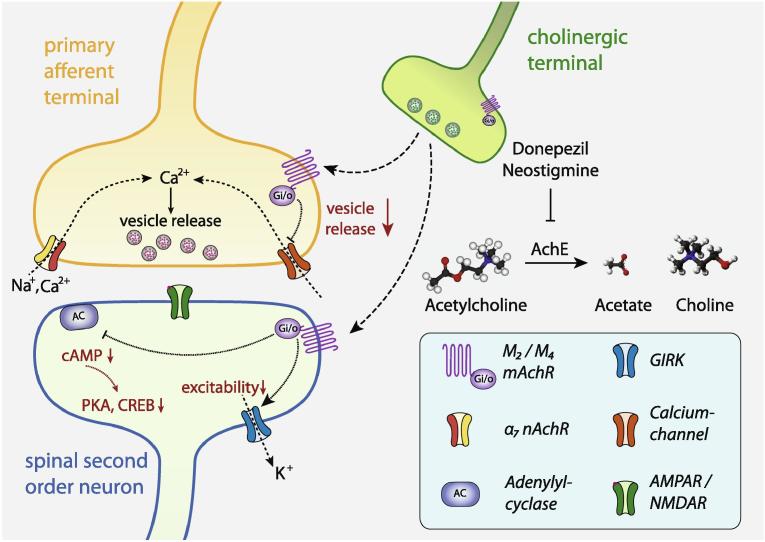
In addition to being a key component of the autonomic nervous system, acetylcholine acts as a prominent neurotransmitter and neuromodulator upon release from key groups of cholinergic projection neurons and interneurons distributed across the central nervous system. It has been more than forty years since it was discovered that cholinergic transmission profoundly modifies the perception of pain. Directly activating cholinergic receptors or extending the action of endogenous acetylcholine via pharmacological blockade of acetylcholine esterase reduces pain in rodents as well as humans; conversely, inhibition of muscarinic cholinergic receptors induces nociceptive hypersensitivity. Here, we aim to review the considerable progress in our understanding of peripheral, spinal and brain contributions to cholinergic modulation of pain. We discuss the distribution of cholinergic neurons, muscarinic and nicotinic receptors over the central nervous system and the synaptic and circuit-level modulation by cholinergic signaling. AchRs profoundly regulate nociceptive transmission at the level of the spinal cord via pre- as well as postsynaptic mechanisms. Moreover, we attempt to provide an overview of how some of the salient regions in the pain network spanning the brain, such as the primary somatosensory cortex, insular cortex, anterior cingulate cortex, the medial prefrontal cortex and descending modulatory systems are influenced by cholinergic modulation. Finally, we critically discuss the clinical relevance of cholinergic signaling to pain therapy. Cholinergic mechanisms contribute to several both conventional as well as unorthodox forms of pain treatments, and reciprocal interactions between cholinergic and opioidergic modulation impact on the function and efficacy of both opioids and cholinomimetic drugs.
除了作为自主神经系统的关键组成部分外,乙酰胆碱从分布于中枢神经系统的胆碱能投射神经元和中间神经元的关键组群释放后,还作为一种重要的神经递质和神经调质发挥作用。自发现胆碱能传递深刻改变疼痛感知以来,已经过去了四十多年。直接激活胆碱能受体或通过药理学阻断乙酰胆碱酯酶来延长内源性乙酰胆碱的作用,可减轻啮齿动物和人类的疼痛;相反,抑制毒蕈碱型胆碱能受体则会诱发伤害性超敏反应。在此,我们旨在综述我们在理解外周、脊髓和大脑对胆碱能调节疼痛的贡献方面取得的重大进展。我们讨论胆碱能神经元、毒蕈碱型和烟碱型受体在中枢神经系统的分布,以及胆碱能信号传导在突触和回路水平的调节。乙酰胆碱受体通过突触前和突触后机制在脊髓水平深刻调节伤害性传递。此外,我们试图概述疼痛网络中一些跨越大脑的显著区域,如初级体感皮层、岛叶皮层、前扣带回皮层、内侧前额叶皮层和下行调节系统是如何受到胆碱能调节的影响。最后,我们批判性地讨论胆碱能信号传导与疼痛治疗的临床相关性。胆碱能机制有助于多种传统和非传统形式的疼痛治疗,胆碱能和阿片样物质调节之间的相互作用会影响阿片类药物和拟胆碱药物的功能和疗效。