Rajappa Akila Theyyar, Soriano Kristie R, Ziemer Courtney, Troche Michelle S, Malandraki Jaime Bauer, Malandraki Georgia A
Department of Biobehavioral Sciences, Teachers College, Columbia University, New York, NY, United States.
Department of Speech Pathology and Audiology, JFK Rehabilitation Institute, Edison, NJ, United States.
Front Neurol. 2017 Aug 25;8:436. doi: 10.3389/fneur.2017.00436. eCollection 2017.
Preliminary evidence has shown that reduced ability to maximally raise vocal pitch correlates with the occurrence of aspiration (i.e., airway invasion by food or liquid). However, it is unclear if this simple task can be used as a reliable predictor of aspiration in stroke patients. Our aim was to examine whether maximum vocal pitch elevation predicted airway invasion and dysphagia in stroke.
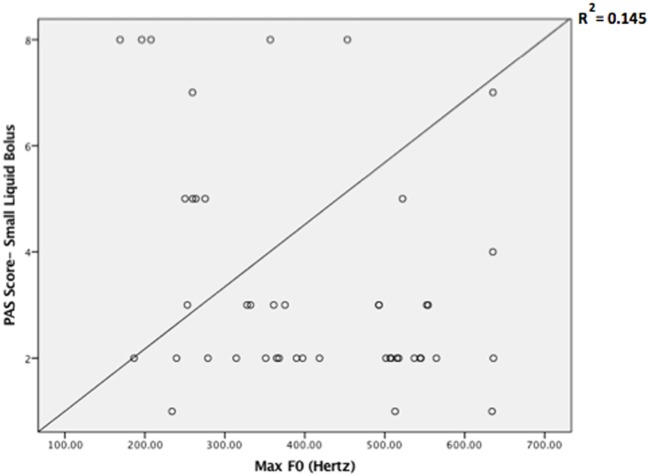
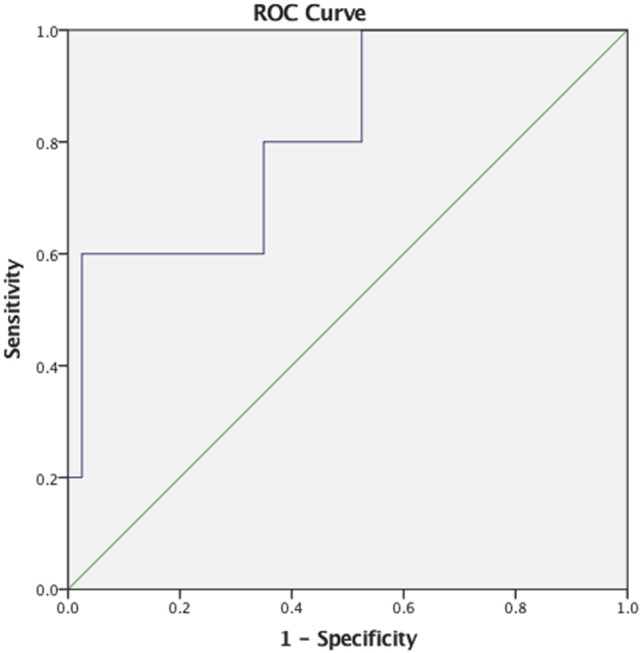
Forty-five consecutive stroke patients (<1 month poststroke) at a rehabilitation setting participated in a videofluoroscopic swallow study and two maximum vocal pitch elevation tasks. Maximum pitch was evaluated acoustically [maximum fundamental frequency (max )] and perceptually. Swallowing safety was rated using the Penetration/Aspiration Scale and swallowing performance was assessed using components of the Modified Barium Swallow Impairment Profile (MBSImPTM©). Data were analyzed using simple regression and receiver operating characteristics curves to test the sensitivity and specificity of max in predicting aspiration. Correlations between max and MBSImP variables were also examined.
Max predicted silent aspiration of small liquid volumes with 80% sensitivity and 65% specificity ( = 0.023; area under the curve: 0.815; cutoff value of 359.03 Hz). Max did not predict non-silent aspiration or penetration in this sample and did not significantly correlate with MBSImP variables. Furthermore, all participants who aspirated silently on small liquid volumes (11% of sample) had suffered cortical or subcortical lesions.
In stroke patients (<1 month poststroke), reduced maximum pitch elevation predicts silent aspiration of small liquid volumes with high sensitivity and moderate specificity. Future large-scale studies focusing on further validating this finding and exploring the value of this simple and non-invasive tool as part of a dysphagia screening are warranted.
初步证据表明,最大程度提高嗓音音高的能力下降与误吸(即食物或液体侵入气道)的发生相关。然而,尚不清楚这项简单任务能否作为中风患者误吸的可靠预测指标。我们的目的是研究最大嗓音音高升高是否能预测中风患者的气道侵入和吞咽困难。
在康复机构中连续纳入45例中风患者(中风后<1个月),参与电视荧光吞咽造影研究和两项最大嗓音音高升高任务。通过声学方法[最大基频(max )]和主观感受评估最大音高。使用渗透/误吸量表对吞咽安全性进行评分,并使用改良钡剂吞咽障碍轮廓量表(MBSImPTM©)的组成部分评估吞咽表现。使用简单回归和受试者工作特征曲线分析数据,以测试max 在预测误吸方面的敏感性和特异性。还检查了max 与MBSImP变量之间的相关性。
Max 预测小体积液体的无声误吸,敏感性为80%,特异性为65%( = 0.023;曲线下面积:0.815;截断值为359.03 Hz)。在该样本中,Max 不能预测非无声误吸或渗透,且与MBSImP变量无显著相关性。此外,所有小体积液体无声误吸的参与者(占样本的11%)均有皮质或皮质下病变。
在中风患者(中风后<1个月)中,最大音高升高降低可预测小体积液体的无声误吸,具有高敏感性和中等特异性。未来有必要开展大规模研究进一步验证这一发现,并探索将这种简单且无创的工具作为吞咽困难筛查一部分的价值。