Institute of Normal and Pathological Physiology, Slovak Academy of Sciences, Sienkiewiczova 1, 813 71, Bratislava, Slovakia.
Institute of Chemistry, Slovak Academy of Sciences, Bratislava, Slovakia.
J Biomed Sci. 2017 Sep 11;24(1):72. doi: 10.1186/s12929-017-0366-4.
The brain stem contains important nuclei that control cardiovascular function via the sympathetic nervous system (SNS), which is strongly influenced by nitric oxide. Its biological activity is also largely determined by oxygen free radicals. Despite many experimental studies, the role of AT1R-NAD(P)H oxidase-superoxide pathway in NO-deficiency is not yet sufficiently clarified. We determined changes in free radical signaling and antioxidant and detoxification response in the brain stem of young and adult Wistar rats during chronic administration of exogenous NO inhibitors.
Young (4 weeks) and adult (10 weeks) Wistar rats were treated with 7-nitroindazole (7-NI group, 10 mg/kg/day), a specific nNOS inhibitor, with N-nitro-L-arginine-methyl ester (L-NAME group, 50 mg/kg/day), a nonspecific NOS inhibitor, and with drinking water (Control group) during 6 weeks. Systolic blood pressure was measured by non-invasive plethysmography. Expression of genes (AT1R, AT2R, p22phox, SOD and NOS isoforms, HO-1, MDR1a, housekeeper GAPDH) was identified by real-time PCR. NOS activity was detected by conversion of [3H]-L-arginine to [3H]-L-citrulline and SOD activity was measured using UV VIS spectroscopy.
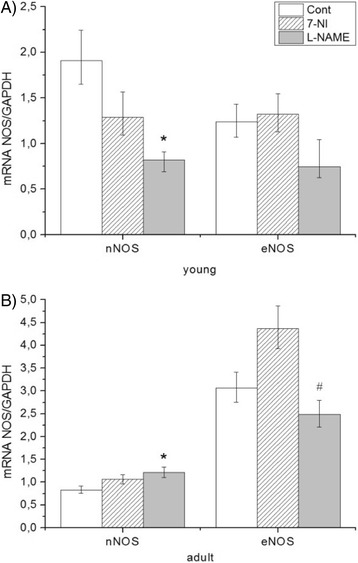
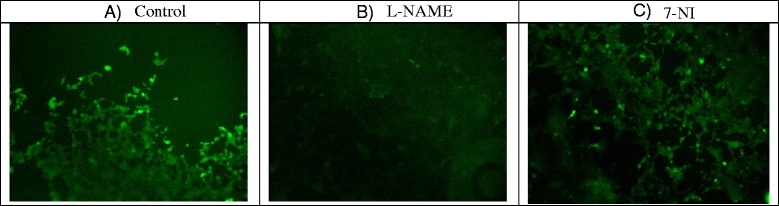
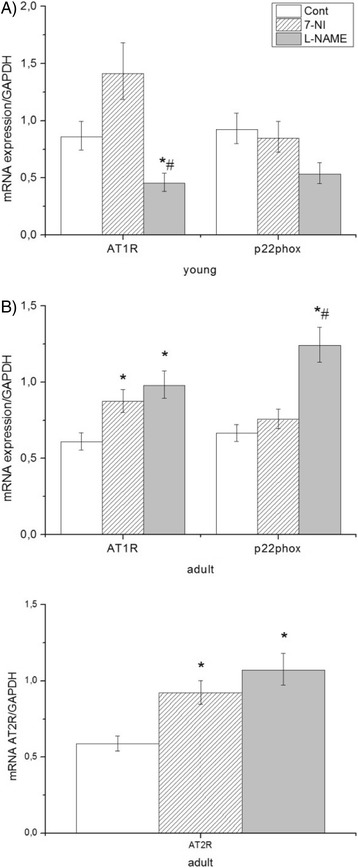
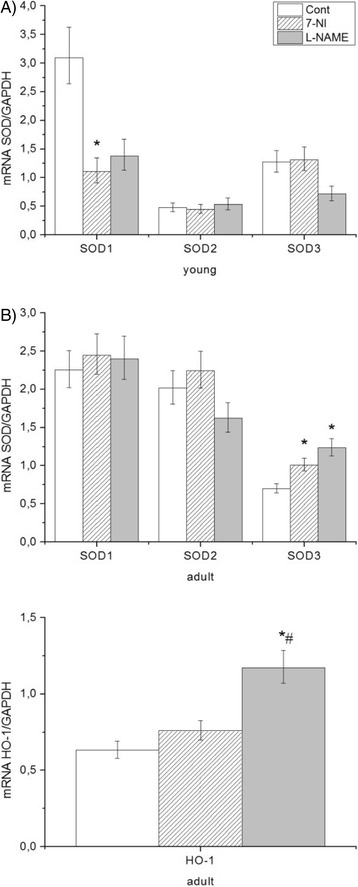
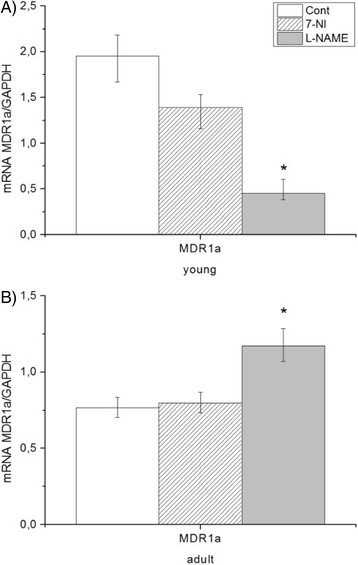
We observed a blood pressure elevation and decrease in NOS activity only after L-NAME application in both age groups. Gene expression of nNOS (youngs) and eNOS (adults) in the brain stem decreased after both inhibitors. The radical signaling pathway triggered by AT1R and p22phox was elevated in L-NAME adults, but not in young rats. Moreover, L-NAME-induced NOS inhibition increased antioxidant response, as indicated by the observed elevation of mRNA SOD3, HO-1, AT2R and MDR1a in adult rats. 7-NI did not have a significant effect on AT1R-NADPH oxidase-superoxide pathway, yet it affected antioxidant response of mRNA expression of SOD1 and stimulated total activity of SOD in young rats and mRNA expression of AT2R in adult rats.
Our results show that chronic NOS inhibition by two different NOS inhibitors has age-dependent effect on radical signaling and antioxidant/detoxificant response in Wistar rats. While 7-NI had neuroprotective effect in the brain stem of young Wistar rats, L-NAME- induced NOS inhibition evoked activation of AT1R-NAD(P)H oxidase pathway in adult Wistar rats. Triggering of the radical pathway was followed by activation of protective compensation mechanism at the gene expression level.
脑干包含控制心血管功能的重要核,通过交感神经系统(SNS),其强烈影响一氧化氮。其生物活性也主要由氧自由基决定。尽管进行了许多实验研究,但 AT1R-NAD(P)H 氧化酶-超氧化物途径在一氧化氮缺乏中的作用尚不清楚。我们确定了在慢性给予外源性一氧化氮抑制剂期间,年轻和成年 Wistar 大鼠脑干中自由基信号和抗氧化和解毒反应的变化。
年轻(4 周)和成年(10 周)Wistar 大鼠用 7-硝基吲唑(7-NI 组,10mg/kg/天),一种特异性 nNOS 抑制剂,用 N-硝基-L-精氨酸甲酯(L-NAME 组,50mg/kg/天),一种非特异性 NOS 抑制剂和饮用水(对照组)治疗 6 周。收缩压通过非侵入性体积描记法测量。通过实时 PCR 鉴定基因(AT1R、AT2R、p22phox、SOD 和 NOS 同工型、HO-1、MDR1a、管家 GAPDH)的表达。NOS 活性通过[3H]-L-精氨酸转化为[3H]-L-瓜氨酸来检测,SOD 活性通过 UV VIS 光谱法测量。
我们观察到只有在两组年龄的 L-NAME 应用后,血压升高和 NOS 活性降低。两种抑制剂后,脑干中的 nNOS(年轻)和 eNOS(成年)基因表达减少。L-NAME 诱导的 AT1R 和 p22phox 触发的自由基信号通路在成年大鼠中升高,但在幼年大鼠中没有升高。此外,L-NAME 诱导的 NOS 抑制增加了抗氧化反应,如成年大鼠中观察到的 mRNA SOD3、HO-1、AT2R 和 MDR1a 的升高所表明的那样。7-NI 对 AT1R-NADPH 氧化酶-超氧化物途径没有显著影响,但它影响了 SOD1 的抗氧化反应 mRNA 表达并刺激了年轻大鼠的总 SOD 活性和成年大鼠的 AT2R 的 mRNA 表达。
我们的结果表明,两种不同的 NOS 抑制剂对慢性 NOS 抑制对 Wistar 大鼠的自由基信号和抗氧化/解毒反应具有年龄依赖性影响。虽然 7-NI 在年轻 Wistar 大鼠的脑干中具有神经保护作用,但 L-NAME 诱导的 NOS 抑制在成年 Wistar 大鼠中引发了 AT1R-NAD(P)H 氧化酶途径的激活。自由基途径的触发随后在基因表达水平上激活了保护补偿机制。