Bok Marina, Alassia Martín, Frank Flavia, Vega Celina G, Wigdorovitz Andrés, Parreño Viviana
Instituto de Virología, CICVyA, Instituto Nacional de Tecnología Agropecuaria (INTA), Los Reseros y Nicolás Repetto S/N, Castelar, 1712 Buenos Aires, Argentina.
Departamento de Producción Lechera, Facultad de Ciencias Agrarias, Universidad Nacional del Litoral, Kreder 2805, 3080 Esperanza, Santa Fe, Argentina.
Rev Argent Microbiol. 2018 Jan-Mar;50(1):23-30. doi: 10.1016/j.ram.2017.03.007. Epub 2017 Oct 12.
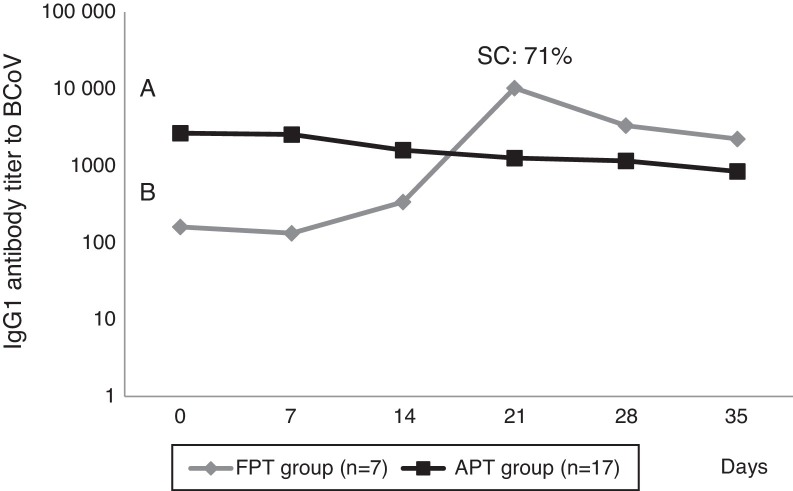
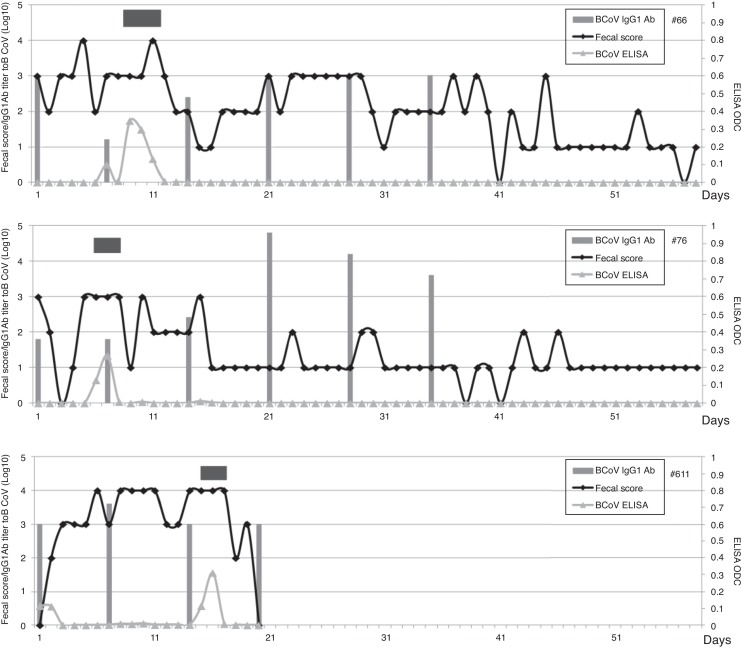
Bovine coronavirus (BCoV) is a viral enteric pathogen associated with calf diarrhea worldwide being, in Argentina, mostly detected in dairy husbandry systems. The aim of the present work was to study if maternal IgG1 antibodies (Abs) to BCoV acquired by colostrum intake modulate the development of BCoV infection in calves reared in a dairy farm in Argentina. Thirty Holstein calves were monitored during their first 60 days of age. Animals were classified into two groups depending on their initial BCoV IgG1 Ab titers. The "failure of passive transfer" (FPT) group had significantly lower IgG1 Abs to BCoV than the "acceptable passive transfer" (APT) group of calves (log10 1.98 vs. 3.38 respectively) (p<0.0001). These differences were also observed when the total protein levels in both groups were compared (p=0.0081). Moreover, 71% (5/7) of calves from the FPT group showed IgG1 seroconversion to BCoV compared to 29.4% (5/17) of animals from the APT group. Regarding viral circulation, BCoV was detected in 10% (3/30) of all calves and BCoV IgG1 Ab seroconversion was detected in 42% of the total animals showing that almost half of the calves were infected with BCoV. In conclusion, calves with high titers of specific BCoV IgG1 (≥1024) were mostly protected against viral infection, while animals with low titers of IgG1 (<1024) were mostly infected with BCoV. IgG1 Abs from colostrum origin are critical for prevention of BCoV infection.
牛冠状病毒(BCoV)是一种病毒性肠道病原体,在全球范围内与犊牛腹泻有关,在阿根廷,主要在奶牛养殖系统中被检测到。本研究的目的是探讨通过初乳摄入获得的针对BCoV的母源IgG1抗体是否能调节阿根廷一家奶牛场饲养的犊牛中BCoV感染的发展。对30头荷斯坦犊牛在其出生后的前60天进行了监测。根据它们最初的BCoV IgG1抗体滴度,将动物分为两组。“被动转移失败”(FPT)组犊牛针对BCoV的IgG1抗体显著低于“可接受的被动转移”(APT)组犊牛(分别为log10 1.98和3.38)(p<0.0001)。当比较两组的总蛋白水平时,也观察到了这些差异(p=0.0081)。此外,FPT组71%(5/7)的犊牛显示针对BCoV的IgG1血清转化,而APT组为29.4%(5/17)。关于病毒传播,在所有犊牛中有10%(3/30)检测到BCoV,在42%的动物中检测到BCoV IgG1抗体血清转化,这表明几乎一半的犊牛感染了BCoV。总之,具有高滴度特异性BCoV IgG1(≥1024)的犊牛大多受到病毒感染的保护,而IgG1滴度低(<1024)的动物大多感染了BCoV。来自初乳的IgG1抗体对于预防BCoV感染至关重要。