Doherty Sally, Dolan Elizabeth, Flynn Jennifer, O'Carroll Ronan E, Doyle Frank
Department of Psychology, Division of Population Health Sciences, Royal College of Surgeons in IrelandDublin, Ireland.
Department of Psychology, Royal College of Surgeons in Ireland - Medical University of BahrainBusaiteen, Bahrain.
Front Psychol. 2017 Aug 28;8:1443. doi: 10.3389/fpsyg.2017.01443. eCollection 2017.
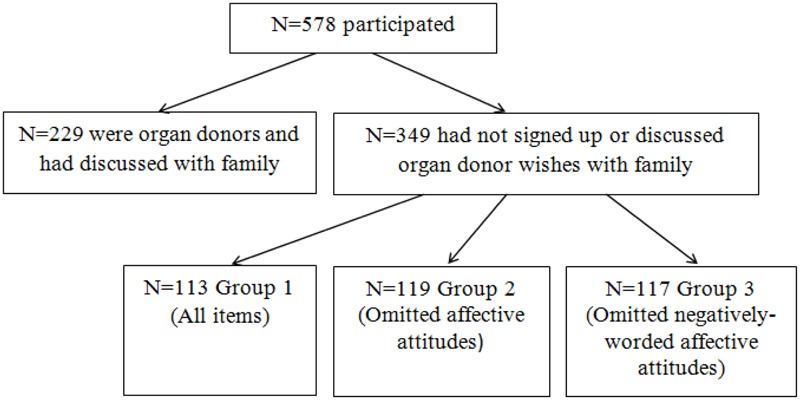
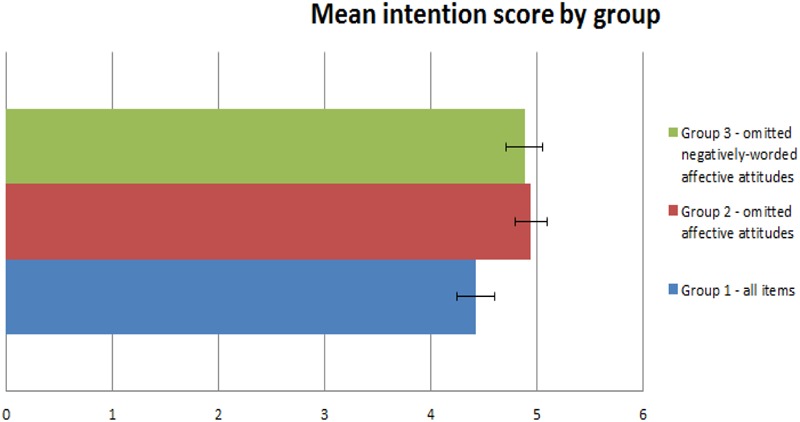
Including or excluding certain questions about organ donation may influence peoples' intention to donate. We investigated the effect of omitting certain affective attitudinal items on potential donors' intention and behavior for donation. A cross-sectional survey with a subgroup nested randomized trial. A total of 578 members of the public in four shopping centers were surveyed on their attitudes to organ donation. Non-donors ( = 349) were randomly assigned to one of three groups: Group 1 completed items on affective and cognitive attitudes, anticipated regret, intention, subjective norm and perceived behavioral control. Group 2 completed all items above but excluded affective attitudes. Group 3 completed all items but omitted negatively worded affective attitudes. The primary outcome was intention to donate, taking a donor card after the interview was a secondary behavioral outcome, and both were predicted using linear and logistic regression with group 1 as the reference. Mean (SD) 1-7 intention scores for groups 1, 2 and 3 were, respectively: 4.43 (SD 1.89), 4.95 (SD 1.64) and 4.88 (SD 1.81), with group 2 significantly higher than group 1 (β = 0.518, 95% confidence interval [CI] 0.18 to 0.86).At the end of the interview, people in group 2 (66.7%; OR = 1.40, 95% CI 0.94 to 2.07, = 0.096) but not those in group 3 (61.7%; OR = 1.10, 95% CI 0.69 to 1.75, = 0.685), were marginally more likely to accept a donor card from the interviewer than people in group 1 (59.7%). Omitting affective attitudinal items results in higher intention to donate organs and marginally higher rates of acceptance of donor cards, which has important implications for future organ donation public health campaigns.
纳入或排除某些关于器官捐赠的问题可能会影响人们的捐赠意愿。我们研究了省略某些情感态度项目对潜在捐赠者捐赠意愿和行为的影响。这是一项包含亚组嵌套随机试验的横断面调查。在四个购物中心对总共578名公众进行了关于器官捐赠态度的调查。非捐赠者(n = 349)被随机分配到三组中的一组:第1组完成关于情感和认知态度、预期遗憾、意愿、主观规范和感知行为控制的项目。第2组完成上述所有项目,但排除情感态度。第3组完成所有项目,但省略了措辞消极的情感态度。主要结果是捐赠意愿,访谈后领取捐赠卡是次要行为结果,两者均以第1组为参照,使用线性回归和逻辑回归进行预测。第1组、第2组和第3组的平均(标准差)1 - 7分意愿得分分别为:4.43(标准差1.89)、4.95(标准差1.64)和4.88(标准差1.81),第2组显著高于第1组(β = 0.518,95%置信区间[CI] 0.18至0.86)。在访谈结束时,第2组的人(66.7%;OR = 1.40,95% CI 0.94至2.07,P = 0.096),但不是第3组的人(61.7%;OR = 1.10,95% CI 0.69至1.75,P = 0.685),比第1组的人(59.7%)略微更有可能从访谈者那里接受捐赠卡。省略情感态度项目会导致更高的器官捐赠意愿以及略微更高的捐赠卡接受率,这对未来的器官捐赠公共卫生运动具有重要意义。