Grammatico Sara, Scalzulli Emilia, Petrucci Maria Teresa
Hematology, Department of Cellular Biotechnologies and Hematology, "Sapienza" University, Rome, Italy.
Mediterr J Hematol Infect Dis. 2017 Aug 23;9(1):e2017052. doi: 10.4084/MJHID.2017.052. eCollection 2017.
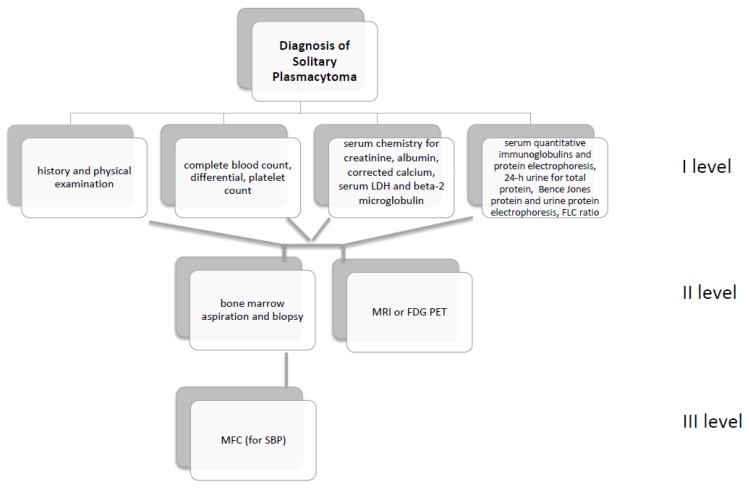
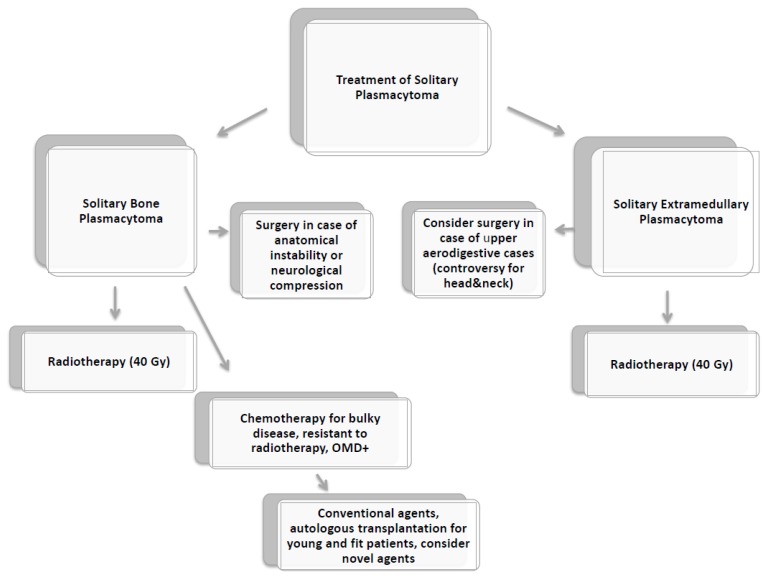
Solitary plasmacytoma is a rare disease characterized by a localized proliferation of neoplastic monoclonal plasma cells, without evidence of systemic disease. It can be subdivided into solitary bone plasmacytoma if the lesion originates in bone, or solitary extramedullary plasmacytoma if the lesion involves a soft tissue. The incidence of solitary bone plasmacytoma is higher than solitary extramedullary plasmacytoma. Also, the prognosis is different: even if both forms respond well to treatment, overall survival and progression-free survival of solitary bone plasmacytoma are poorer than solitary extramedullary plasmacytoma due to its higher rate of evolution in multiple myeloma. However, the recent advances in the diagnosis of multiple myeloma can better refine also the diagnosis of plasmacytoma. Flow cytometry studies and molecular analysis may reveal clonal plasma cells in the bone marrow; magnetic resonance imaging or 18 Fluorodeoxyglucose positron emission tomography could better define osteolytic bone lesions. A more explicit exclusion of possible occult systemic involvement can avoid cases of misdiagnosed multiple myeloma patients, which were previously considered solitary plasmacytoma and less treated, with an unavoidable poor prognosis. Due to the rarity of the disease, there is no uniform consensus about prognostic factors and treatment. Radiotherapy is the treatment of choice; however, some authors debate about the radiotherapy dose and the relationship with the response rate. Moreover, the role of surgery and chemotherapy is still under debate. Nevertheless, we must consider that the majority of studies include a small number of patients and analyze the efficacy of conventional chemotherapy; few cases are reported concerning the efficacy of novel agents.
孤立性浆细胞瘤是一种罕见疾病,其特征为肿瘤性单克隆浆细胞的局限性增殖,且无系统性疾病证据。如果病变起源于骨骼,则可分为孤立性骨浆细胞瘤;如果病变累及软组织,则为孤立性髓外浆细胞瘤。孤立性骨浆细胞瘤的发病率高于孤立性髓外浆细胞瘤。此外,其预后也有所不同:尽管两种类型对治疗反应均良好,但由于孤立性骨浆细胞瘤进展为多发性骨髓瘤的发生率较高,其总生存期和无进展生存期比孤立性髓外浆细胞瘤更差。然而,多发性骨髓瘤诊断方面的最新进展也能更好地完善浆细胞瘤的诊断。流式细胞术研究和分子分析可能会揭示骨髓中的克隆性浆细胞;磁共振成像或18氟脱氧葡萄糖正电子发射断层扫描可以更好地明确溶骨性骨病变。更明确地排除可能隐匿的系统性受累情况,可避免将先前被误诊为孤立性浆细胞瘤且治疗较少、预后不可避免较差的多发性骨髓瘤患者误诊。由于该疾病罕见,关于预后因素和治疗尚无统一共识。放射治疗是首选治疗方法;然而,一些作者对放射治疗剂量及其与缓解率的关系存在争议。此外,手术和化疗的作用仍存在争议。尽管如此,我们必须考虑到大多数研究纳入的患者数量较少,且分析的是传统化疗的疗效;关于新型药物疗效的报道病例较少。