Yugandhar Pulicherla, Kumar Konidala Kranthi, Neeraja Pabbaraju, Savithramma Nataru
Department of Botany, Sri Venkateswara University, Tirupati, Andhra Pradesh, India.
Department of Zoology, Sri Venkateswara University, Tirupati, Andhra Pradesh, India.
J Intercult Ethnopharmacol. 2017 Jul 12;6(3):296-310. doi: 10.5455/jice.20170709031835. eCollection 2017 Jul-Sep.
This study aims to isolate, characterize, and evaluate of anticancer polyphenols from different parts of .
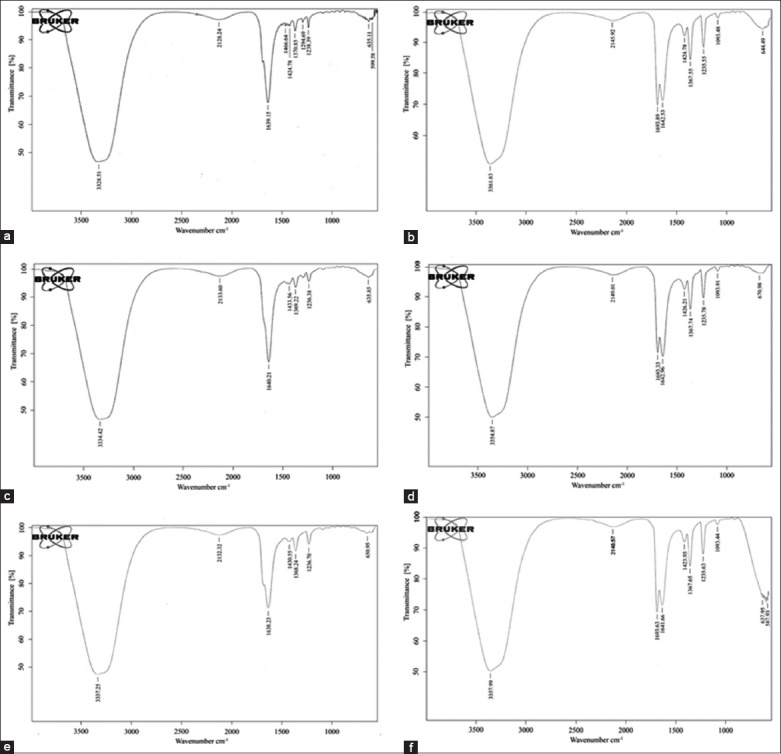
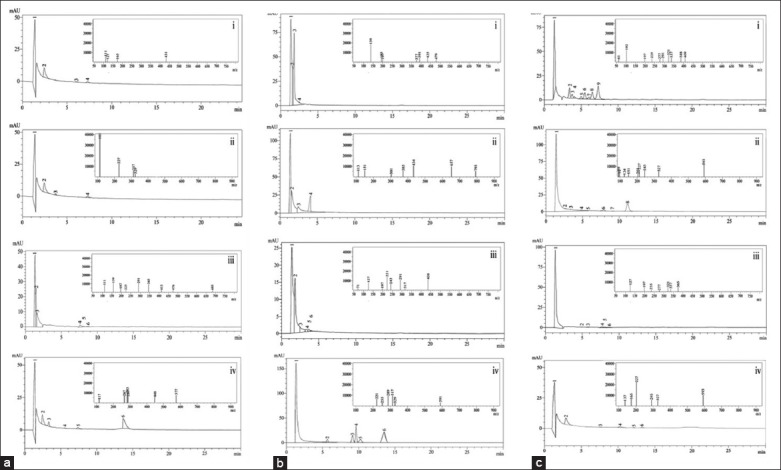
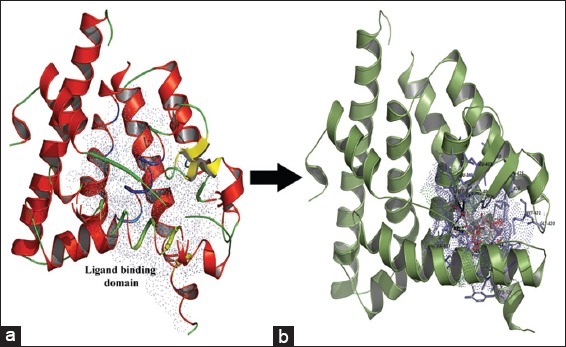
The polyphenols were isolated by standard protocol and characterized using Fourier-transform infrared (FT-IR), High performance liquid chromatography - Photodiode array detector coupled with Electrospray ionization - mass spectrometry (MS/MS). The compounds were elucidated based on retention time and molecular ions () either by [M+H]/[M-H] with the comparison of standard phenols as well as ReSpect software tool. Furthermore, absorption, distribution, metabolism, and excretion (ADME)/toxicity properties of selected phenolic scaffolds were screened using OSIRIS and SwissADME programs, which incorporate toxicity risk assessments, pharmacokinetics, and rule of five principles. Molecular docking studies were carried out for selected toxicity filtered compounds against breast cancer estrogen receptor a (ERa) structure (protein data bank-ID: 1A52) through AutoDock scoring functions by PyRx virtual screening program.
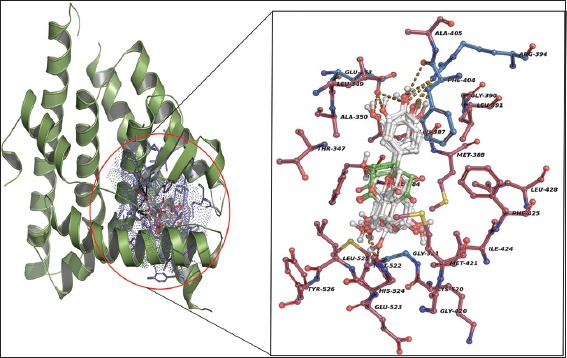
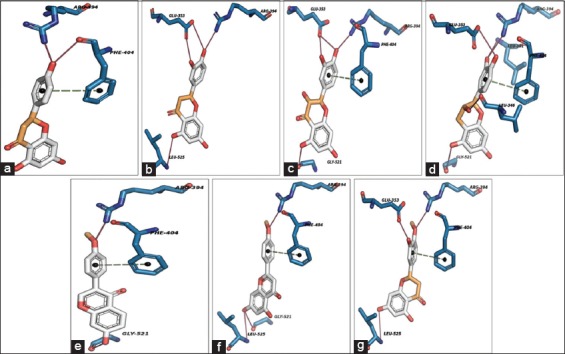
The obtained results showed two intensive peaks in each polyphenol fraction analyzed with FT-IR, confirms O-H/C-O stretch of the phenolic functional group. A total of 40 compounds were obtained, which categorized as 9 different classes. Among them, flavonol group represents more number of polyphenols. studies suggest seven compounds have the possibility to use as future nontoxic inhibitors. Molecular docking studies with ERa revealed the lead molecules unequivocally interact with Leu, Glu, Leu, Arg, Gly, Leu residues, and Phe formed atomic π-stacking with dihydrochromen-4-one ring of ligands as like estrodial, which stabilizes the receptor structure and complicated to generate a single mutation for drug resistance.
Overall, these results significantly proposed that isolated phenolics could be served as potential ER mitigators for breast cancer therapy.
本研究旨在从……的不同部位分离、表征和评估抗癌多酚。
采用标准方案分离多酚,并通过傅里叶变换红外光谱(FT-IR)、高效液相色谱-光电二极管阵列检测器结合电喷雾电离-质谱(MS/MS)进行表征。通过与标准酚类物质比较以及使用ReSpect软件工具,根据保留时间和分子离子([M+H]/[M-H])来阐明化合物。此外,使用OSIRIS和SwissADME程序筛选所选酚类支架的吸收、分布、代谢和排泄(ADME)/毒性特性,这些程序纳入了毒性风险评估、药代动力学和五原则。通过PyRx虚拟筛选程序的AutoDock评分函数,对所选毒性过滤化合物针对乳腺癌雌激素受体α(ERα)结构(蛋白质数据库ID:1A52)进行分子对接研究。
FT-IR分析所得结果显示,每个多酚组分中有两个强峰,证实了酚官能团的O-H/C-O伸缩振动。共获得40种化合物,分为9个不同类别。其中,黄酮醇类代表的多酚数量较多。研究表明,有7种化合物有可能用作未来的无毒抑制剂。与ERα的分子对接研究表明,先导分子明确地与亮氨酸、谷氨酸、亮氨酸、精氨酸、甘氨酸、亮氨酸残基相互作用,并且苯丙氨酸与配体的二氢色原酮环形成原子π堆积,如同雌二醇一样,这稳定了受体结构,并且难以产生单一的耐药性突变。
总体而言,这些结果显著表明,分离出的酚类物质可作为乳腺癌治疗中潜在的雌激素受体调节剂。