Casal Diogo, Mota-Silva Eduarda, Pais Diogo, Iria Inês, Videira Paula A, Tanganho David, Alves Sara, Mascarenhas-Lemos Luís, Martins Ferreira José, Ferraz-Oliveira Mário, Vassilenko Valentina, O'Neill João Goyri
Plastic and Reconstructive Surgery Department and Burn Unit, Centro Hospitalar de Lisboa Central, Lisbon, Portugal; Anatomy Department, Nova Medical School, Lisbon, Portugal; Glycoimmunology, CEDOC, NOVA Medical School, Lisbon, Portugal; LIBPhys, Physics Department, Faculdade de Ciências e Tecnologias, Universidade NOVA de Lisboa, Caparica, Portugal; Department of Life Sciences, Faculdade de Ciências e Tecnologias, Universidade NOVA de Lisboa, Caparica, Portugal; and Pathology Department, Centro Hospitalar de Lisboa Central, Lisbon, Portugal.
Plast Reconstr Surg Glob Open. 2017 Aug 17;5(8):e1436. doi: 10.1097/GOX.0000000000001436. eCollection 2017 Aug.
Although numerous experimental models of arterialized venous flaps (AVFs) have been proposed, no single model has gained widespread acceptance. The main aim of this work was to evaluate the survival area of AVFs produced with different vascular constructs in the abdomen of the rat.
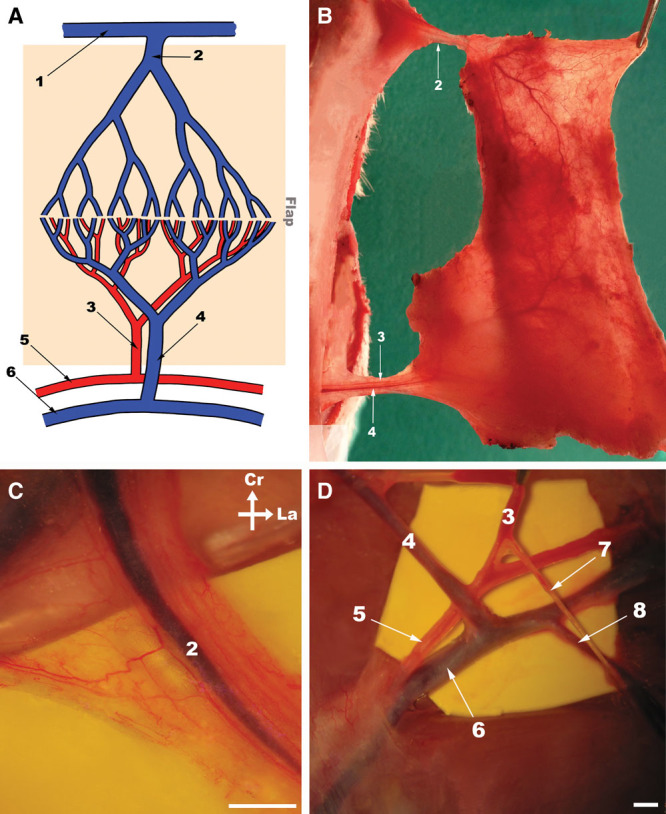
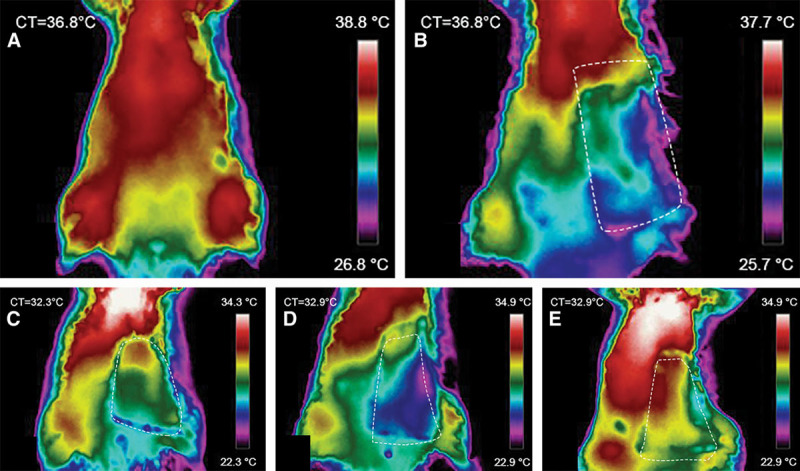
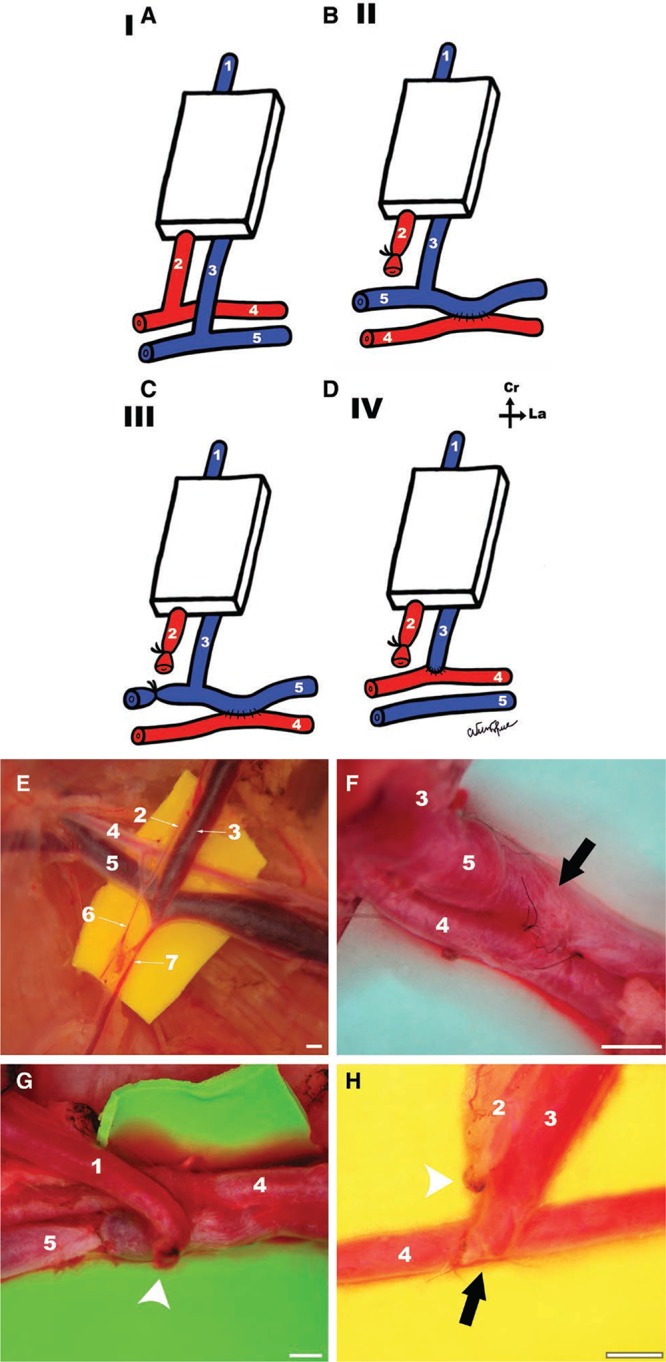
Fifty-three male rats were divided into 4 groups. In group I (n = 12), a 5-cm-long and 3-cm-wide conventional epigastric flap was raised on the left side of the abdomen. This flap was pedicled on the superficial caudal epigastric vessels caudally and on the lateral thoracic vein cranially. In groups II, III, and IV, a similar flap was raised, but the superficial epigastric artery was ligated. In these groups, AVFs were created using the following arterial venous anastomosis at the caudal end of the flap: group II (n = 13) a 1-mm-long side-to-side anastomosis was performed between the femoral artery and vein laterally to the ending of the superficial caudal epigastric vein. In group III (n = 14), in addition to the procedure described for group II, the femoral vein was ligated medially. Finally, in group IV (n = 14), the superficial caudal epigastric vein was cut from the femoral vein with a 1-mm-long ellipse of adjacent tissue, and an end-to-side arterial venous anastomosis was established between it and the femoral artery.
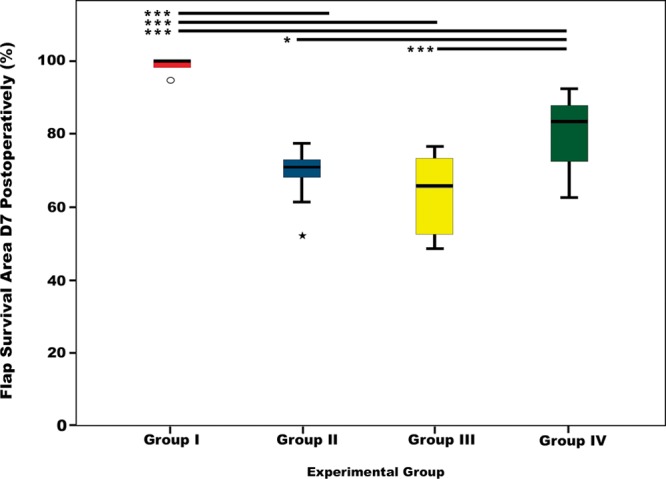
Seven days postoperatively, the percentage of flap survival was 98.89 ± 1.69, 68.84 ± 7.36, 63.84 ± 10.38, 76.86 ± 13.67 in groups I-IV, respectively.
An optimized AVF can be produced using the vascular architecture described for group IV.
尽管已经提出了许多动脉化静脉皮瓣(AVF)的实验模型,但没有一个模型得到广泛认可。这项工作的主要目的是评估在大鼠腹部用不同血管构建物制作的AVF的存活面积。
53只雄性大鼠分为4组。在第一组(n = 12)中,在腹部左侧掀起一个长5 cm、宽3 cm的传统上腹部皮瓣。该皮瓣尾侧以腹壁浅静脉为蒂,头侧以胸外侧静脉为蒂。在第二、三、四组中,掀起类似的皮瓣,但结扎腹壁浅动脉。在这些组中,在皮瓣尾端采用以下动静脉吻合方式制作AVF:第二组(n = 13)在腹壁浅静脉末端外侧,在股动脉和静脉之间进行1 mm长的侧侧吻合。在第三组(n = 14)中,除了第二组所述的操作外,在内侧结扎股静脉。最后,在第四组(n = 14)中,将腹壁浅静脉从股静脉处连同相邻组织的1 mm长椭圆形一并切断,并在其与股动脉之间建立端侧动静脉吻合。
术后7天,第一至四组皮瓣存活百分比分别为98.89±1.69、68.84±7.36、63.84±10.38、76.86±13.67。
使用第四组所述的血管结构可以制作出优化的AVF。