Frey Jordan D, Salibian Ara A, Choi Mihye, Karp Nolan S
Hansjörg Wyss Department of Plastic Surgery, NYU Langone Medical Center, New York, N.Y.
Plast Reconstr Surg Glob Open. 2017 Aug 8;5(8):e1439. doi: 10.1097/GOX.0000000000001439. eCollection 2017 Aug.
Ischemic complications after nipple-sparing mastectomy (NSM) have been associated with numerous variables. However, the impact of NSM flap thickness has been incompletely evaluated.
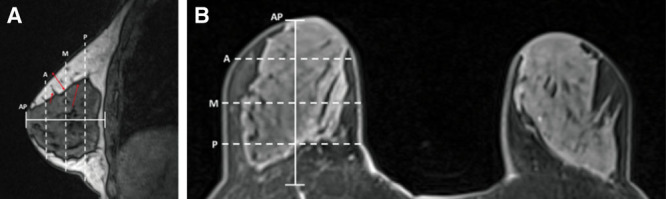
NSM flap thickness was determined for all NSMs from 2006 to 2016 with available pre- or postoperative breast magnetic resonance imaging (MRIs). Demographics and outcomes were stratified by those with and without ischemic complications.
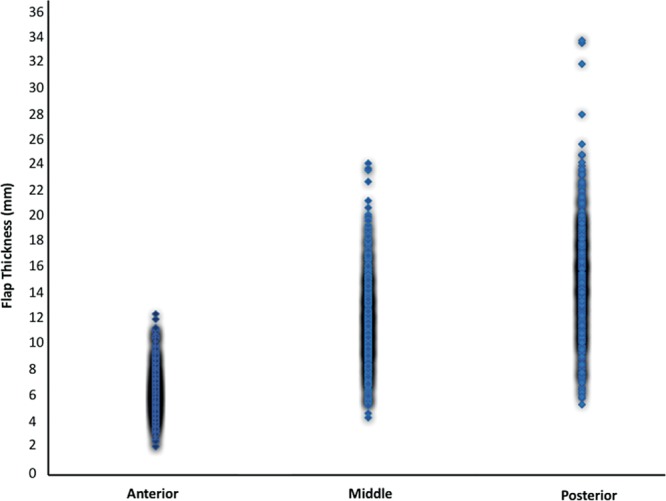
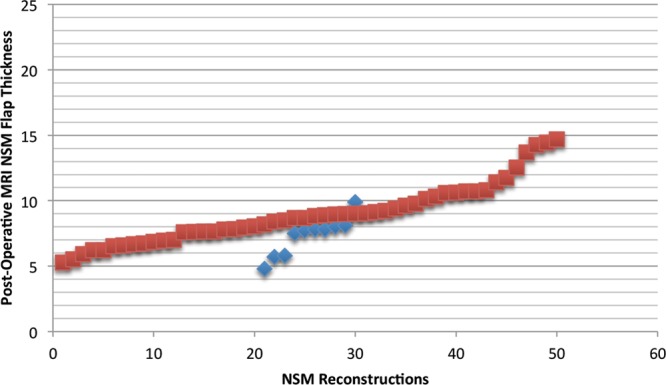
Of 1,037 NSM reconstructions, 420 NSMs had MRI data available, which included 379 preoperative MRIs and 60 postoperative MRIs. Average total preoperative skin/subcutaneous tissue NSM flap thickness was 11.4 mm. Average total postoperative NSM flap thickness was 8.7 mm. NSMs with ischemic complications were found to have significantly thinner overall postoperative NSM flap thickness compared with those without ischemic complications ( = 0.0280). Average overall postoperative NSM flap thickness less than 8.0 mm was found to be an independent predictor of ischemic complications (odds ratio, 6.5263; = 0.026). In NSMs with both pre- and postoperative MRIs, the overall average postoperative NSM flap thickness was 68.2% of preoperative measurements. Average overall postoperative NSM flap thickness was significantly less than average overall preoperative NSM flap thickness ( < 0.0001). NSMs with ischemic complications were found to have a significantly lower ratio of overall postoperative to preoperative flap thickness (52.0% versus 74.0%; < 0.0001).
Ischemic complications after NSM are significantly associated with thinner postoperative NSM flap thickness. Particularly, NSM flap thickness less than 8.0 mm is a positive independent predictor of ischemic complications. The ratio of postoperative to preoperative NSM flap thickness was significantly lower in reconstructions with ischemic complications.
保乳根治术(NSM)后的缺血性并发症与众多变量相关。然而,NSM皮瓣厚度的影响尚未得到充分评估。
对2006年至2016年所有接受NSM且有术前或术后乳腺磁共振成像(MRI)资料的患者确定NSM皮瓣厚度。根据有无缺血性并发症对人口统计学和结果进行分层。
在1037例NSM重建手术中,420例有MRI数据,其中包括379例术前MRI和60例术后MRI。术前皮肤/皮下组织NSM皮瓣平均总厚度为11.4毫米。术后NSM皮瓣平均总厚度为8.7毫米。发现有缺血性并发症的NSM术后总体皮瓣厚度明显薄于无缺血性并发症的患者(P = 0.0280)。发现术后总体NSM皮瓣平均厚度小于8.0毫米是缺血性并发症的独立预测因素(比值比,6.5263;P = 0.026)。在有术前和术后MRI的NSM中,术后NSM皮瓣总体平均厚度为术前测量值的68.2%。术后NSM皮瓣总体平均厚度明显小于术前NSM皮瓣总体平均厚度(P < 0.0001)。发现有缺血性并发症的NSM术后与术前皮瓣厚度之比明显更低(52.0%对74.0%;P < 0.0001)。
NSM后的缺血性并发症与术后NSM皮瓣厚度变薄显著相关。特别是,NSM皮瓣厚度小于8.0毫米是缺血性并发症的一个积极独立预测因素。有缺血性并发症的重建手术中,术后与术前NSM皮瓣厚度之比明显更低。