School of Human Movement and Nutrition Sciences, The University of Queensland, Brisbane, QLD 4072, Australia.
Department of Neurobiology, Care Sciences and Society, Division of Nursing, Karolinska Institute, Stockholm 171 77, Sweden.
Nutrients. 2017 Sep 12;9(9):1003. doi: 10.3390/nu9091003.
Improvements in diet and/or exercise are often advocated during prostate cancer treatment, yet the efficacy of, and optimal nutrition and exercise prescription for managing cancer-related fatigue and quality of life remains elusive. The aim of this study is to systematically review the effects of nutrition and/or exercise on cancer-related fatigue and/or quality of life.
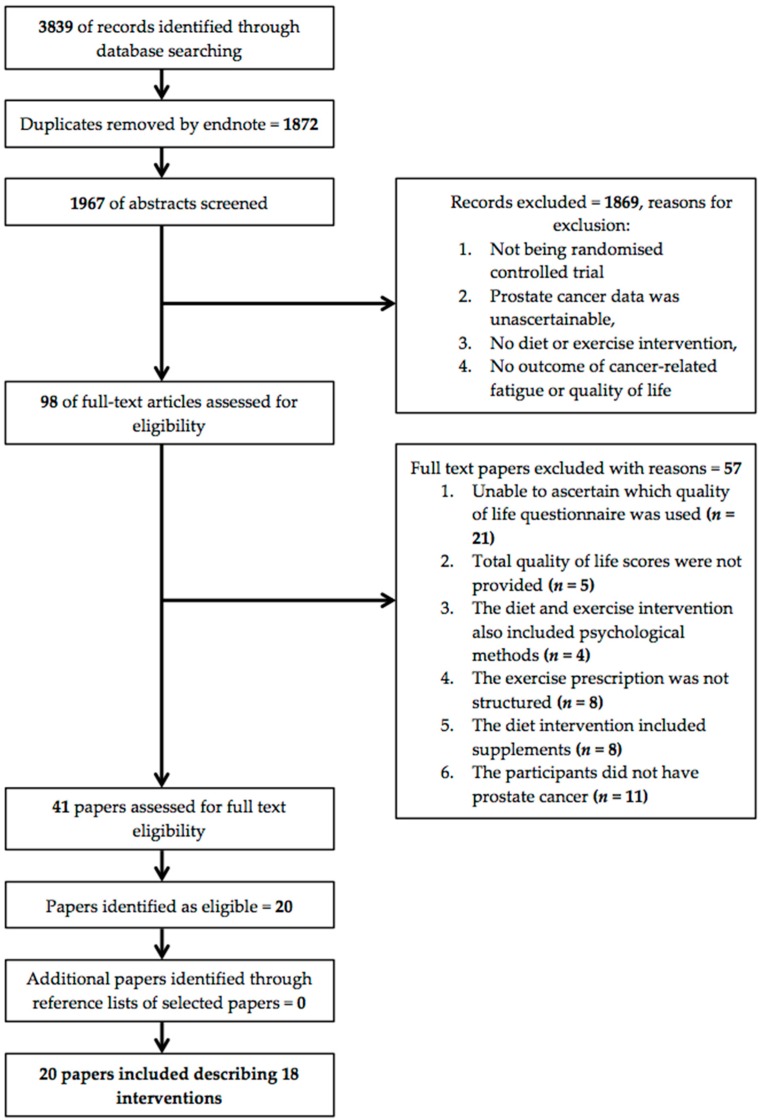
A literature search was conducted in six electronic databases. The Delphi quality assessment list was used to evaluate the methodological quality of the literature. The study characteristics and results were summarized in accordance with the review's Population, Intervention, Control, Outcome (PICO) criteria.
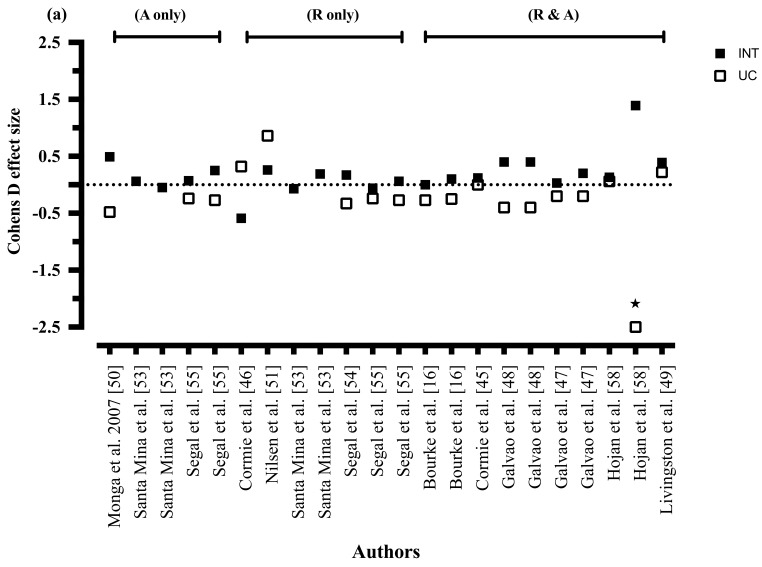
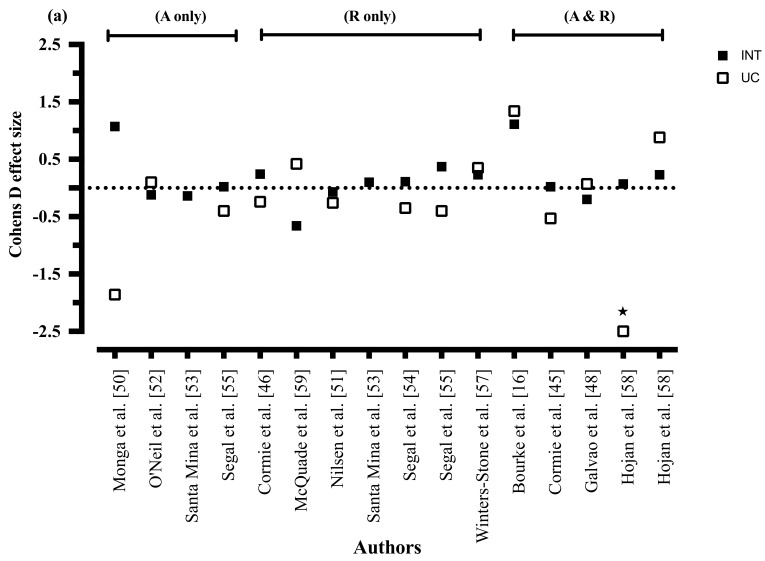
A total of 20 articles (one diet only, two combined diet and exercise, and seventeen exercise only studies) were included in the review. Soy supplementation improved quality of life, but resulted in several adverse effects. Prescribing healthy eating guidelines with combined resistance training and aerobic exercise improved cancer-related fatigue, yet its effect on quality of life was inconclusive. Combined resistance training with aerobic exercise showed improvements in cancer-related fatigue and quality of life. In isolation, resistance training appears to be more effective in improving cancer-related fatigue and quality of life than aerobic exercise. Studies that utilised an exercise professional to supervise the exercise sessions were more likely to report improvements in both cancer-related fatigue and quality of life than those prescribing unsupervised or partially supervised sessions. Neither exercise frequency nor duration appeared to influence cancer-related fatigue or quality of life, with further research required to explore the potential dose-response effect of exercise intensity.
Supervised moderate-hard resistance training with or without moderate-vigorous aerobic exercise appears to improve cancer-related fatigue and quality of life. Targeted physiological pathways suggest dietary intervention may alleviate cancer-related fatigue and improve quality of life, however the efficacy of nutrition management with or without exercise prescription requires further exploration.
在前列腺癌治疗过程中,常提倡改善饮食和/或运动,但管理癌症相关疲劳和生活质量的最佳营养和运动处方的疗效仍难以捉摸。本研究旨在系统评价营养和/或运动对癌症相关疲劳和/或生活质量的影响。
在六个电子数据库中进行文献检索。使用德尔菲质量评估清单评估文献的方法学质量。根据综述的人群、干预、对照、结局(PICO)标准,总结研究特征和结果。
共纳入 20 篇文章(一篇仅饮食,两篇饮食结合运动,十七篇仅运动研究)。大豆补充剂改善了生活质量,但有一些不良反应。制定健康饮食指南,结合抗阻训练和有氧运动,可改善癌症相关疲劳,但对生活质量的影响尚不确定。结合抗阻训练和有氧运动可改善癌症相关疲劳和生活质量。单独进行抗阻训练似乎比有氧运动更能有效改善癌症相关疲劳和生活质量。由运动专业人员监督运动课程的研究更有可能报告改善癌症相关疲劳和生活质量,而规定非监督或部分监督课程的研究则不然。运动频率和持续时间似乎都不会影响癌症相关疲劳或生活质量,需要进一步研究以探讨运动强度的潜在剂量反应效应。
有或没有中等强度有氧运动的监督中等强度抗阻训练似乎可以改善癌症相关疲劳和生活质量。靶向生理途径表明,饮食干预可能减轻癌症相关疲劳并改善生活质量,但营养管理与运动处方的疗效仍需要进一步探索。