Department of Orthopaedic Surgery, the First Affiliated Hospital of Nanchang University, Nanchang, 330006, PR China.
Sci Rep. 2017 Sep 12;7(1):11325. doi: 10.1038/s41598-017-11700-4.
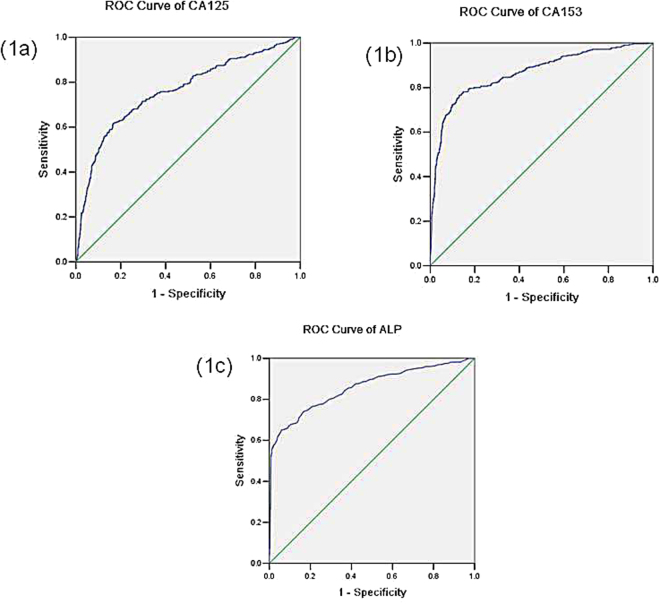
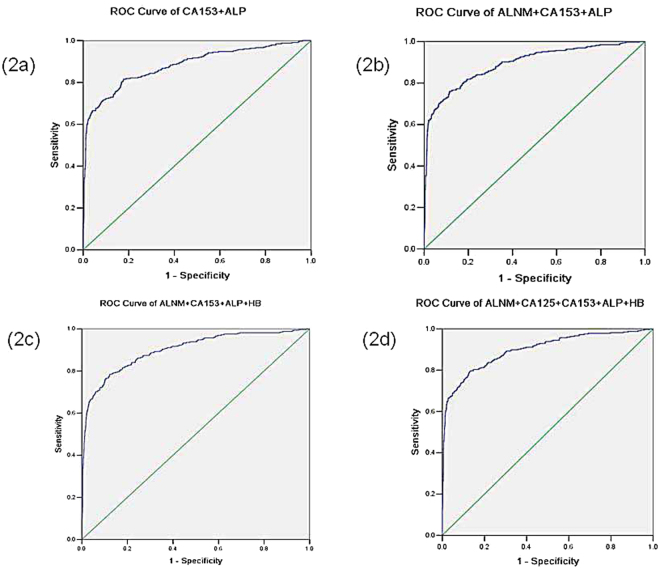
The risk factors for predicting bone metastases in patients with breast cancer are still controversial. Here, a total of 2133 patients with breast cancer, including 327 with bone metastases (15.33%) and 1806 without bone metastases (84.67%) were retrospective reviewed from January 2005 to December 2015. The spine was found to be the most common site for bone metastases, followed by ribs (57.5%), pelvis (54.1%) and sternum (44.3%). The results indicated that axillary lymph node metastases and the concentrations of CA125, CA153, ALP and hemoglobin were the independent risk factors for bone metastases in patients with breast cancer. The receiver operating characteristics (ROC) curves showed that combined axillary lymph node metastases, high CA153 and ALP, with low hemoglobin were the most accurate biomarkers for predicting bone metastases in breast cancer [area under the curve = 0.900], and the sensitivity and specificity for the prediction were 78.5% and 87.8%, respectively. Therefore, breast cancer patients with more axillary lymph node metastases, high serum concentrations of CA125, CA153, ALP and low level of hemoglobin were closely related to bone metastases. Combined axillary lymph node metastases, CA153, ALP with hemoglobin have the highest predictive accuracy for bone metastases in breast cancer.
乳腺癌患者发生骨转移的预测因素仍存在争议。本研究回顾性分析了 2005 年 1 月至 2015 年 12 月间收治的 2133 例乳腺癌患者,其中 327 例(15.33%)发生骨转移,1806 例(84.67%)未发生骨转移。结果发现,乳腺癌患者骨转移最常见的部位是脊柱,其次是肋骨(57.5%)、骨盆(54.1%)和胸骨(44.3%)。研究表明,腋窝淋巴结转移及 CA125、CA153、碱性磷酸酶和血红蛋白浓度是乳腺癌患者发生骨转移的独立危险因素。受试者工作特征(ROC)曲线分析显示,联合腋窝淋巴结转移、CA153 和 ALP 升高及血红蛋白降低是预测乳腺癌骨转移的最准确的生物标志物[曲线下面积(AUC)=0.900],预测骨转移的敏感度和特异度分别为 78.5%和 87.8%。因此,腋窝淋巴结转移较多、血清 CA125、CA153、ALP 浓度升高和血红蛋白水平降低的乳腺癌患者与骨转移密切相关。联合腋窝淋巴结转移、CA153、ALP 和血红蛋白对乳腺癌骨转移具有最高的预测准确性。