Paradis Julie, Boureau Pierre, Moyon Thomas, Nicklaus Sophie, Parnet Patricia, Paillé Vincent
UMR 1280 Physiologie des Adaptations Nutritionnelles (PhAN), INRA, Université de Nantes, Institut des Maladies de l'Appareil Digestif (IMAD), Nantes, France.
UMR 1324 Centre des Sciences du Goût et de l'Alimentation (CSGA), INRA, CNRS, Université de Bourgogne, Dijon, France.
Front Endocrinol (Lausanne). 2017 Aug 29;8:216. doi: 10.3389/fendo.2017.00216. eCollection 2017.
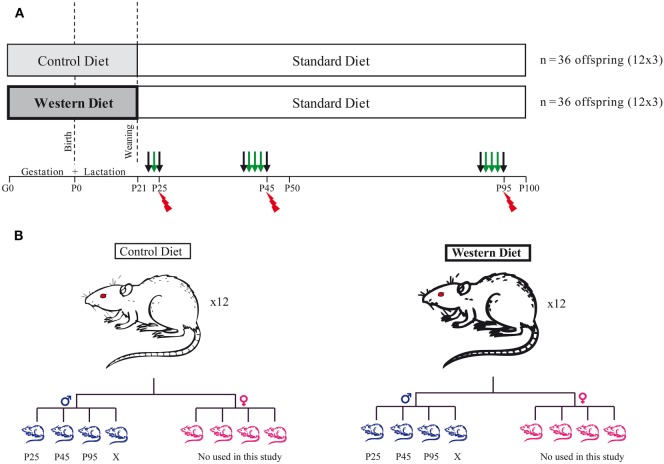
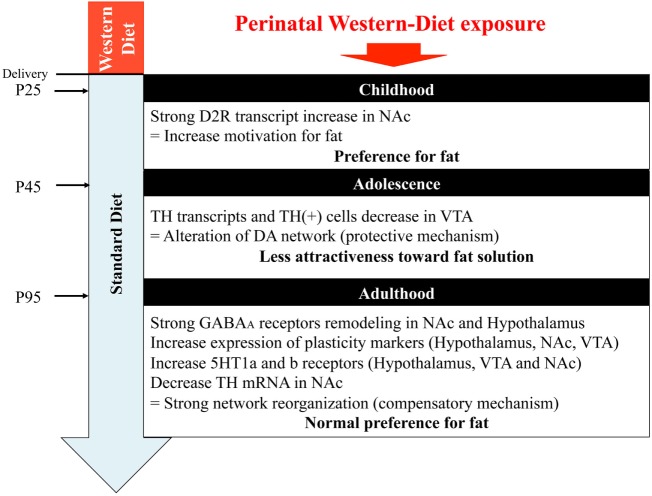
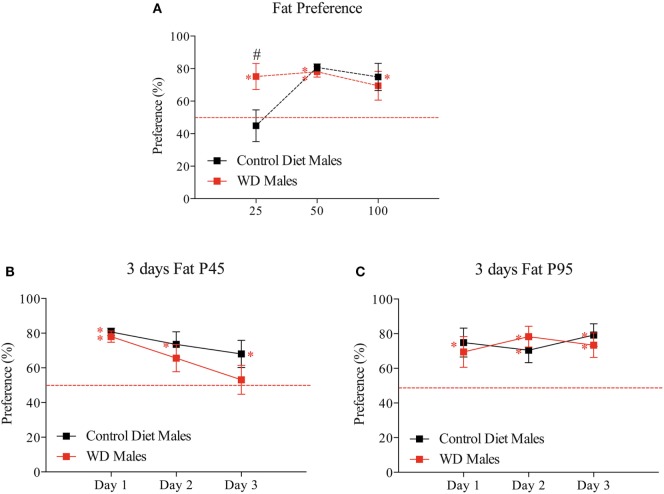
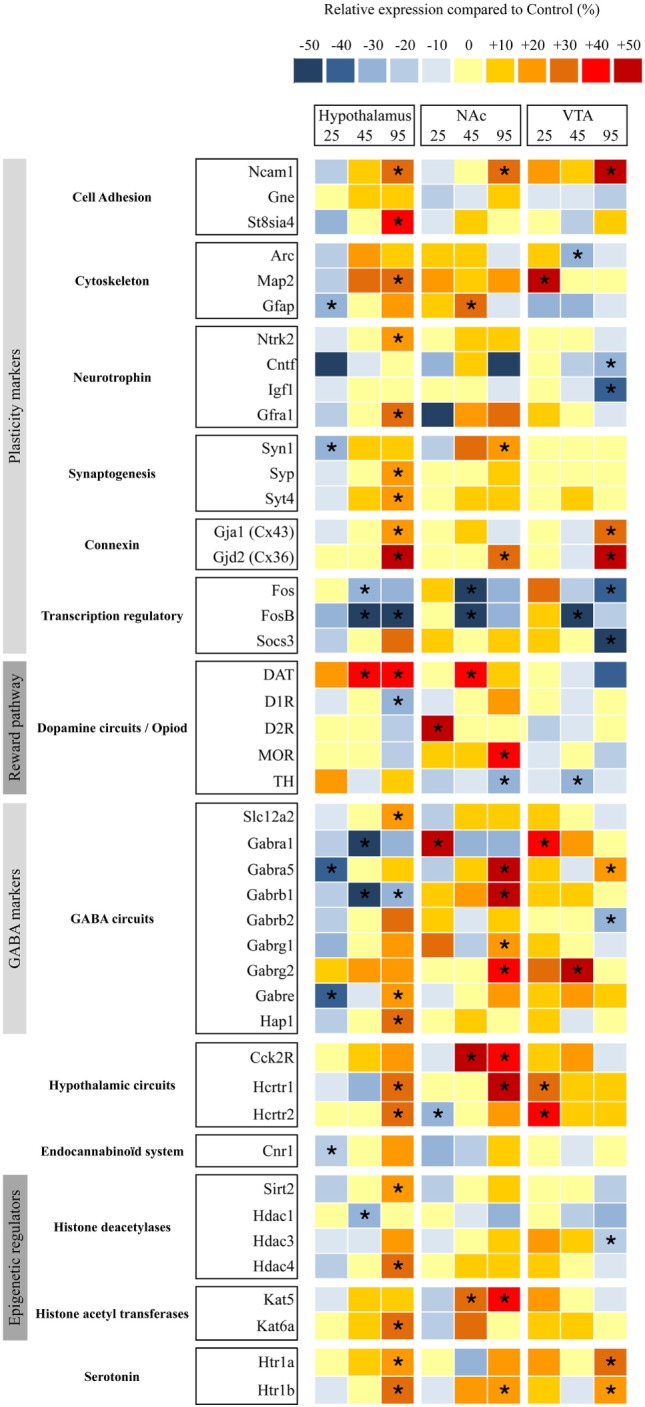
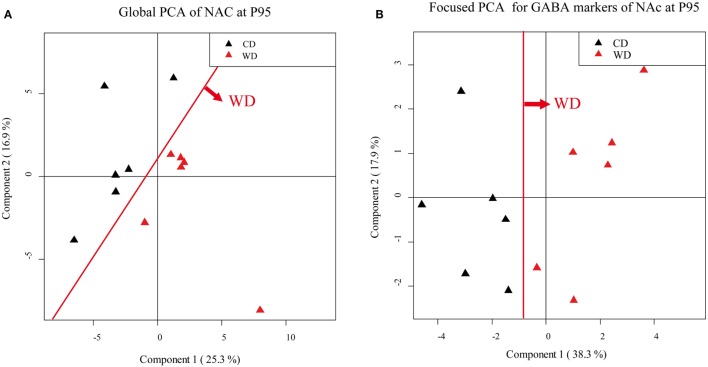
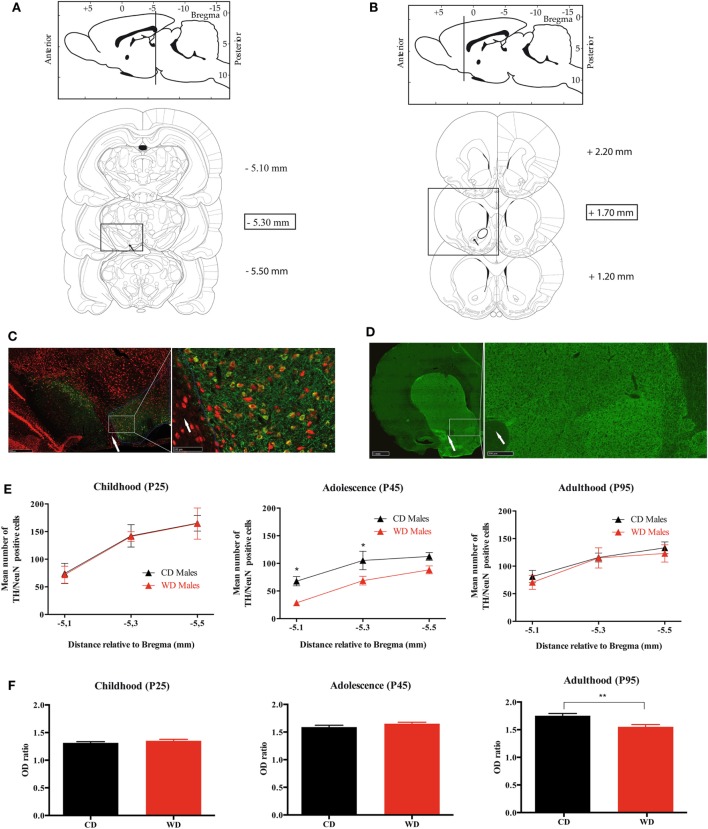
Perinatal maternal consumption of energy dense food increases the risk of obesity in children. This is associated with an overconsumption of palatable food that is consumed for its hedonic property. The underlying mechanism that links perinatal maternal diet and offspring preference for fat is still poorly understood. In this study, we aim at studying the influence of maternal high-fat/high-sugar diet feeding [western diet (WD)] during gestation and lactation on the reward pathways controlling feeding in the rat offspring from birth to sexual maturity. We performed a longitudinal follow-up of WD and Control offspring at three critical time periods (childhood, adolescence, and adulthood) and focus on investigating the influence of perinatal exposure to palatable diet on (i) fat preference, (ii) gene expression profile, and (iii) neuroanatomical/architectural changes of the mesolimbic dopaminergic networks. We showed that WD feeding restricted to the perinatal period has a clear long-lasting influence on the organization of homeostatic and hedonic brain circuits but not on fat preference. We demonstrated a period specific evolution of the preference for fat that we correlated with specific brain molecular signatures. In offspring from WD fed dams, we observed during childhood the existence of fat preference associated with a higher expression of key gene involved in the dopamine (DA) systems; at adolescence, a high-fat preference for both groups, progressively reduced during the 3 days test for the WD group and associated with a reduced expression of key gene involved in the DA systems for the WD group that could suggest a compensatory mechanism to protect them from further high-fat exposure; and finally at adulthood, a preference for fat that was identical to control rats but associated with profound modification in key genes involved in the γ-aminobutyric acid network, serotonin receptors, and polysialic acid-NCAM-dependent remodeling of the hypothalamus. Altogether, these data reveal that maternal WD, restricted to the perinatal period, has no sustained impact on energy homeostasis and fat preference later in life even though a strong remodeling of the hypothalamic homeostatic and reward pathway involved in eating behavior occurred. Further functional experiments would be needed to understand the relevance of these circuits remodeling.
围产期母亲食用能量密集型食物会增加儿童肥胖的风险。这与为了其享乐特性而过度食用美味食物有关。围产期母亲饮食与后代对脂肪的偏好之间的潜在机制仍知之甚少。在本研究中,我们旨在研究妊娠和哺乳期母亲高脂/高糖饮食喂养[西式饮食(WD)]对大鼠后代从出生到性成熟期间控制进食的奖赏通路的影响。我们在三个关键时期(童年、青春期和成年期)对WD和对照后代进行了纵向随访,并着重研究围产期暴露于美味饮食对(i)脂肪偏好、(ii)基因表达谱以及(iii)中脑边缘多巴胺能网络的神经解剖学/结构变化的影响。我们发现,仅在围产期进行WD喂养对稳态和享乐性脑回路的组织有明显的长期影响,但对脂肪偏好没有影响。我们证明了对脂肪偏好的特定时期演变,这与特定的脑部分子特征相关。在由WD喂养的母鼠所生的后代中,我们观察到在童年期存在与多巴胺(DA)系统中关键基因高表达相关的脂肪偏好;在青春期,两组都有高脂肪偏好,WD组在3天测试期间逐渐降低,并且与WD组中参与DA系统的关键基因表达降低相关,这可能表明存在一种补偿机制以保护它们免受进一步的高脂肪暴露;最后在成年期,对脂肪的偏好与对照大鼠相同,但与参与γ-氨基丁酸网络、血清素受体以及下丘脑多唾液酸-N-钙黏蛋白依赖性重塑的关键基因的深刻改变有关。总之,这些数据表明,仅在围产期进行的母亲WD喂养对生命后期的能量稳态和脂肪偏好没有持续影响,尽管参与进食行为的下丘脑稳态和奖赏通路发生了强烈重塑。还需要进一步的功能实验来了解这些回路重塑的相关性。