Department of Chemistry, Istanbul Technical University, Maslak, Istanbul 34469, Turkey.
Chemistry Group Laboratories, TUBITAK-UME P.O. Box 54, Gebze, Kocaeli 41471, Turkey.
Molecules. 2017 Sep 13;22(9):1522. doi: 10.3390/molecules22091522.
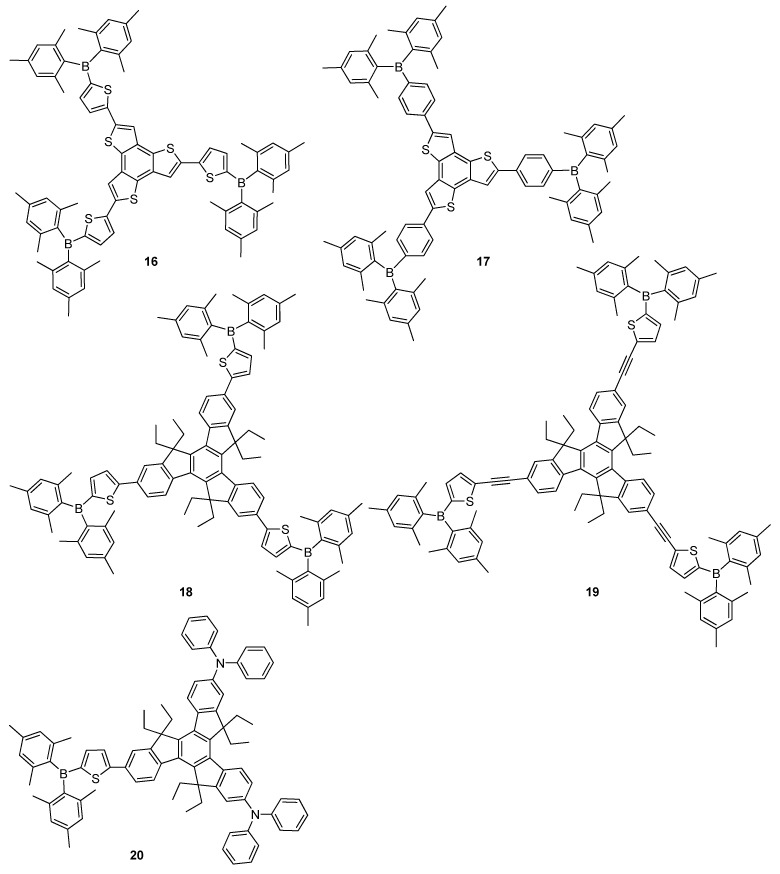
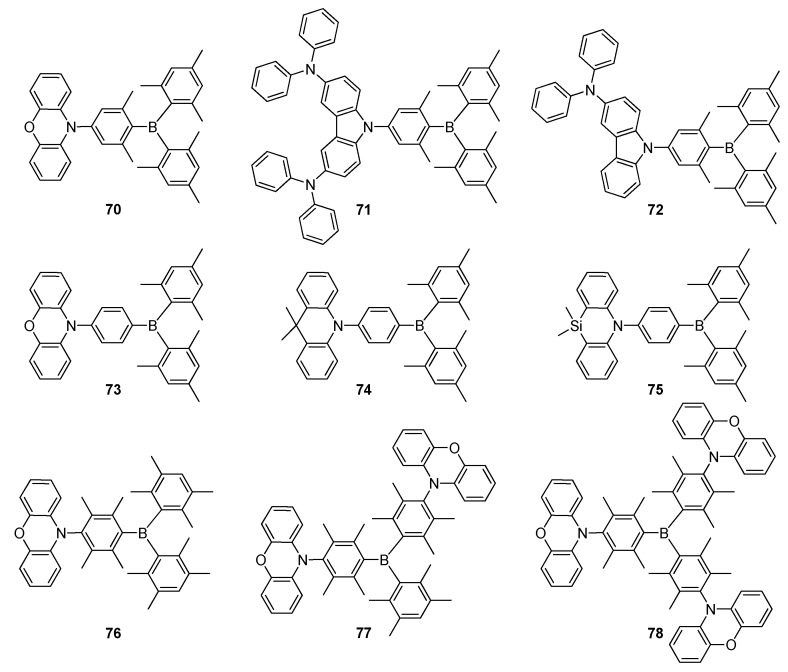
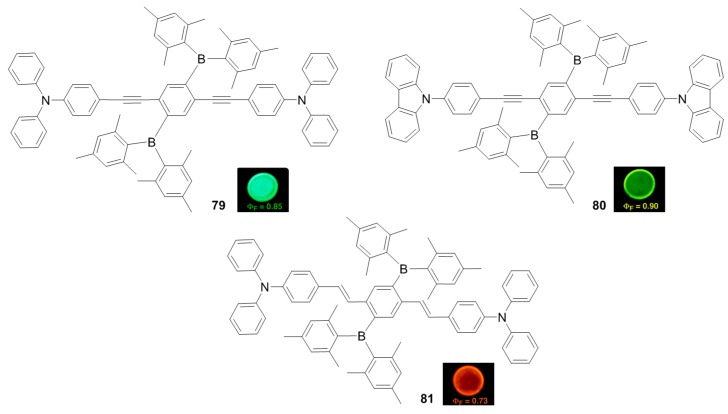
Multidisciplinary research on organic fluorescent molecules has been attracting great interest owing to their potential applications in biomedical and material sciences. In recent years, electron deficient systems have been increasingly incorporated into fluorescent materials. Triarylboranes with the empty p orbital of their boron centres are electron deficient and can be used as strong electron acceptors in conjugated organic fluorescent materials. Moreover, their applications in optoelectronic devices, energy harvesting materials and anion sensing, due to their natural Lewis acidity and remarkable solid-state fluorescence properties, have also been investigated. Furthermore, fluorescent triarylborane-based materials have been commonly utilized as emitters and electron transporters in organic light emitting diode (OLED) applications. In this review, triarylborane-based small molecules and polymers will be surveyed, covering their structure-property relationships, intramolecular charge transfer properties and solid-state fluorescence quantum yields as functional emissive materials in OLEDs. Also, the importance of the boron atom in triarylborane compounds is emphasized to address the key issues of both fluorescent emitters and their host materials for the construction of high-performance OLEDs.
有机荧光分子的多学科研究由于其在生物医学和材料科学中的潜在应用而引起了极大的兴趣。近年来,缺电子体系越来越多地被引入荧光材料中。具有硼中心空 p 轨道的三芳基硼是缺电子的,可以用作共轭有机荧光材料中的强电子受体。此外,由于其天然的路易斯酸度和显著的固态荧光性质,它们在光电设备、能量收集材料和阴离子传感中的应用也得到了研究。此外,荧光三芳基硼基材料通常被用作有机发光二极管(OLED)应用中的发射器和电子传输体。在这篇综述中,将调查基于三芳基硼的小分子和聚合物,涵盖它们在 OLED 中作为功能发射材料的结构-性质关系、分子内电荷转移性质和固态荧光量子产率。此外,还强调了三芳基硼化合物中硼原子的重要性,以解决荧光发射器及其主体材料的关键问题,从而构建高性能 OLED。