Waeber Patrick O, Gardner Charlie J, Lourenço Wilson R, Wilmé Lucienne
ETH Zurich, Department of ITES, Forest Management and Development (ForDev) Group, Universitätstrasse 16, Zurich, Switzerland.
Durrell Institute of Conservation and Ecology (DICE), University of Kent, Canterbury, United Kingdom.
PLoS One. 2017 Sep 13;12(9):e0183903. doi: 10.1371/journal.pone.0183903. eCollection 2017.
For centuries taxonomy has relied on dead animal specimens, a practice that persists today despite the emergence of innovative biodiversity assessment methods. Taxonomists and conservationists are engaged in vigorous discussions over the necessity of killing animals for specimen sampling, but quantitative data on taxonomic trends and specimen sampling over time, which could inform these debates, are lacking.
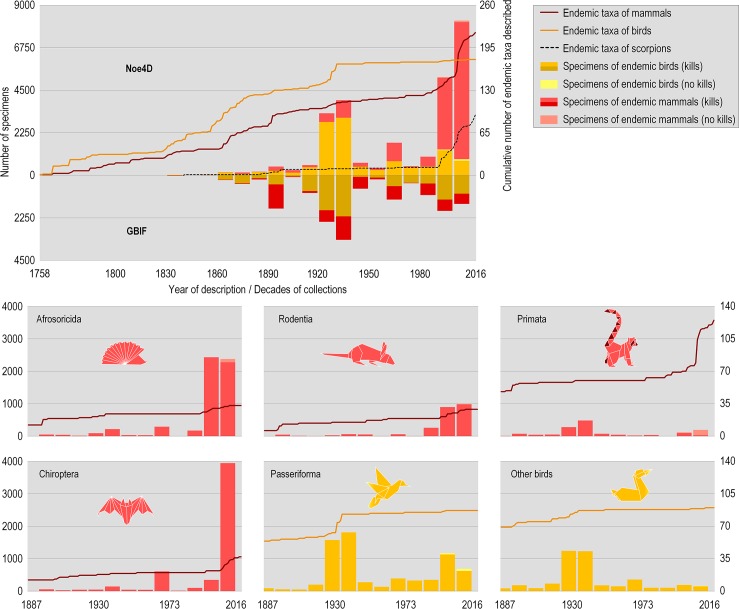
We interrogated a long-term research database documenting 2,723 land vertebrate and 419 invertebrate taxa from Madagascar, and their associated specimens conserved in the major natural history museums. We further compared specimen collection and species description rates for the birds, mammals and scorpions over the last two centuries, to identify trends and links to taxon descriptions.
We located 15,364 specimens documenting endemic mammals and 11,666 specimens documenting endemic birds collected between 1820 and 2010. Most specimens were collected at the time of the Mission Zoologique Franco-Anglo-Américaine (MZFAA) in the 1930s and during the last two decades, with major differences according to the groups considered. The small mammal and bat collections date primarily from recent years, and are paralleled by the description of new species. Lemur specimens were collected during the MZFAA but the descriptions of new taxa are recent, with the type series limited to non-killed specimens. Bird specimens, particularly of non-passerines, are mainly from the time of the MZFAA. The passerines have also been intensely collected during the last two decades; the new material has been used to solve the phylogeny of the groups and only two new endemic taxa of passerine birds have been described over the last two decades.
Our data show that specimen collection has been critical for advancing our understanding of the taxonomy of Madagascar's biodiversity at the onset of zoological work in Madagascar, but less so in recent decades. It is crucial to look for alternatives to avoid killing animals in the name of documenting life, and encourage all efforts to share the information attached to historical and recent collections held in natural history museums. In times of conservation crisis and the advancement in digital technologies and open source sharing, it seems obsolete to kill animals in well-known taxonomic groups for the sake of enriching natural history collections around the world.
几个世纪以来,分类学一直依赖于动物标本,尽管出现了创新的生物多样性评估方法,但这种做法至今仍在持续。分类学家和保护主义者就是否有必要捕杀动物以获取标本展开了激烈讨论,但缺乏有关分类学趋势和随时间推移的标本采样的定量数据,而这些数据本可为这些辩论提供参考。
我们查阅了一个长期研究数据库,该数据库记录了来自马达加斯加的2723种陆地脊椎动物和419种无脊椎动物分类单元,以及保存在主要自然历史博物馆中的相关标本。我们进一步比较了过去两个世纪鸟类、哺乳动物和蝎子的标本采集率和物种描述率,以确定趋势以及与分类单元描述的联系。
我们找到了15364份记录1820年至2010年间特有哺乳动物的标本以及11666份记录特有鸟类的标本。大多数标本是在20世纪30年代的法英美动物学考察团(MZFAA)期间以及过去二十年中采集的,不同类群之间存在重大差异。小型哺乳动物和蝙蝠的标本主要来自近年来,同时伴随着新物种的描述。狐猴标本是在MZFAA期间采集的,但新分类单元的描述是最近才有的,模式系列仅限于未捕杀的标本。鸟类标本,尤其是非雀形目鸟类标本,主要来自MZFAA时期。雀形目鸟类在过去二十年中也被大量采集;新材料已被用于解决该类群的系统发育问题,过去二十年中仅描述了两种新的特有雀形目鸟类分类单元。
我们的数据表明,在马达加斯加动物学工作开始时,标本采集对于推进我们对马达加斯加生物多样性分类学的理解至关重要,但在最近几十年中重要性有所降低。至关重要的是要寻找替代方法,避免以记录生命之名捕杀动物,并鼓励各方努力共享自然历史博物馆中保存的历史和近期标本所附带的信息。在保护危机以及数字技术和开源共享不断发展的时代,为了丰富世界各地的自然历史收藏而捕杀知名分类群中的动物似乎已经过时。