Schuch Michael, Groß G Alexander, Köhler J Michael
Institute for Micro and Nanotechnologies, Institute for Physics, Techn. Univ. Ilmenau, 98684 Ilmenau, Germany.
Sensors (Basel). 2007 Oct 30;7(11):2499-2509. doi: 10.3390/s7112499.
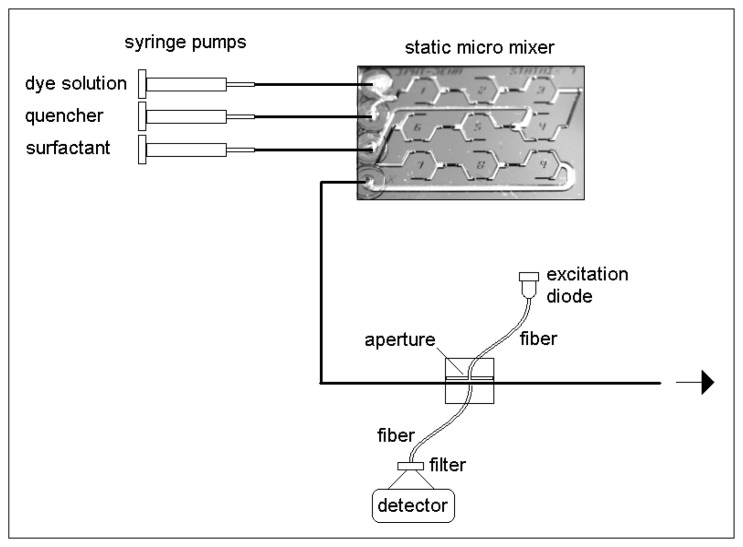
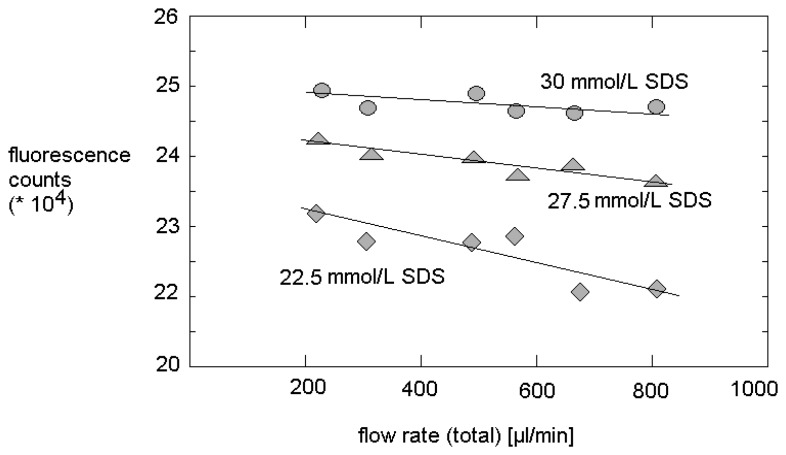
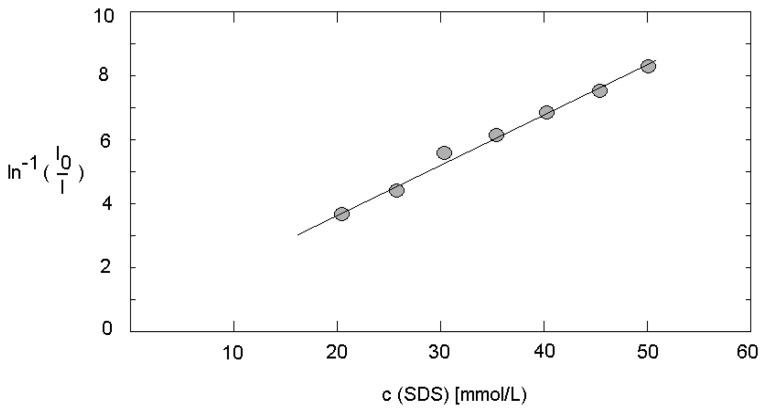
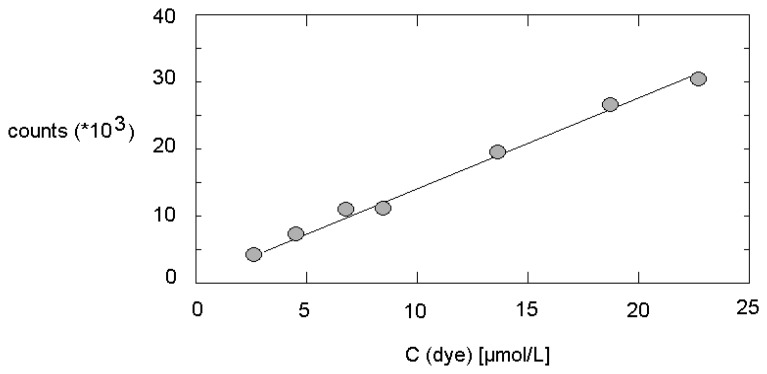
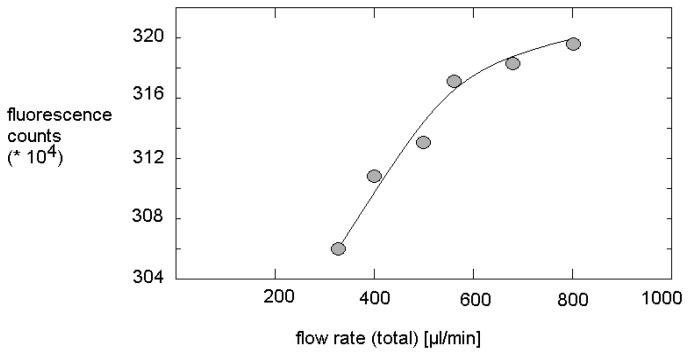
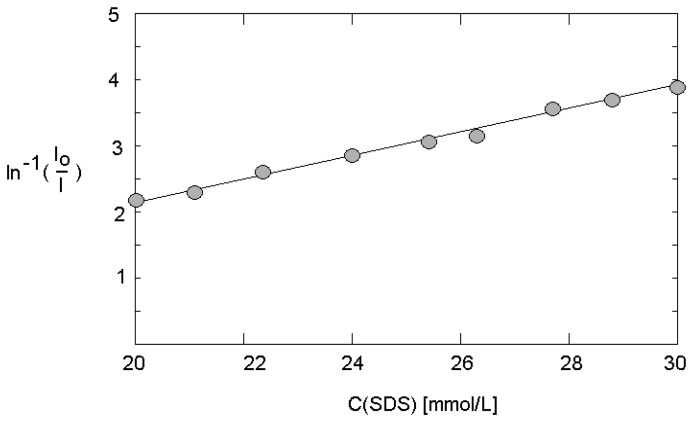
The formation and behaviour of micelles of sodium dodecylsulfate in water byuse of a static micro mixer were studied. Trisbipyridylruthenium(II) was applied asindicator dye, 9-methylanthracene was used for fluorescence quenching. All experimentswere carried out by a micro fluid arrangement with three syringe pumps, a 2 1 two-stepstatic micro mixer (IPHT Jena) and a on-line micro fluorimetry including a luminescencediode for excitation, a blue glass filter (BG 7, Linos), two edge filters (RG 630, Linos) anda photo counting module (MP 900, Perkin Elmer). It was possible to measure thefluorescence inside the PTFE tube (inner diameter 0.5 mm) directly. A linear dependenceof fluorescence intensity from dye concentration was observed in absence of quencher andsurfactant as expected. An aggregation number of about 62 was found in the flow raterange between 300 and 800 μL/min. The fluorescence intensity increases slightly, butsignificant with increasing flow rate, if no quencher is present. In the presence of quencher,the fluorescence intensity decreases with decreasing surfactant concentration and withenhanced flow rate. The strength of the flow rate effect on the fluorescence increases withdecreasing surfactant concentration. The size of micelles was determined in micro channelsby the micro fluorimetric method in analogy to the conventional system. The micellesextract the quencher from the solution and lower, this way, the quenching effect. The sizeof micelles was estimated and it could be shown, that the flow rate has only low effect onthe aggregation number at the investigated flow rates. The effect of flow rate andsurfactant concentration on the fluorescence in the presence of quencher was interpreted asa shift in the micelle concentration due to the shear forces. It is expected, that thefluorescence intensity is lowered, if more quencher molecules are molecular disperse distributed inside the solution. Obviously, the lowered fluorescence intensity at higher flow rates suggests a reduction of the micelle density causing an increase of quencher concentration outside the micelles.
研究了使用静态微混合器时十二烷基硫酸钠在水中胶束的形成和行为。使用三联吡啶钌(II)作为指示染料,9-甲基蒽用于荧光猝灭。所有实验均通过微流体装置进行,该装置包括三个注射泵、一个2×1两步静态微混合器(耶拿光子技术研究所)和一个在线微荧光测定仪,该测定仪包括一个用于激发的发光二极管、一个蓝色玻璃滤光片(BG 7,Linos)、两个边缘滤光片(RG 630,Linos)和一个光计数模块(MP 900,珀金埃尔默公司)。可以直接测量聚四氟乙烯管(内径0.5毫米)内的荧光。正如预期的那样,在没有猝灭剂和表面活性剂的情况下,观察到荧光强度与染料浓度呈线性关系。在流速为300至800微升/分钟的范围内,发现聚集数约为62。如果没有猝灭剂,荧光强度会随着流速的增加而略有但显著增加。在有猝灭剂的情况下,荧光强度随着表面活性剂浓度的降低和流速的增加而降低。流速对荧光的影响强度随着表面活性剂浓度的降低而增加。通过微荧光测定法,类似于传统系统,在微通道中测定了胶束的大小。胶束从溶液中萃取猝灭剂,从而降低猝灭效果。估计了胶束的大小,结果表明,在所研究的流速下,流速对聚集数的影响很小。在有猝灭剂的情况下,流速和表面活性剂浓度对荧光的影响被解释为由于剪切力导致胶束浓度的变化。可以预期,如果更多的猝灭剂分子分子分散地分布在溶液中,荧光强度会降低。显然,在较高流速下荧光强度的降低表明胶束密度降低,导致胶束外猝灭剂浓度增加。