Departamento de Microbiologia, Imunologia e Parasitologia, Escola Paulista de Medicina, Universidade Federal de São Paulo, São Paulo, SP, Brazil.
Laboratoire Entrée muqueuse du VIH et Immunité muqueuse, Department Infection, Immunité et Inflammation, Institut Cochin, Paris, France.
BMC Microbiol. 2017 Sep 13;17(1):195. doi: 10.1186/s12866-017-1102-7.
Outbreaks of infections caused by rapidly growing mycobacteria have been reported worldwide generally associated with medical procedures. Mycobacterium abscessus subsp. massiliense CRM0019 was obtained during an epidemic of postsurgical infections and was characterized by increased persistence in vivo. To better understand the successful survival strategies of this microorganism, we evaluated its infectivity and proliferation in macrophages (RAW and BMDM) and alveolar epithelial cells (A549). For that, we assessed the following parameters, for both M. abscessus CRM0019 as well as the reference strain M. abscessus ATCC 19977: internalization, intracellular survival for up 3 days, competence to subvert lysosome fusion and the intracellular survival after cell reinfection.
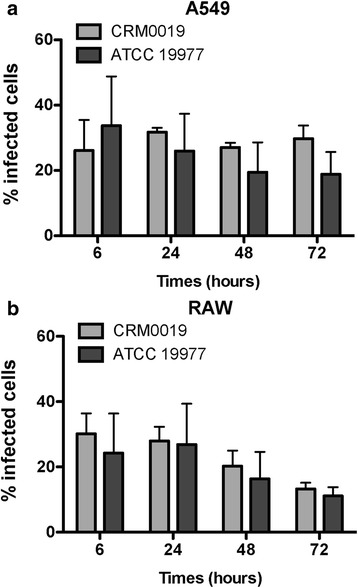
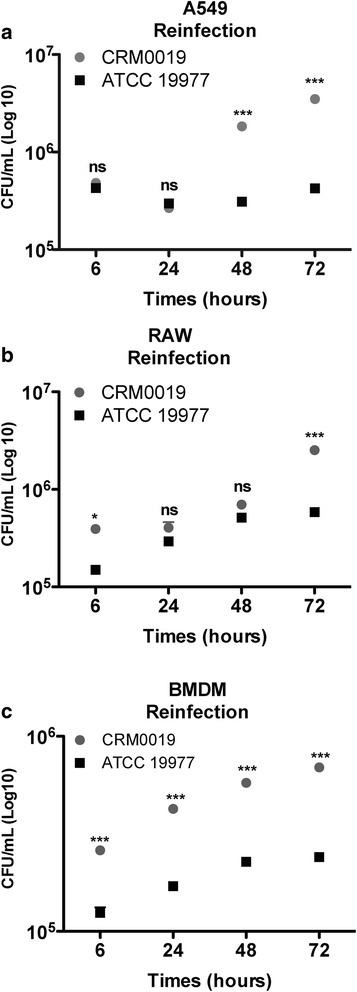
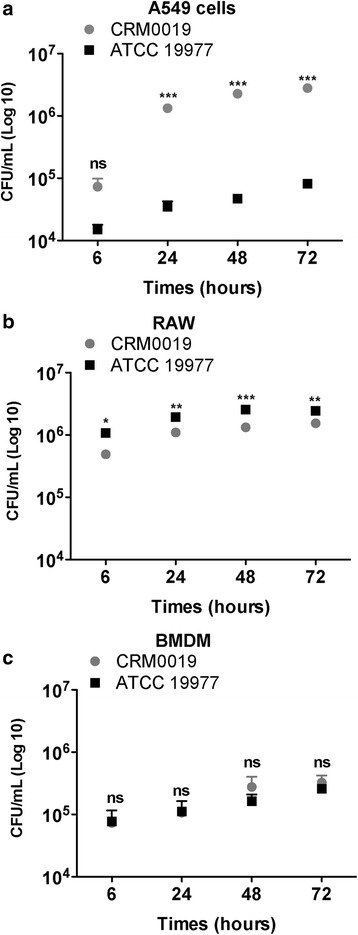
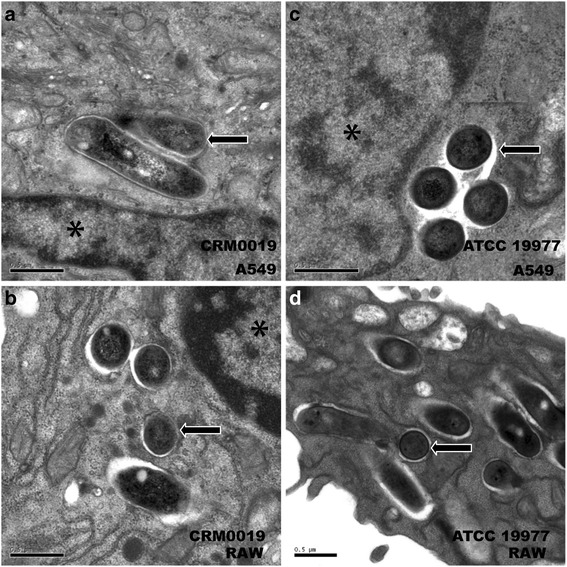
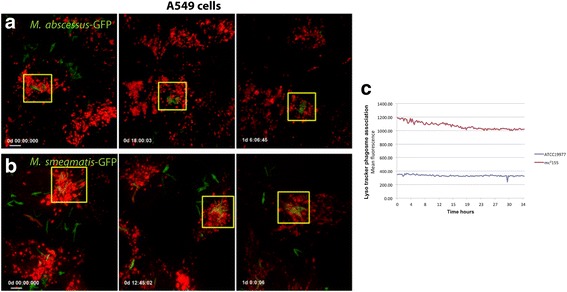
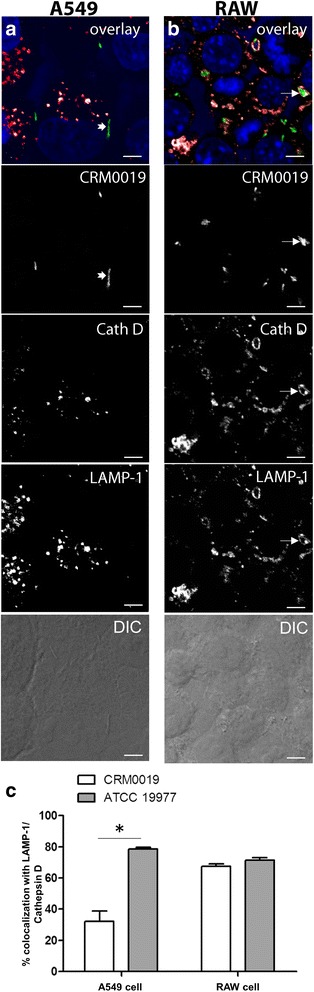
CRM0019 and ATCC 19977 strains showed the same internalization rate (approximately 30% after 6 h infection), in both A549 and RAW cells. However, colony forming units data showed that CRM0019 survived better in A549 cells than the ATCC 19977 strain. Phagosomal characteristics of CRM0019 showed the bacteria inside tight phagosomes in A549 cells, contrasting to the loosely phagosomal membrane in macrophages. This observation holds for the ATCC 19977 strain in both cell types. The competence to subvert lysosome fusion was assessed by acidification and acquisition of lysosomal protein. For M. abscessus strains the phagosomes were acidified in all cell lines; nevertheless, the acquisition of lysosomal protein was reduced by CRM0019 compared to the ATCC 19977 strain, in A549 cells. Conversely, in macrophages, both M. abscessus strains were located in mature phagosomes, however without bacterial death. Once recovered from macrophages M. abscessus could establish a new intracellular infection. Nevertheless, only CRM0019 showed a higher growth rate in A549, increasing nearly 10-fold after 48 and 72 h.
M. abscessus CRM0019 creates a protective and replicative niche in alveolar epithelial cells mainly by avoiding phagosome maturation. Once recovered from infected macrophages, CRM0019 remains infective and displays greater intracellular growth in A549 cells compared to the ATCC 19977 strain. This evasion strategy in alveolar epithelial cells may contribute to the long survival of the CRM0019 strain in the host and thus to the inefficacy of in vivo treatment.
迅速生长的分枝杆菌引起的感染爆发已在全球范围内报道,通常与医疗程序有关。分枝杆菌脓肿亚种。CRM0019 是在手术后感染的流行期间获得的,其特征是体内持续存在增加。为了更好地了解这种微生物的成功生存策略,我们评估了其在巨噬细胞(RAW 和 BMDM)和肺泡上皮细胞(A549)中的感染性和增殖能力。为此,我们评估了以下参数,对于分枝杆菌脓肿 CRM0019 和参考菌株分枝杆菌脓肿 ATCC 19977 都是如此:内化、3 天内的细胞内存活、破坏溶酶体融合的能力以及细胞再感染后的细胞内存活。
CRM0019 和 ATCC 19977 菌株在 A549 和 RAW 细胞中均显示出相同的内化率(感染后 6 小时约为 30%)。然而,菌落形成单位数据显示,CRM0019 在 A549 细胞中的存活能力优于 ATCC 19977 菌株。CRM0019 的吞噬体特征显示,在 A549 细胞中,细菌位于紧密的吞噬体中,与巨噬细胞中的松散吞噬体膜形成对比。在这两种细胞类型中,ATCC 19977 菌株也是如此。通过酸化和获得溶酶体蛋白来评估破坏溶酶体融合的能力。对于分枝杆菌属菌株,所有细胞系中的吞噬体都被酸化;然而,与 ATCC 19977 菌株相比,CRM0019 在 A549 细胞中获得的溶酶体蛋白减少。相反,在巨噬细胞中,两种分枝杆菌属菌株都位于成熟的吞噬体中,但没有细菌死亡。一旦从巨噬细胞中恢复,分枝杆菌属可以建立新的细胞内感染。然而,只有 CRM0019 在 A549 中显示出更高的生长速度,在 48 和 72 小时后增加了近 10 倍。
分枝杆菌脓肿 CRM0019 主要通过避免吞噬体成熟在肺泡上皮细胞中创造一个保护性和复制性的小生境。一旦从受感染的巨噬细胞中恢复,CRM0019 仍然具有感染力,并在 A549 细胞中比 ATCC 19977 菌株显示出更大的细胞内生长。这种在肺泡上皮细胞中的逃避策略可能有助于 CRM0019 菌株在宿主中的长期存活,从而导致体内治疗无效。