Center for Genomic Science of IIT@SEMM, Fondazione Istituto Italiano di Tecnologia (IIT), 20139 Milan, Italy.
Department of Experimental Oncology, European Institute of Oncology (IEO), 20139 Milan, Italy.
Genome Res. 2017 Oct;27(10):1658-1664. doi: 10.1101/gr.226035.117. Epub 2017 Sep 13.
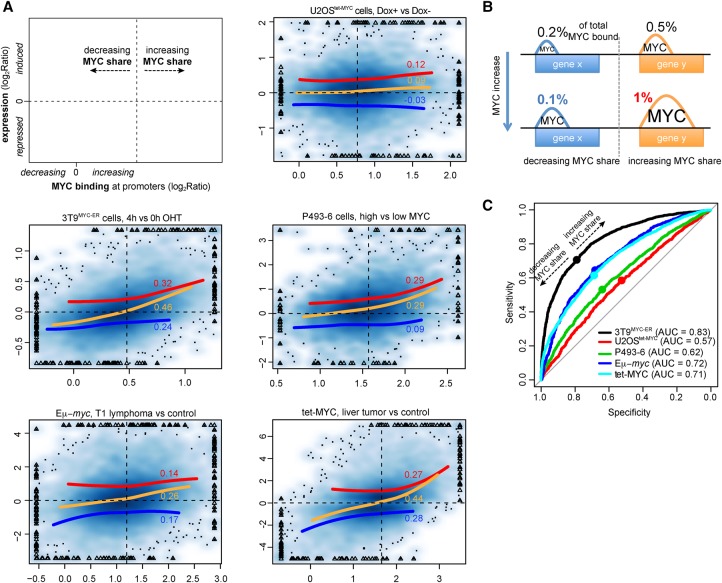
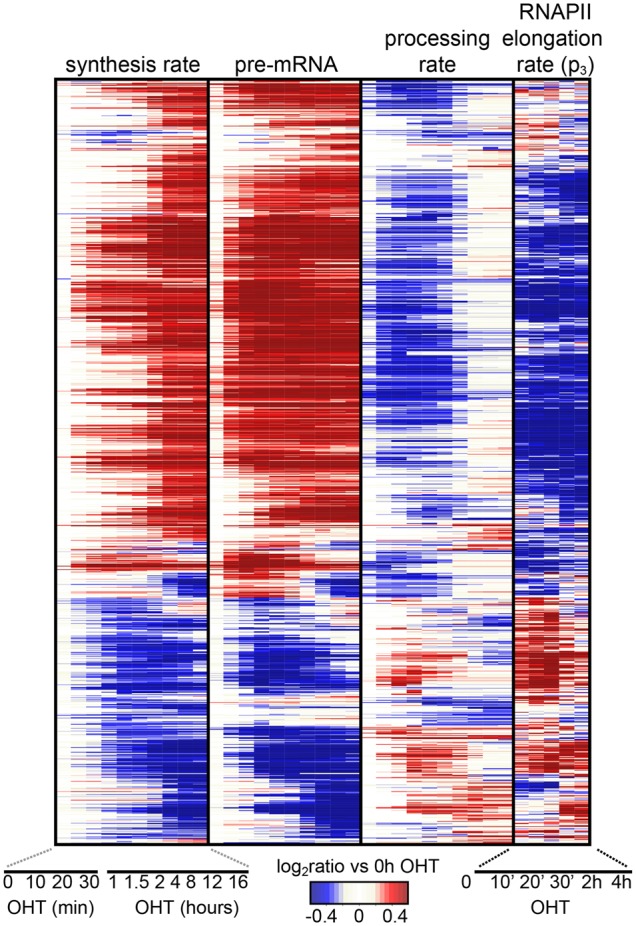
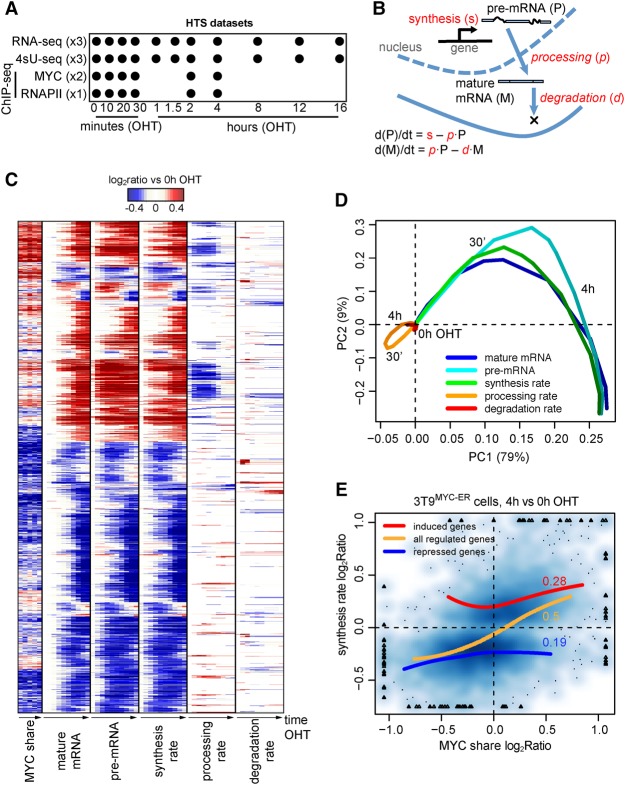
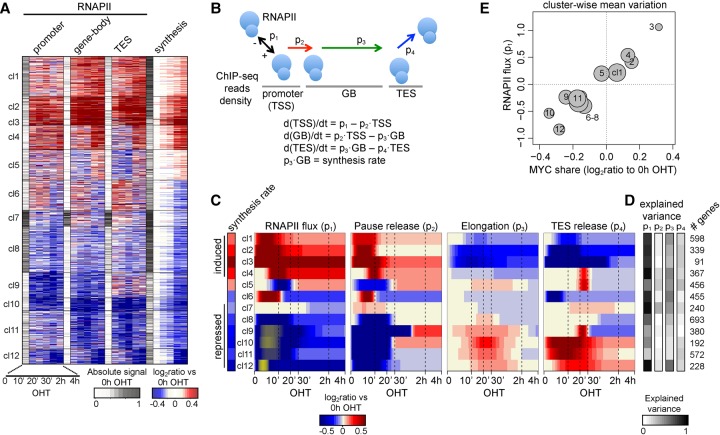
Overexpression of the MYC transcription factor causes its widespread interaction with regulatory elements in the genome but leads to the up- and down-regulation of discrete sets of genes. The molecular determinants of these selective transcriptional responses remain elusive. Here, we present an integrated time-course analysis of transcription and mRNA dynamics following MYC activation in proliferating mouse fibroblasts, based on chromatin immunoprecipitation, metabolic labeling of newly synthesized RNA, extensive sequencing, and mathematical modeling. Transcriptional activation correlated with the highest increases in MYC binding at promoters. Repression followed a reciprocal scenario, with the lowest gains in MYC binding. Altogether, the relative abundance (henceforth, "share") of MYC at promoters was the strongest predictor of transcriptional responses in diverse cell types, predominating over MYC's association with the corepressor ZBTB17 (also known as MIZ1). MYC activation elicited immediate loading of RNA polymerase II (RNAPII) at activated promoters, followed by increases in pause-release, while repressed promoters showed opposite effects. Gains and losses in RNAPII loading were proportional to the changes in the MYC share, suggesting that repression by MYC may be partly indirect, owing to competition for limiting amounts of RNAPII. Secondary to the changes in RNAPII loading, the dynamics of elongation and pre-mRNA processing were also rapidly altered at MYC regulated genes, leading to the transient accumulation of partially or aberrantly processed mRNAs. Altogether, our results shed light on how overexpressed MYC alters the various phases of the RNAPII cycle and the resulting transcriptional response.
MYC 转录因子的过表达导致其与基因组中的调控元件广泛相互作用,但导致离散基因集的上调和下调。这些选择性转录反应的分子决定因素仍然难以捉摸。在这里,我们基于染色质免疫沉淀、新合成 RNA 的代谢标记、广泛的测序和数学建模,呈现了 MYC 在增殖的小鼠成纤维细胞中被激活后转录和 mRNA 动态的综合时程分析。转录激活与 MYC 在启动子处结合的最大增加相关。抑制遵循相反的情况,MYC 结合的增益最低。总的来说,启动子处 MYC 的相对丰度(下文称为“份额”)是预测不同细胞类型转录反应的最强预测因子,超过了 MYC 与核心抑制因子 ZBTB17(也称为 MIZ1)的关联。MYC 激活在激活的启动子处立即引发 RNA 聚合酶 II(RNAPII)的加载,随后增加暂停释放,而受抑制的启动子则显示相反的效果。RNAPII 加载的增加和减少与 MYC 份额的变化成正比,这表明 MYC 的抑制可能部分是间接的,因为它与有限数量的 RNAPII 竞争。其次,由于 RNAPII 加载的变化,在 MYC 调节的基因中,伸长和前体 mRNA 加工的动力学也迅速改变,导致部分或异常加工的 mRNA 短暂积累。总的来说,我们的结果阐明了过表达的 MYC 如何改变 RNAPII 周期的各个阶段以及由此产生的转录反应。