Nielsen Anne L, Fleischer Shelby, Hamilton George C, Hancock Tori, Krawczyk Gregorz, Lee Jana C, Ogburn Emily, Pote John M, Raudenbush Amy, Rucker Ann, Saunders Michael, Skillman Victoria P, Sullivan Jeanne, Timer Jody, Walgenbach James, Wiman Nik G, Leskey Tracy C
Department of Entomology Rutgers University New Brunswick NJ USA.
Department of Entomology Pennsylvania State University University Park PA USA.
Ecol Evol. 2017 Jul 21;7(17):6680-6690. doi: 10.1002/ece3.3125. eCollection 2017 Sep.
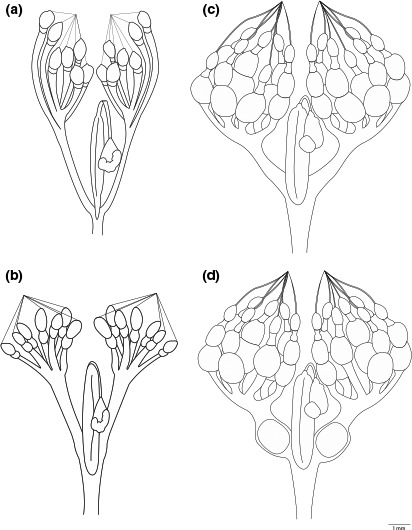
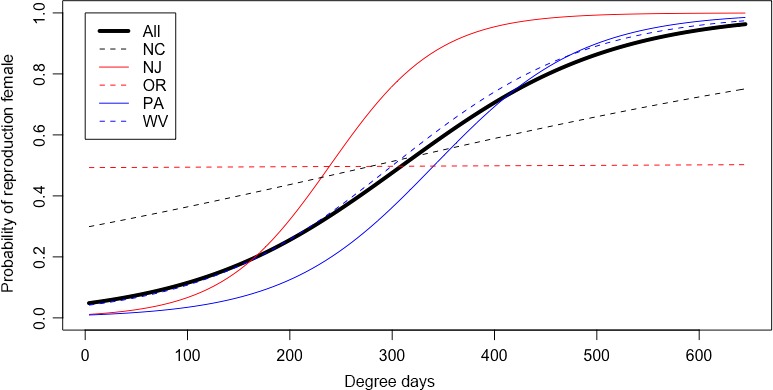
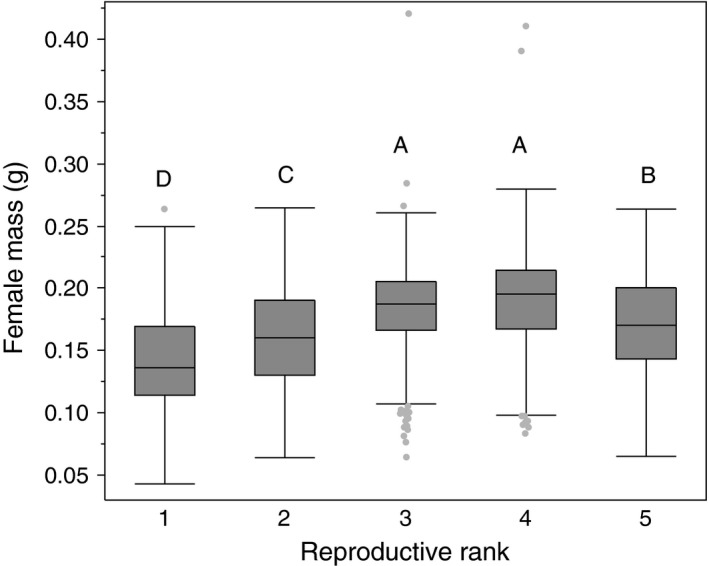
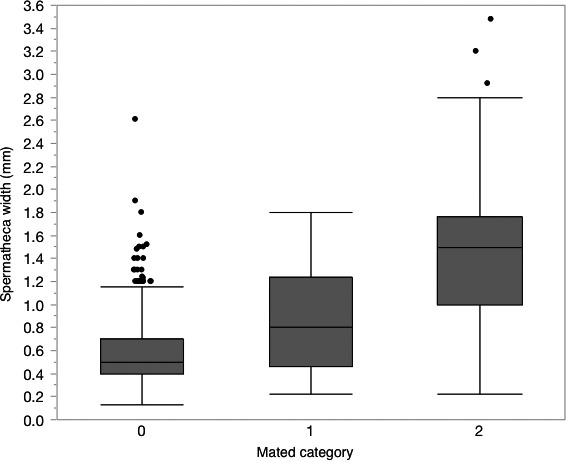
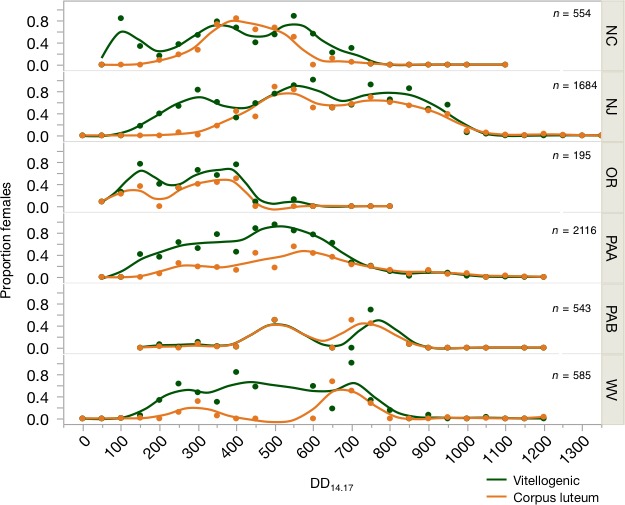
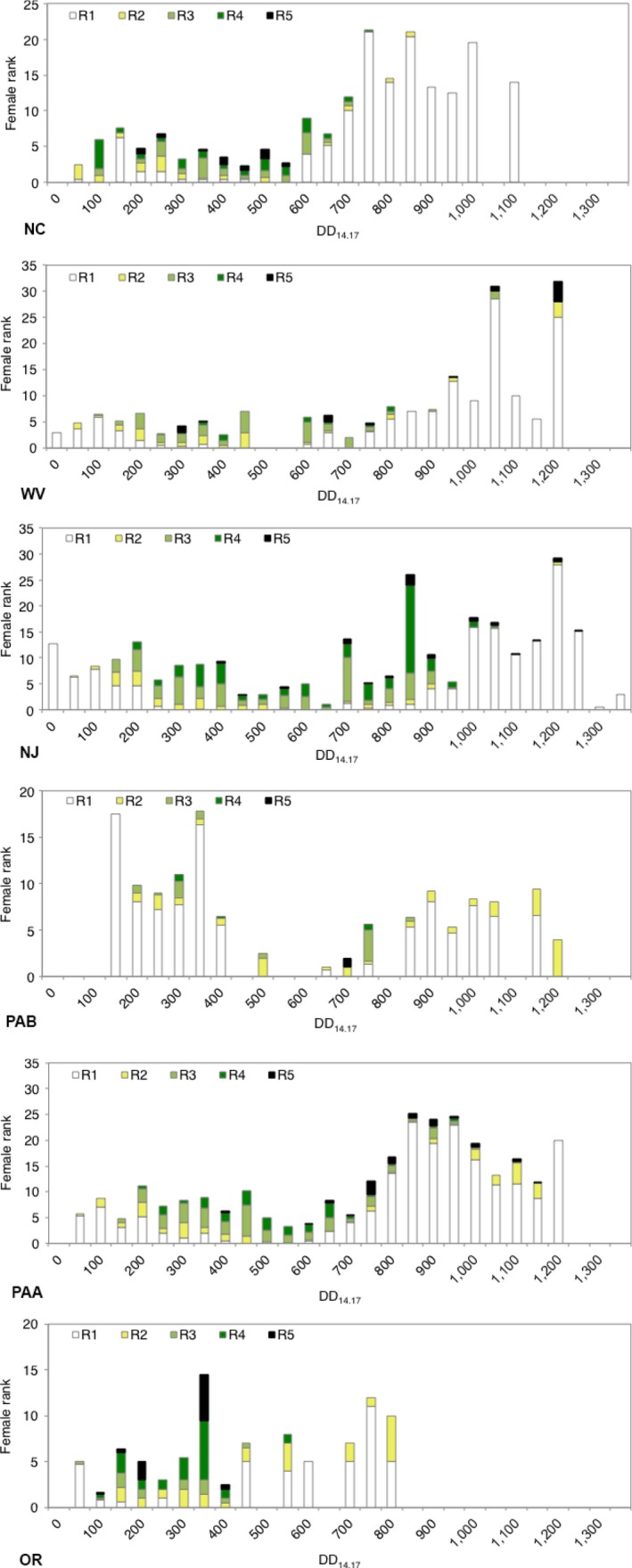
Temperature-based degree-day models describe insect seasonality and to predict key phenological events. We expand on the use of a temperature-based process defining timing of reproduction through the incorporation of female reproductive physiology for the invasive pentatomid species the brown marmorated stink bug. A five-stage ranking system based on ovary development was able to distinguish between the reproductive statuses of field-collected females. Application of this ranking method described aspects of ' seasonality, overwintering biology, and phenology across geographic locations. Female were collected in the US from NJ, WV, NC, OR, and two sites in PA in 2006-2008 (Allentown, PA only) and 2012-2014. Results identify that enters reproductive diapause in temperate locations in the fall and that a delay occurs in developmental maturity after diapause termination in the spring. Modification of the Snyder method to identify biofix determined 12.7-hr photoperiod as the best fit to define initiation of reproduction in the spring. Applying the biofix, we demonstrated significant differences between locations for the rate at which the overwintering generation transition into reproductive status and the factors contributing to this difference require further study. For example, after including abiotic variables influencing development such as temperature and photoperiod (critical diapause cue), reproduction occurred earlier in OR and for an extended period in NJ. This data describe a method to investigate insect seasonality by incorporating physiological development across multiple regions that can clarify phenology for insects with overlapping generations.
基于温度的度日模型描述昆虫的季节性并预测关键物候事件。我们通过纳入入侵的蝽象物种——褐纹蝽象的雌虫生殖生理学,扩展了基于温度的过程的应用,该过程定义了繁殖时间。基于卵巢发育的五阶段分级系统能够区分野外采集雌虫的生殖状态。这种分级方法的应用描述了不同地理位置的季节性、越冬生物学和物候学方面的情况。2006 - 2008年(仅宾夕法尼亚州的阿伦敦)以及2012 - 2014年,在美国新泽西州、西弗吉尼亚州、北卡罗来纳州、俄勒冈州以及宾夕法尼亚州的两个地点采集了雌虫。结果表明,该昆虫在秋季温带地区进入生殖滞育,并且在春季滞育结束后发育成熟出现延迟。对斯奈德方法进行修改以确定生物固定点,确定12.7小时光周期最适合定义春季繁殖的开始。应用该生物固定点,我们证明了越冬代转变为生殖状态的速率在不同地点之间存在显著差异,导致这种差异的因素需要进一步研究。例如,在纳入影响发育的非生物变量如温度和光周期(关键滞育线索)后,俄勒冈州的繁殖发生得更早,新泽西州的繁殖持续时间更长。这些数据描述了一种通过纳入多个地区的生理发育来研究昆虫季节性的方法,该方法可以阐明具有重叠世代的昆虫的物候学。