Watson Andrew, Brickson Stacey, Brooks M Alison, Dunn Warren
Department of Orthopedics, University of Wisconsin School of Medicine and Public Health, Madison, Wisconsin, USA.
Orthop J Sports Med. 2017 Sep 5;5(9):2325967117726976. doi: 10.1177/2325967117726976. eCollection 2017 Sep.
Although preseason aerobic fitness has been suggested as a modifiable risk factor for injury in adult athletes, the relationship between aerobic fitness, injury, and illness in youth athletes is unknown.
To determine whether preseason aerobic fitness predicts in-season injury and illness risk in female adolescent soccer players.
Case-control study; Level of evidence, 3.
Fifty-four female adolescent soccer players underwent preseason evaluation to determine years of experience, body mass index (BMI), maximal aerobic capacity (VO), and time to exhaustion (T) during cycle ergometer testing. All injuries and illnesses during the subsequent 20-week season were recorded. Variables were compared between individuals with and without a self-reported injury and individuals with and without a self-reported illness. Separate Poisson regression models were developed to predict number of injuries and illnesses for each individual by use of age, years of experience, BMI, VO, and T
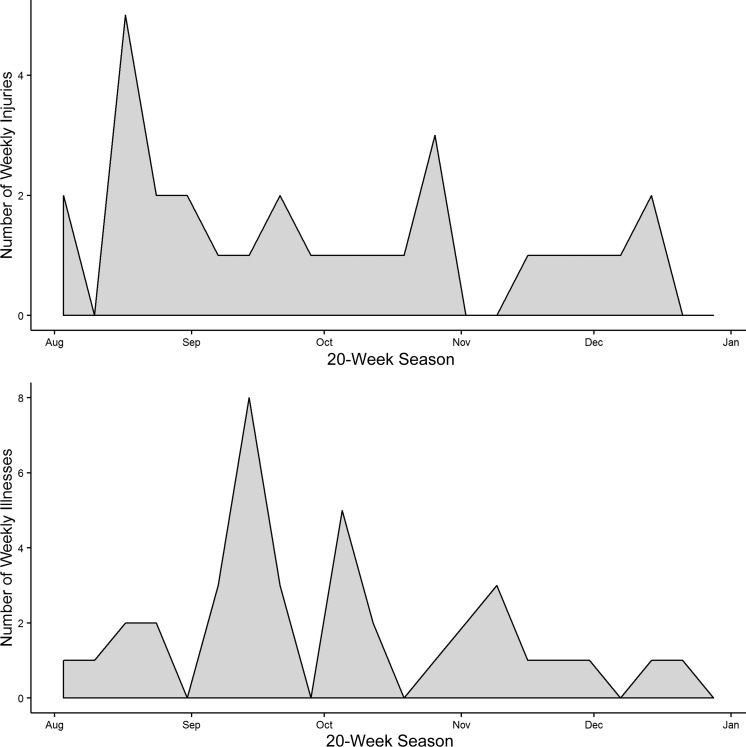
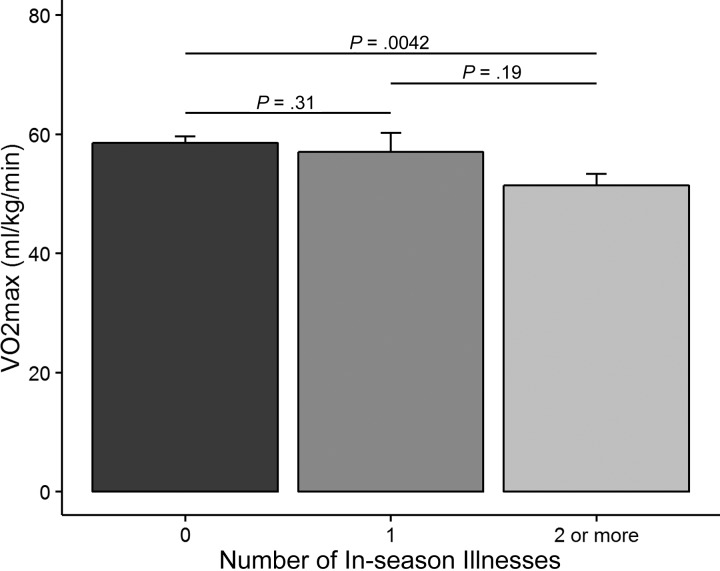
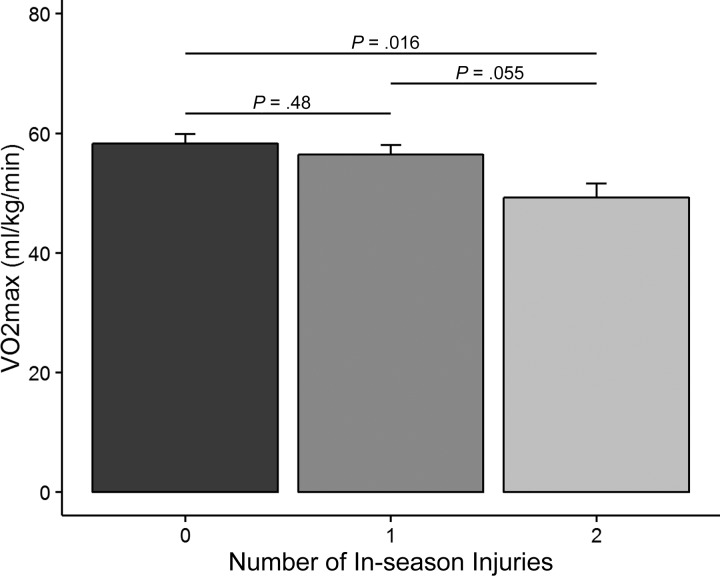
Twenty-eight injuries and 38 illnesses in 23 individuals were recorded during the season. Although not a statistically significant finding, individuals who reported an in-season injury had lower VO than those who did not (54.9 ± 7.3 vs 58.3 ± 8.5 mL/kg/min, = .13). Individuals who reported an illness had significantly lower VO than those who did not (54.5 ± 9.9 vs 58.8 ± 6.2 mL/kg/min, = .014). With the Poisson regression models, VO was a significant predictor of both injury (odds ratio [OR], 0.95; = .046) and illness (OR, 0.94; = .009), while no significant relationships were identified between injury or illness and age, years of experience, T, or BMI (all > .05).
Among adolescent female soccer players, greater preseason aerobic fitness is associated with a reduced risk of in-season injury and illness. Off-season intervention to promote aerobic fitness may help reduce the risk of lost time during the season due to injury and illness.
尽管季前有氧适能已被认为是成年运动员受伤的一个可改变的风险因素,但青少年运动员的有氧适能、受伤和患病之间的关系尚不清楚。
确定季前有氧适能是否能预测青少年女子足球运动员的赛季内受伤和患病风险。
病例对照研究;证据等级,3级。
54名青少年女子足球运动员接受季前评估,以确定其比赛年限、体重指数(BMI)、最大有氧能力(VO)以及在自行车测力计测试中的力竭时间(T)。记录随后20周赛季中的所有受伤和患病情况。比较有自我报告受伤和无自我报告受伤的个体之间以及有自我报告患病和无自我报告患病的个体之间的变量。通过使用年龄、比赛年限、BMI、VO和T,建立单独的泊松回归模型来预测每个个体的受伤和患病数量。
赛季期间共记录了23名个体的28次受伤和38次患病情况。尽管这不是一个具有统计学意义的发现,但报告赛季内受伤的个体的VO低于未受伤个体(54.9±7.3 vs 58.3±8.5 mL/kg/min,P = 0.13)。报告患病的个体的VO显著低于未患病个体(54.5±9.9 vs 58.8±6.2 mL/kg/min,P = 0.014)。在泊松回归模型中,VO是受伤(优势比[OR],0.95;P = 0.046)和患病(OR,0.94;P = 0.009)的显著预测因素,而未发现受伤或患病与年龄、比赛年限、T或BMI之间存在显著关系(所有P>0.05)。
在青少年女子足球运动员中,更高的季前有氧适能与赛季内受伤和患病风险降低相关。在休赛期进行促进有氧适能的干预可能有助于降低因受伤和患病而导致的赛季内失时风险。