Bekkali Noor L H, Hoekman Daniël R, Liem Olivia, Bongers Marloes E J, van Wijk Michiel P, Zegers Bas, Pelleboer Rolf A, Verwijs Wim, Koot Bart G P, Voropaiev Maksym, Benninga Marc A
Department of Pediatric Gastroenterology and Nutrition, Academic Medical Center, Amsterdam.
Department of Pediatrics, Máxima Medical Center, Veldhoven.
J Pediatr Gastroenterol Nutr. 2018 Jan;66(1):10-15. doi: 10.1097/MPG.0000000000001726.
The long-term efficacy and safety of polyethylene glycol (PEG) in constipated children are unknown, and a head-to-head comparison of the different PEG formulations is lacking. We aimed to investigate noninferiority of PEG3350 with electrolytes (PEG3350 + E) compared to PEG4000 without electrolytes (PEG4000).
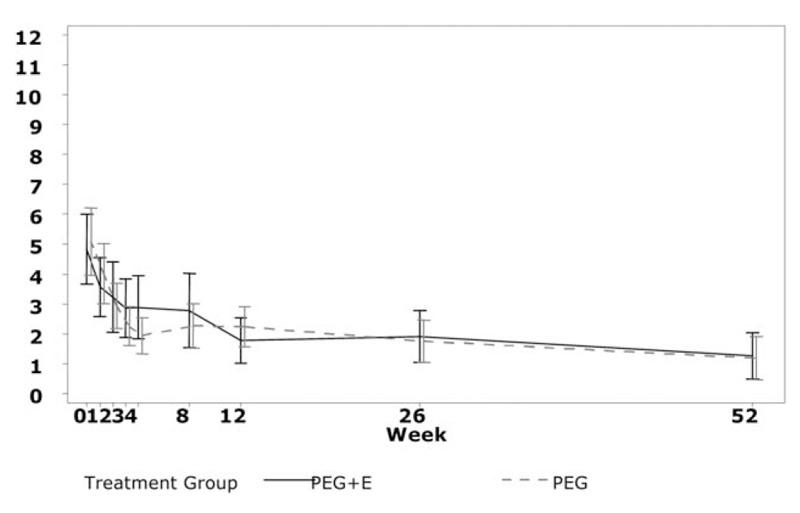
In this double-blind trial, children aged 0.5 to 16 years with constipation, defined as a defecation frequency of <3 times per week, were randomized to receive either PEG3350 + E or PEG4000. Primary outcomes were change in total sum score (TSS) at week 52 compared to baseline, and dose range determination. TSS was the sum of the severity of 5 constipation symptoms rated on a 4-point scale (0-3). Noninferiority margin was a difference in TSS of ≤1.5 based on a 95%-confidence interval [CI]. Treatment success was defined as a defecation frequency of ≥3 per week with <1 episode of fecal incontinence.
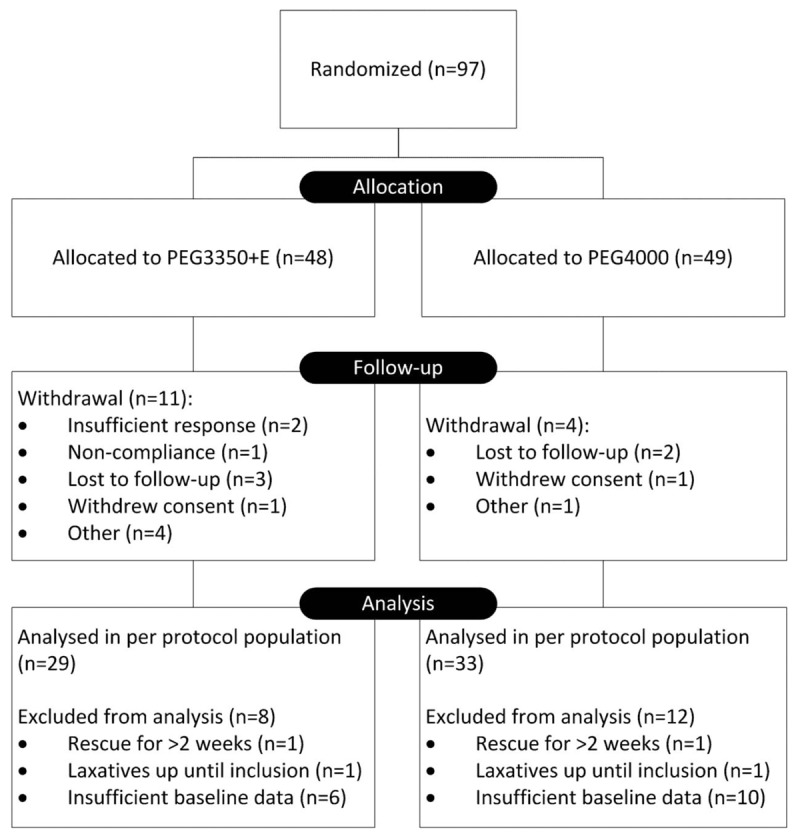
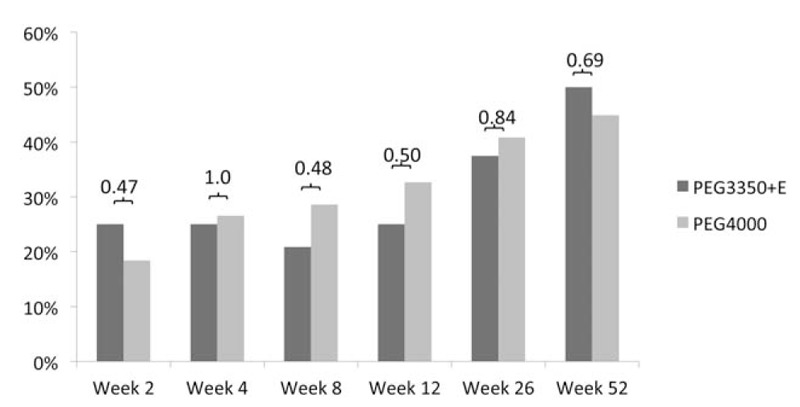
Ninety-seven subjects were included, of whom 82 completed the study. Mean reduction in TSS was -3.81 (95% CI: -4.96 to -2.65) and -3.74 (95%CI: -5.08 to -2.40), for PEG3350 + E and PEG4000, respectively. Noninferiority criteria were not met (maximum difference between groups: -1.81 to 1.68). Daily sachet use was: 0 to 2 years: 0.4 to 2.3 and 0.9 to 2.1; 2 to 4 years: 0.1 to 3.5 and 1.2 to 3.2; 4 to 8 years: 1.1 to 2.8 and 0.7 to 3.8; 8 to 16 years 0.6 to 3.7 and 1.0 to 3.7, in PEG3350 + E and PEG4000, respectively. Treatment success after 52 weeks was achieved in 50% and 45% of children, respectively (P = 0.69). Rates of adverse events were similar between groups, and no drug-related serious adverse events occurred.
Noninferiority regarding long-term constipation-related symptoms of PEG3350 + E compared to PEG4000 was not demonstrated. However, analysis of secondary outcomes suggests similar efficacy and safety of these agents.
聚乙二醇(PEG)用于便秘儿童的长期疗效和安全性尚不清楚,且缺乏不同PEG制剂的直接对比研究。我们旨在研究含电解质的PEG3350(PEG3350+E)与不含电解质的PEG4000相比的非劣效性。
在这项双盲试验中,将年龄在0.5至16岁、排便频率<每周3次(即便秘)的儿童随机分为两组,分别接受PEG3350+E或PEG4000治疗。主要结局指标为第52周时与基线相比的总分(TSS)变化以及剂量范围确定。TSS是对5种便秘症状的严重程度按4分制(0-3分)进行评分后的总和。基于95%置信区间[CI],非劣效性界值为TSS差异≤1.5。治疗成功定义为每周排便频率≥3次且大便失禁发作次数<1次。
共纳入97名受试者,其中82名完成了研究。PEG3350+E组和PEG4000组的TSS平均降低值分别为-3.81(95%CI:-4.96至-2.65)和-3.74(95%CI:-5.08至-2.40)。未达到非劣效性标准(两组间最大差异:-1.81至1.68)。PEG3350+E组和PEG4000组每日小包使用量分别为:0至2岁:0.4至2.3包和0.9至2.1包;2至4岁:0.1至3.5包和1.2至3.2包;4至8岁:1.1至2.8包和0.7至3.8包;8至16岁:0.6至3.7包和1.0至3.7包。52周后,分别有50%和45%的儿童治疗成功(P=0.69)。两组不良事件发生率相似,且未发生与药物相关的严重不良事件。
未证明PEG3350+E与PEG4000相比在长期便秘相关症状方面具有非劣效性。然而,对次要结局指标的分析表明这两种药物具有相似的疗效和安全性。