Soma-Pillay P, Louw M C, Adeyemo A O, Makin J, Pattinson R C
Cardiac Obstetric Unit, Department of Obstetrics and Gynaecology, University of Pretoria, Steve Biko Academic Hospital, Pretoria, South Africa; South African Medical Research Council; Maternal and Infant Health Care Strategies Unit, Department of Obstetrics and Gynaecology, University of Pretoria, Pretoria, South Africa. Email:
Department of Cardiology, University of Pretoria, Steve Biko Academic Hospital, Pretoria, South Africa.
Cardiovasc J Afr. 2018;29(1):26-31. doi: 10.5830/CVJA-2017-031. Epub 2017 Aug 31.
Pre-eclampsia is associated with significant changes to the cardiovascular system during pregnancy. Eccentric and concentric remodelling of the left ventricle occurs, resulting in impaired contractility and diastolic dysfunction. It is unclear whether these structural and functional changes resolve completely after delivery.
The objective of the study was to determine cardiac diastolic function at delivery and one year post-partum in women with severe pre-eclampsia, and to determine possible future cardiovascular risk.
This was a descriptive study performed at Steve Biko Academic Hospital, a tertiary referral hospital in Pretoria, South Africa. Ninety-six women with severe preeclampsia and 45 normotensive women with uncomplicated pregnancies were recruited during the delivery admission. Seventy-four (77.1%) women in the pre-eclamptic group were classified as a maternal near miss. Transthoracic Doppler echocardiography was performed at delivery and one year post-partum.
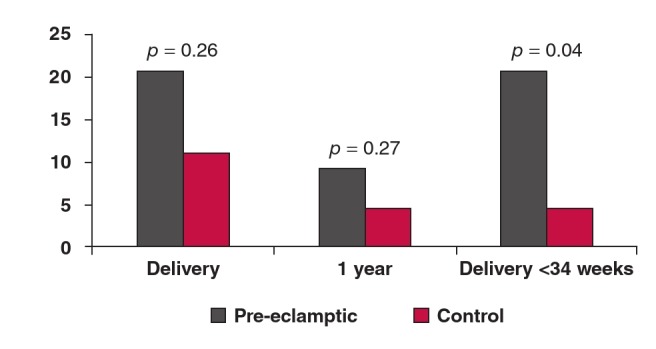
At one year post-partum, women with pre-eclampsia had a higher diastolic blood pressure (p = 0.001) and body mass index (p = 0.02) than women in the normotensive control group. Women with early onset pre-eclampsia requiring delivery prior to 34 weeks' gestation had an increased risk of diastolic dysfunction at one year post-partum (RR 3.41, 95% CI: 1.11-10.5, p = 0.04) and this was irrespective of whether the patient had chronic hypertension or not.
Women who develop early-onset pre-eclampsia requiring delivery before 34 weeks are at a significant risk of developing cardiac diastolic dysfunction one year after delivery compared to normotensive women with a history of a low-risk pregnancy.
子痫前期与孕期心血管系统的显著变化相关。左心室发生离心性和向心性重塑,导致收缩功能受损和舒张功能障碍。尚不清楚这些结构和功能变化在分娩后是否会完全恢复。
本研究的目的是确定重度子痫前期女性在分娩时及产后一年的心脏舒张功能,并确定未来可能的心血管风险。
这是一项在南非比勒陀利亚的三级转诊医院史蒂夫·比科学术医院进行的描述性研究。在分娩入院期间招募了96名重度子痫前期女性和45名血压正常且妊娠无并发症的女性。子痫前期组中有74名(77.1%)女性被归类为孕产妇接近死亡病例。在分娩时及产后一年进行经胸多普勒超声心动图检查。
产后一年,子痫前期女性的舒张压(p = 0.001)和体重指数(p = 0.02)高于血压正常的对照组女性。早发型子痫前期且在妊娠34周前需要分娩的女性在产后一年发生舒张功能障碍的风险增加(相对危险度3.41,95%置信区间:1.11-10.5,p = 0.04),且无论患者是否患有慢性高血压。
与有低风险妊娠史的血压正常女性相比,发生早发型子痫前期且在34周前需要分娩的女性在产后一年发生心脏舒张功能障碍的风险显著增加。