University of Amsterdam, Van 't Hoff Institute for Molecular Sciences (HIMS) , Science Park 904, 1098 XH Amsterdam, The Netherlands.
Anal Chem. 2017 Oct 17;89(20):10769-10775. doi: 10.1021/acs.analchem.7b01937. Epub 2017 Oct 6.
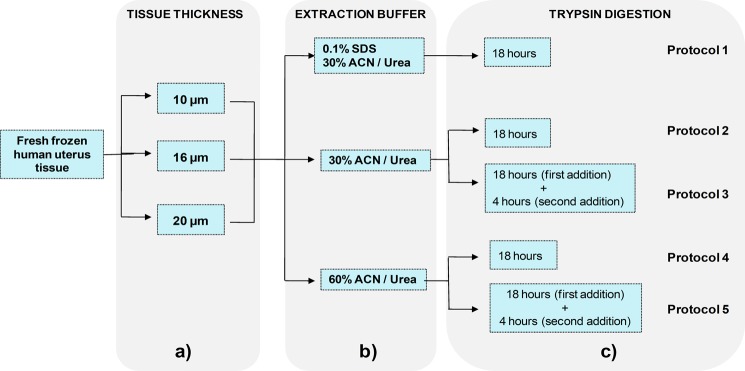
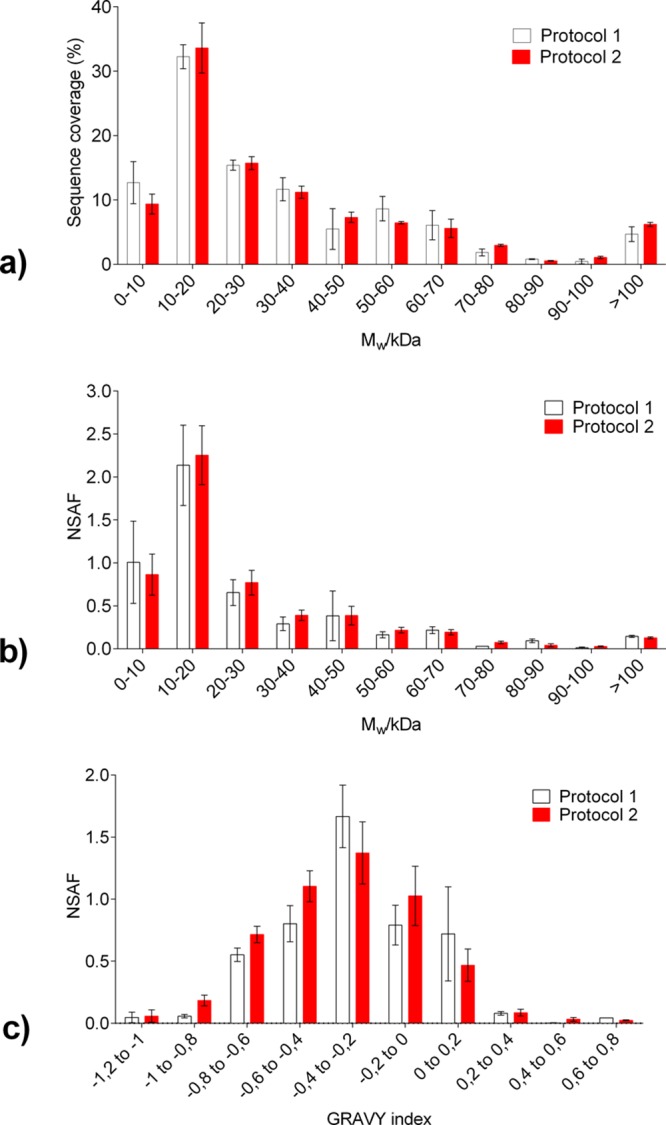
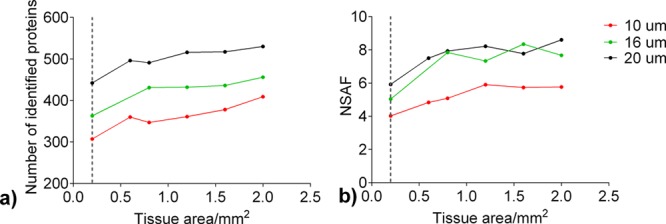
Human tissues are an important link between organ-specific spatial molecular information, patient pathology, and patient treatment options. However, patient tissues are uniquely obtained by time and location, and limited in their availability and size. Currently, little knowledge exists about appropriate and simplified protocols for routine MS-based analysis of the various types and sizes of tissues. Following standard procedures used in pathology, we selected small fresh frozen uterine tissue samples to investigate how the tissue preparation protocol affected the subsequent proteomics analysis. First, we observed that protein extraction with 0.1% SDS followed by extraction with a 30% ACN/urea resulted in a decrease in the number of identified proteins, when compared to extraction with 30% ACN/urea only. The decrease in the number of proteins was approximately 55% and 20%, for 10 and 16 μm thick tissue, respectively. Interestingly, the relative abundance of the proteins shared between the two methods was higher when SDS/ACN/urea was used, compared to the 30% ACN/urea extraction, indicating the role of SDS to be beneficial for protein solubility. Second, the influence of tissue thickness was investigated by comparing the results obtained for 10, 16, and 20 μm thick (1 mm) tissue using urea/30% ACN. We observed an increase in the number of identified proteins and corresponding quantity with an increase in the tissue thickness. Finally, by analyzing very small amounts of tissues (∼0.2 mm) of 10, 16, and 20 μm thickness, we observed that the increase in tissue thickness resulted in a higher number of protein identifications and corresponding quantitative values.
人体组织是连接特定器官的空间分子信息、患者病理和患者治疗方案的重要环节。然而,患者组织是通过时间和地点独特获得的,其可用性和规模有限。目前,对于基于 MS 的各种类型和大小的组织的常规分析,几乎没有关于适当简化方案的知识。我们遵循病理学中使用的标准程序,选择了小的新鲜冷冻子宫组织样本,以研究组织准备方案如何影响随后的蛋白质组学分析。首先,我们观察到,与仅用 30% ACN/脲提取相比,用 0.1% SDS 提取后再用 30% ACN/脲提取,会导致鉴定的蛋白质数量减少。对于 10 和 16 μm 厚的组织,蛋白质数量的减少分别约为 55%和 20%。有趣的是,当 SDS/ACN/urea 用于提取时,两种方法之间共享的蛋白质的相对丰度更高,表明 SDS 对蛋白质溶解度有益。其次,通过比较用尿素/30% ACN 对 10、16 和 20 μm 厚(1 mm)组织获得的结果,研究了组织厚度的影响。我们观察到随着组织厚度的增加,鉴定的蛋白质数量和相应的数量增加。最后,通过分析厚度约为 0.2 mm 的 10、16 和 20 μm 的非常小的组织量,我们观察到组织厚度的增加导致鉴定的蛋白质数量和相应的定量值增加。