Target Discovery Institute, Nuffield Department of Medicine , University of Oxford , Roosevelt Drive , Oxford , OX3 7FZ , U.K.
Academic Unit of Neuropathology, Nuffield Department of Clinical Neurosciences , University of Oxford, John Radcliffe Hospital , Oxford , OX3 9DU , U.K.
J Proteome Res. 2019 Apr 5;18(4):1787-1795. doi: 10.1021/acs.jproteome.8b00981. Epub 2019 Feb 25.
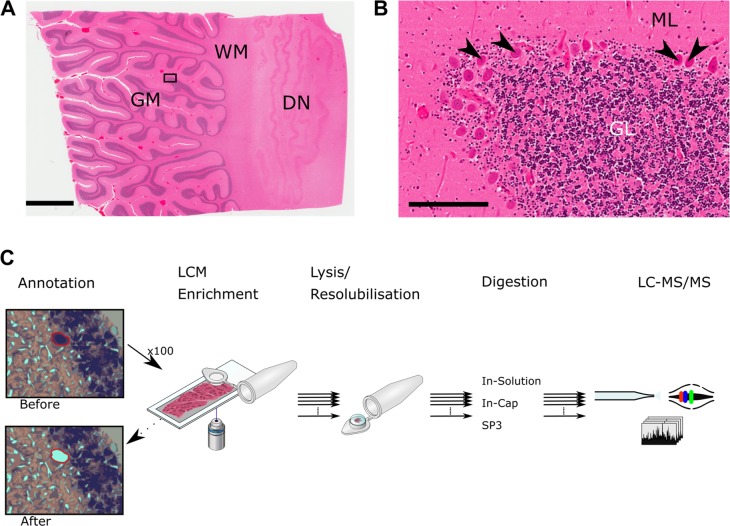
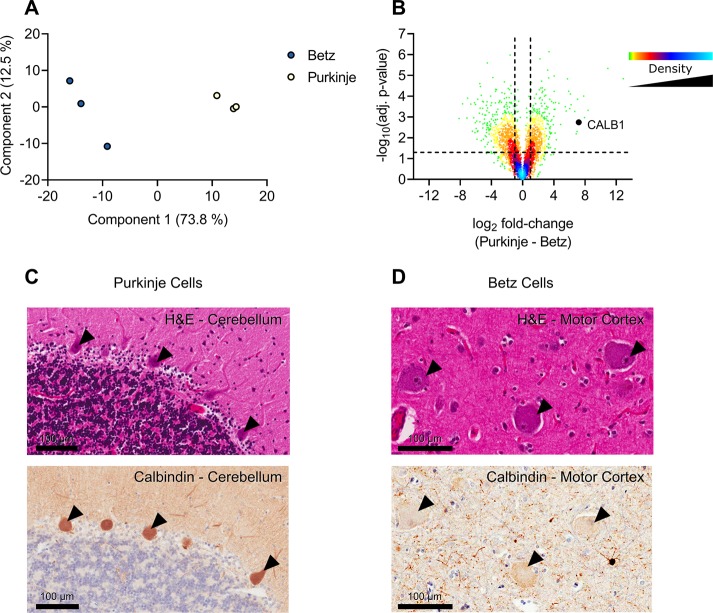
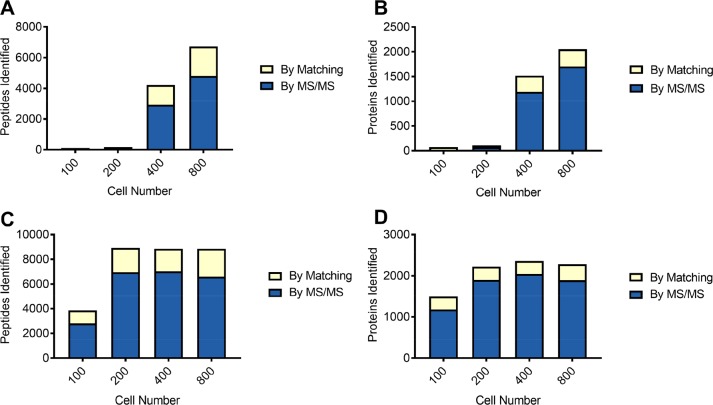
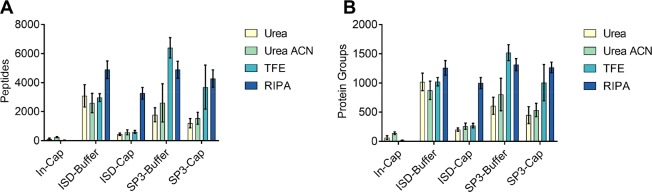
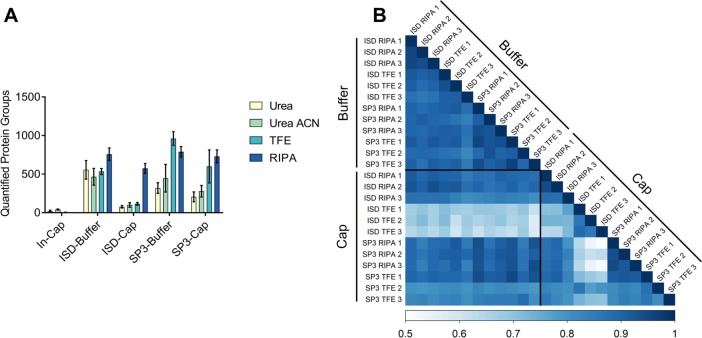
While nearly comprehensive proteome coverage can be achieved from bulk tissue or cultured cells, the data usually lacks spatial resolution. As a result, tissue based proteomics averages protein abundance across multiple cell types and/or localizations. With proteomics platforms lacking sensitivity and throughput to undertake deep single-cell proteome studies in order to resolve spatial or cell type dependent protein expression gradients within tissue, proteome analysis has been combined with sorting techniques to enrich for certain cell populations. However, the spatial resolution and context is lost after cell sorting. Here, we report an optimized method for the proteomic analysis of neurons isolated from post-mortem human brain by laser capture microdissection (LCM). We tested combinations of sample collection methods, lysis buffers and digestion methods to maximize the number of identifications and quantitative performance, identifying 1500 proteins from 60 000 μm of 10 μm thick cerebellar molecular layer with excellent reproducibility. To demonstrate the ability of our workflow to resolve cell type specific proteomes within human brain tissue, we isolated sets of individual Betz and Purkinje cells. Both neuronal cell types are involved in motor coordination and were found to express highly specific proteomes to a depth of 2800 to 3600 proteins.
虽然从组织或培养细胞中可以实现近乎全面的蛋白质组覆盖,但数据通常缺乏空间分辨率。因此,基于组织的蛋白质组学在多个细胞类型和/或定位上平均蛋白质丰度。由于蛋白质组学平台缺乏灵敏度和通量来进行深入的单细胞蛋白质组研究,以解决组织内的空间或细胞类型依赖性蛋白质表达梯度,蛋白质组分析已与分选技术相结合,以富集某些细胞群体。然而,在细胞分选后,空间分辨率和背景会丢失。在这里,我们报告了一种通过激光捕获显微切割 (LCM) 从死后人脑分离神经元进行蛋白质组分析的优化方法。我们测试了样品收集方法、裂解缓冲液和消化方法的组合,以最大限度地提高鉴定数量和定量性能,从 10 μm 厚小脑分子层的 60000 μm 中鉴定出 1500 种蛋白质,具有极好的重现性。为了证明我们的工作流程能够解析人脑组织中特定细胞类型的蛋白质组,我们分离了一组单个贝茨和浦肯野细胞。这两种神经元细胞类型都参与运动协调,并且发现它们表达高度特异性的蛋白质组,深度为 2800 到 3600 种蛋白质。