Le Nguyen Tu Dang, Dinh Pham Luyen, Quang Vo Trung
Department of Pharmacy Administration, Faculty of Pharmacy, University of Medicine and Pharmacy at Ho Chi Minh City, Vietnam.
Diabetes Metab Syndr Obes. 2017 Aug 29;10:363-374. doi: 10.2147/DMSO.S145152. eCollection 2017.
According to the International Diabetes Federation, total global health care expenditures for diabetes tripled between 2003 and 2013 because of increases in the number of people with diabetes as well as in the average expenditures per patient. This study aims to provide accurate and timely information about the economic impacts of type 2 diabetes mellitus (T2DM) in Vietnam.
The cost-of-illness estimates followed a prospective, prevalence-based approach from the societal perspective of T2DM with 392 selected diabetic patients who received treatment from a public hospital in Ho Chi Minh City, Vietnam, during the 2016 fiscal year.
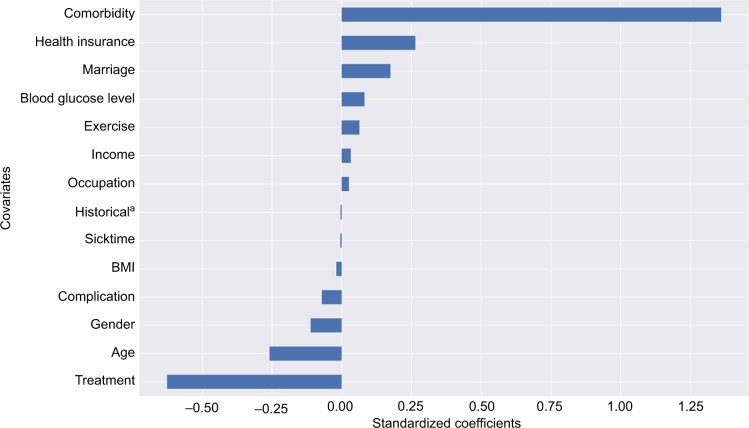
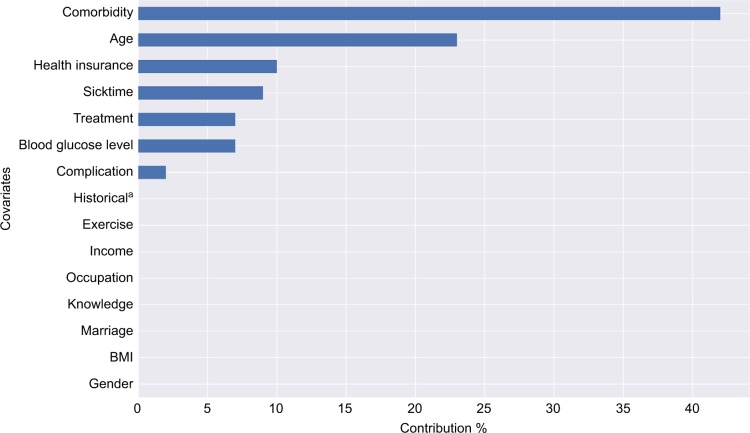
In this study, the annual cost per patient estimate was US $246.10 (95% CI 228.3, 267.2) for 392 patients, which accounted for about 12% (95% CI 11, 13) of the gross domestic product per capita in 2017. That includes US $127.30, US $34.40 and US $84.40 for direct medical costs, direct nonmedical expenditures, and indirect costs, respectively. The cost of pharmaceuticals accounted for the bulk of total expenditures in our study (27.5% of total costs and 53.2% of direct medical costs). A bootstrap analysis showed that female patients had a higher cost of treatment than men at US $48.90 (95% CI 3.1, 95.0); those who received insulin and oral antidiabetics (OAD) also had a statistically significant higher cost of treatment compared to those receiving OAD, US $445.90 (95% CI 181.2, 690.6). The Gradient Boosting Regression (Ensemble method) and Lasso Regression (Generalized Linear Models) were determined to be the best models to predict the cost of T2DM (=65.3, mean square error [MSE]=0.94; and =64.75, MSE=0.96, respectively).
The findings of this study serve as a reference for policy decision making in diabetes management as well as adjustment of costs for patients in order to reduce the economic impact of the disease.
根据国际糖尿病联盟的数据,由于糖尿病患者数量增加以及每位患者平均支出增加,2003年至2013年间全球糖尿病医疗保健总支出增长了两倍。本研究旨在提供有关越南2型糖尿病(T2DM)经济影响的准确及时信息。
疾病成本估算采用前瞻性、基于患病率的方法,从社会角度对T2DM进行研究,选取了2016财年在越南胡志明市一家公立医院接受治疗的392名糖尿病患者。
在本研究中,392名患者的人均年度成本估计为246.10美元(95%置信区间228.3,267.2),约占2017年人均国内生产总值的12%(95%置信区间11,13)。其中直接医疗成本、直接非医疗支出和间接成本分别为127.30美元、34.40美元和84.40美元。药品成本占本研究总支出的大部分(占总成本的27.5%和直接医疗成本的53.2%)。自抽样分析表明,女性患者的治疗成本高于男性,为48.90美元(95%置信区间3.1,95.0);与仅接受口服抗糖尿病药物(OAD)治疗的患者相比,同时接受胰岛素和OAD治疗的患者治疗成本在统计学上也显著更高,为445.90美元(95%置信区间181.2,690.6)。梯度提升回归(集成方法)和套索回归(广义线性模型)被确定为预测T2DM成本的最佳模型(分别为=65.3,均方误差[MSE]=0.94;以及=64.75,MSE=0.96)。
本研究结果可为糖尿病管理的政策决策以及患者费用调整提供参考,以降低该疾病的经济影响。