Nuffield Department of Clinical Neurosciences, University of Oxford, John Radcliffe Hospital, Oxford, UK.
J Parkinsons Dis. 2017;7(4):569-576. doi: 10.3233/JPD-171176.
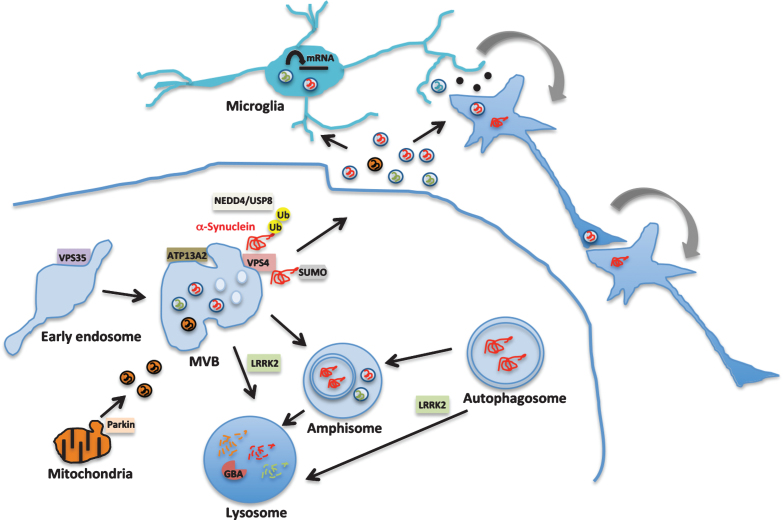
Extracellular vesicles including exosomes are released by a variety of cell types including neurons and exhibit molecular profiles that reflect normal and disease states. As their content represents a snapshot of the intracellular milieu, they could be exploited as biomarkers of the otherwise inaccessible brain microenvironment. In addition they may contribute to the progression of neurodegenerative disorders by facilitating the spread of misfolded proteins at distant sites or activating immune cells. This review summarizes recent advances in the study of exosomes in Parkinson's disease pathophysiology and their potential as disease biomarkers.
细胞外囊泡(包括外泌体)由多种细胞类型释放,其中包括神经元,其分子特征反映了正常和疾病状态。由于其内容代表了细胞内环境的一个快照,因此它们可以作为原本无法进入的大脑微环境的生物标志物。此外,它们可以通过促进错误折叠蛋白在远处的扩散或激活免疫细胞来促进神经退行性疾病的进展。本综述总结了帕金森病病理生理学中外泌体研究的最新进展及其作为疾病生物标志物的潜力。