Program for Hypoplastic Left Heart Syndrome-Center for Regenerative Medicine, Mayo Clinic, Rochester, Minnesota, USA.
Division of General Internal Medicine, Mayo Clinic, Rochester, Minnesota, USA.
Stem Cells Transl Med. 2017 Oct;6(10):1829-1839. doi: 10.1002/sctm.17-0116. Epub 2017 Sep 19.
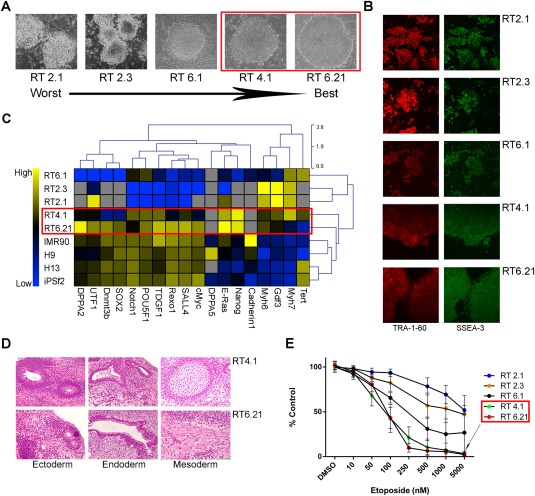
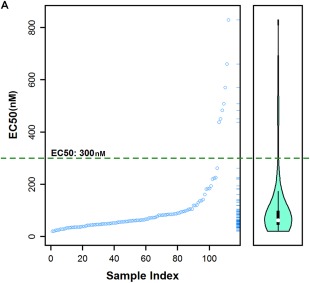
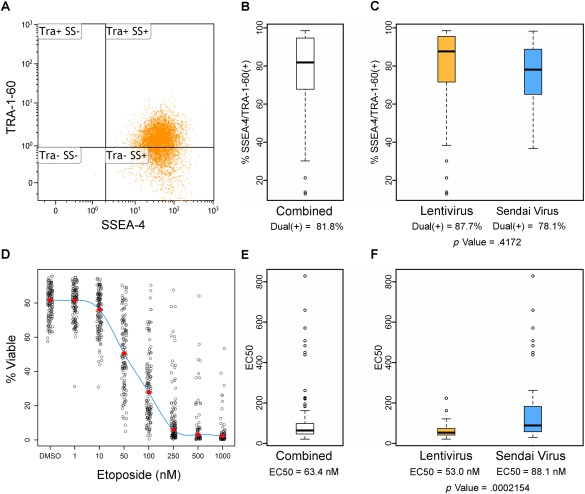
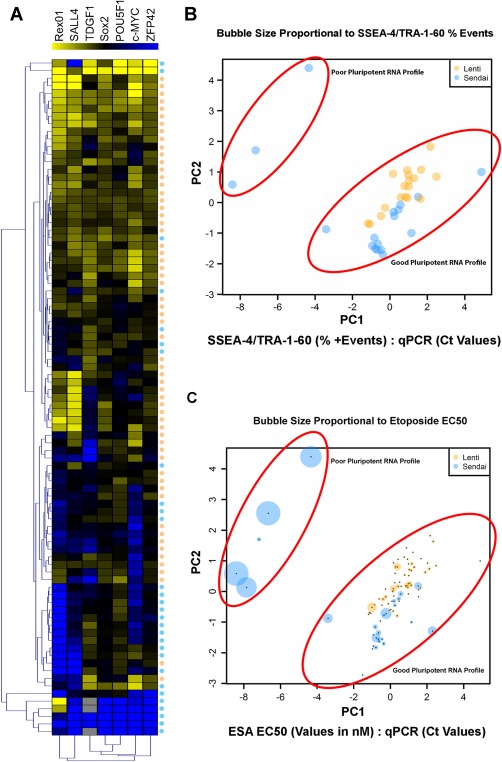
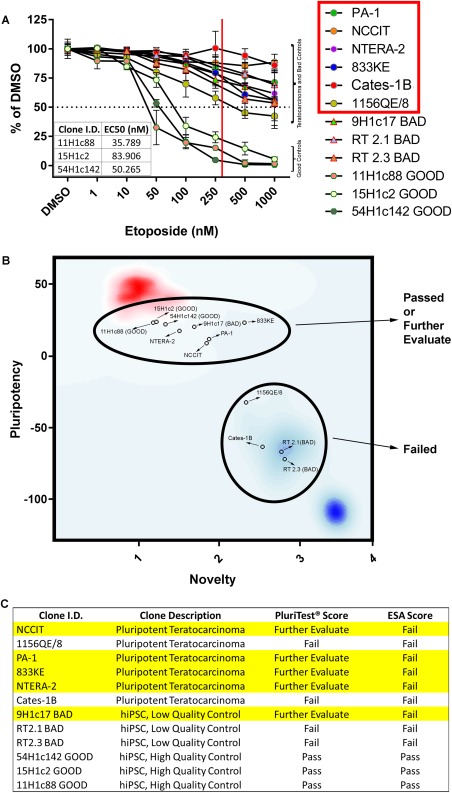
Human induced pluripotent stem cells (hiPSC) hold great promise in diagnostic and therapeutic applications. However, translation of hiPSC technology depends upon a means of assessing hiPSC quality that is quantitative, high-throughput, and can decipher malignant teratocarcinoma clones from normal cell lines. These attributes are lacking in current approaches such as detection of cell surface makers, RNA profiling, and/or teratoma formation assays. The latter remains the gold standard for assessing clone quality in hiPSCs, but is expensive, time-consuming, and incompatible with high-throughput platforms. Herein, we describe a novel method for determining hiPSC quality that exploits pluripotent cells' documented hypersensitivity to the topoisomerase inhibitor etoposide (CAS No. 33419-42-0). Based on a study of 115 unique hiPSC clones, we established that a half maximal effective concentration (EC50) value of <300 nM following 24 hours of exposure to etoposide demonstrated a positive correlation with RNA profiles and colony morphology metrics associated with high quality hiPSC clones. Moreover, our etoposide sensitivity assay (ESA) detected differences associated with culture maintenance, and successfully distinguished malignant from normal pluripotent clones independent of cellular morphology. Overall, the ESA provides a simple, straightforward method to establish hiPSC quality in a quantitative and functional assay capable of being incorporated into a generalized method for establishing a quality control standard for all types of pluripotent stem cells. Stem Cells Translational Medicine 2017;6:1829-1839.
人类诱导多能干细胞(hiPSC)在诊断和治疗应用中具有巨大的应用前景。然而,hiPSC 技术的转化依赖于一种能够定量、高通量地评估 hiPSC 质量的方法,并且能够从正常细胞系中辨别恶性畸胎瘤克隆。目前的方法,如细胞表面标志物检测、RNA 谱分析和/或畸胎瘤形成测定等,都缺乏这些特性。后者仍然是评估 hiPSC 克隆质量的金标准,但它昂贵、耗时,并且与高通量平台不兼容。在这里,我们描述了一种确定 hiPSC 质量的新方法,该方法利用多能细胞对拓扑异构酶抑制剂依托泊苷(CAS No.33419-42-0)的已有记录的高敏感性。基于对 115 个独特的 hiPSC 克隆的研究,我们确定暴露于依托泊苷 24 小时后,半最大有效浓度(EC50)值<300 nM 与与高质量 hiPSC 克隆相关的 RNA 谱和集落形态学指标呈正相关。此外,我们的依托泊苷敏感性测定(ESA)检测到与培养维持相关的差异,并成功地独立于细胞形态学区分恶性和正常多能克隆。总的来说,ESA 提供了一种简单、直接的方法,可在定量和功能测定中建立 hiPSC 质量,能够纳入用于建立所有类型多能干细胞质量控制标准的通用方法。《Stem Cells Translational Medicine》2017 年;6:1829-1839。