Kitahara Kosuke, Hayashi Yoshikatsu, Yano Shiro, Kondo Toshiyuki
Department of Computer and Information Sciences, Tokyo University of Agriculture and Technology, Koganei, Tokyo, Japan.
Biomedical Engineering, School of Biological Sciences, University of Reading, Reading, United Kingdom.
PLoS One. 2017 Sep 19;12(9):e0184245. doi: 10.1371/journal.pone.0184245. eCollection 2017.
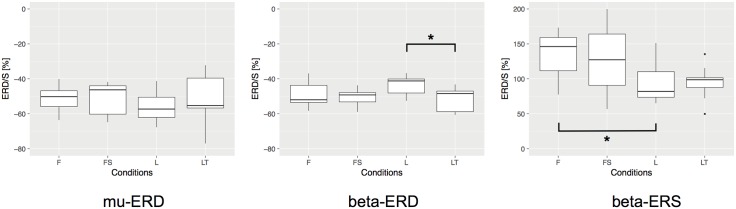
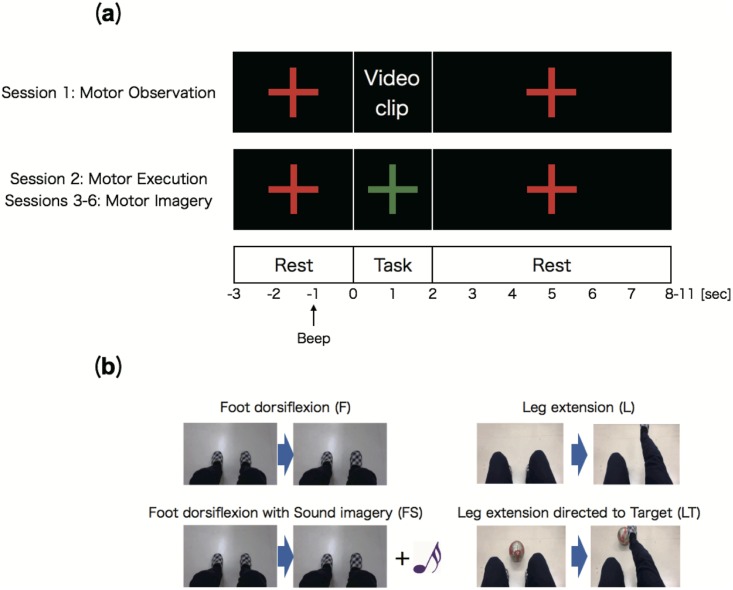
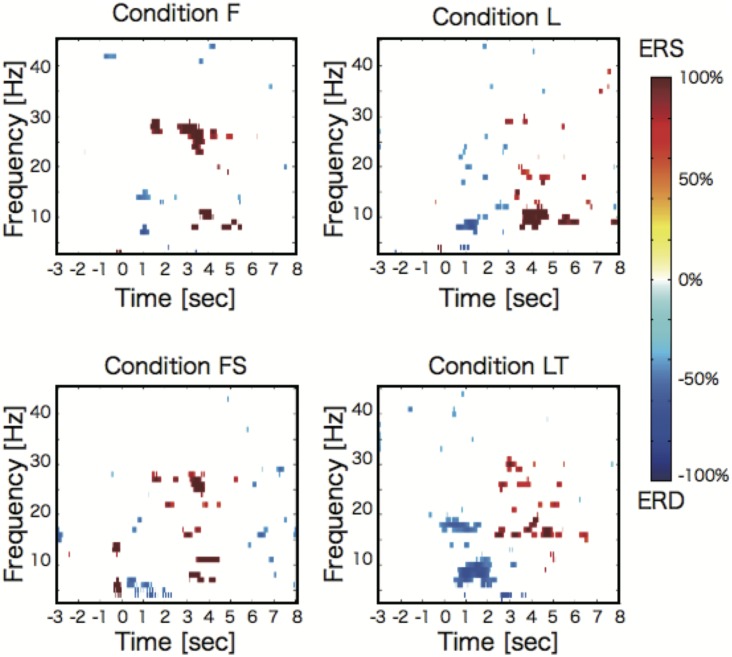
Event-related desynchronization/synchronization (ERD/S) is an electroencephalogram (EEG) feature widely used as control signals for Brain-Computer Interfaces (BCIs). Nevertheless, the underlying neural mechanisms and functions of ERD/S are largely unknown, thus investigating them is crucial to improve the reliability of ERD/S-based BCIs. This study aimed to identify Motor Imagery (MI) conditions that enhance ERD/S. We investigated following three questions: 1) whether target-directed MI affects ERD/S, 2) whether MI with sound imagery affects ERD/S, and 3) whether ERD/S has a body part dependency of MI. Nine participants took part in the experiments of four MI conditions; they were asked to imagine right foot dorsiflexion (F), right foot dorsiflexion and the sound of a bass drum when the sole touched the floor (FS), right leg extension (L), and right leg extension directed toward a soccer ball (LT). Statistical comparison revealed that there were significant differences between conditions L and LT in beta-band ERD and conditions F and L in beta-band ERS. These results suggest that mental rehearsal of target-directed lower limb movement without real sensory stimuli can enhance beta-band ERD; furthermore, MI of foot dorsiflexion induces significantly larger beta-band ERS than that of leg extension. These findings could be exploited for the training of BCIs such as powered prosthetics for disabled person and neurorehabilitation system for stroke patients.
事件相关去同步化/同步化(ERD/S)是一种脑电图(EEG)特征,被广泛用作脑机接口(BCI)的控制信号。然而,ERD/S潜在的神经机制和功能在很大程度上尚不清楚,因此对其进行研究对于提高基于ERD/S的BCI的可靠性至关重要。本研究旨在确定增强ERD/S的运动想象(MI)条件。我们研究了以下三个问题:1)目标导向的MI是否会影响ERD/S,2)伴有声音想象的MI是否会影响ERD/S,以及3)ERD/S是否存在MI的身体部位依赖性。九名参与者参加了四种MI条件的实验;他们被要求想象右脚背屈(F)、右脚背屈以及当脚底触地时低音鼓的声音(FS)、右腿伸展(L)和朝着足球方向的右腿伸展(LT)。统计比较显示,在β波段ERD方面,L和LT条件之间存在显著差异,在β波段ERS方面,F和L条件之间存在显著差异。这些结果表明,在没有实际感觉刺激的情况下,目标导向的下肢运动的心理预演可以增强β波段ERD;此外,脚背屈的MI比腿部伸展的MI诱发的β波段ERS明显更大。这些发现可用于训练BCI,如用于残疾人的动力假肢和用于中风患者的神经康复系统。