Bali Zsolt K, Nagy Lili V, Hernádi István
Department of Experimental Zoology and Neurobiology, Faculty of Sciences, University of PécsPécs, Hungary.
János Szentágothai Research Center, Center for Neuroscience, University of PécsPécs, Hungary.
Front Cell Neurosci. 2017 Sep 5;11:271. doi: 10.3389/fncel.2017.00271. eCollection 2017.
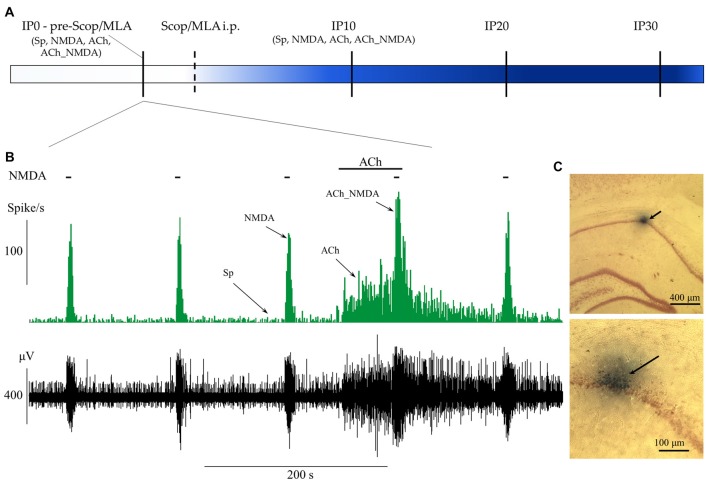
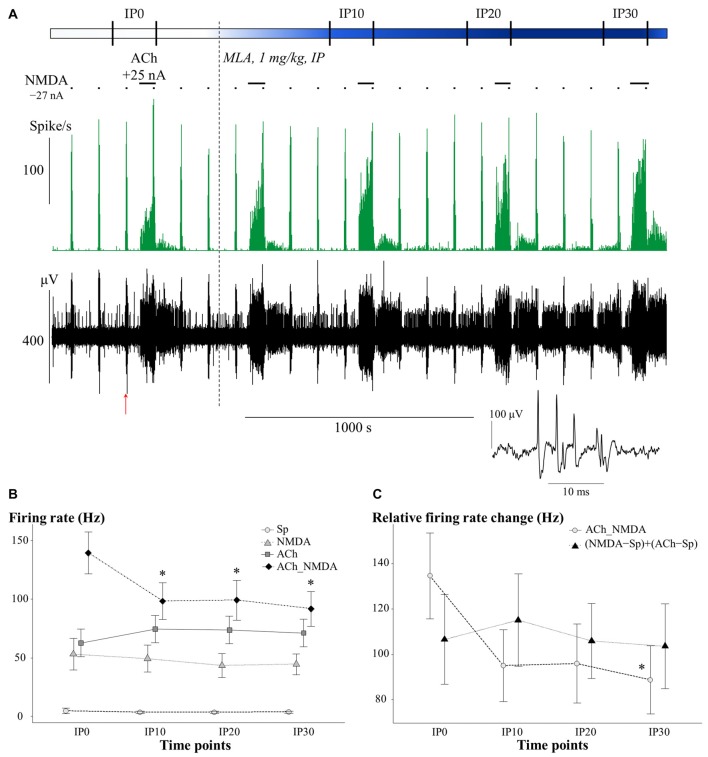
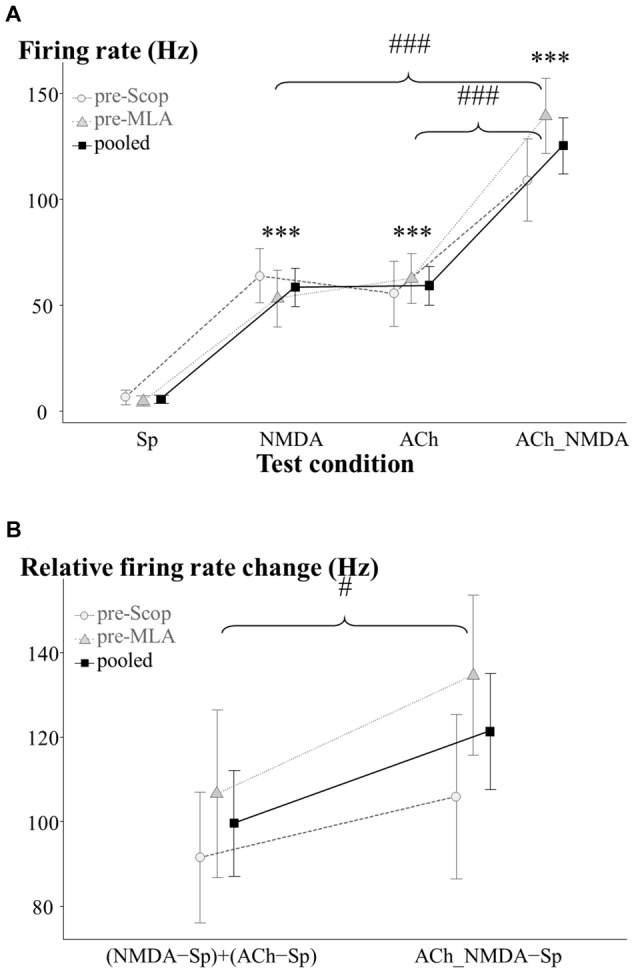
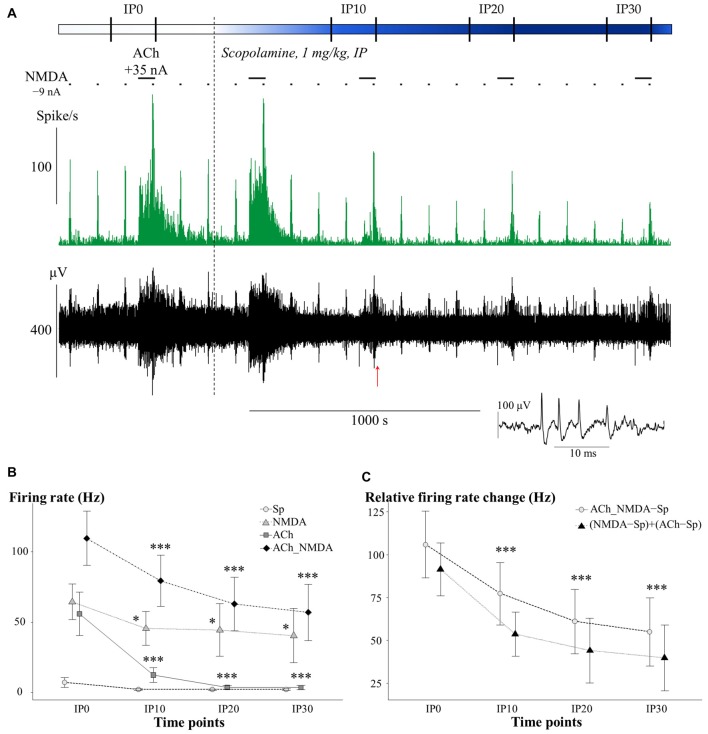
The aim of the present study was to identify electrophysiological correlates of the interaction between cholinergic and glutamatergic neurotransmission underlying memory. Extracellular spike recordings were performed in the hippocampal CA1 region of anesthetized rats in combination with local microiontophoretic administration of N-methyl-D-aspartate (NMDA) and acetylcholine (ACh). Both NMDA and ACh increased the firing rate of the neurons. Furthermore, the simultaneous delivery of NMDA and ACh resulted in a more pronounced excitatory effect that was superadditive over the sum of the two mono-treatment effects and that was explained by cholinergic potentiation of glutamatergic neurotransmission. Next, animals were systemically treated with scopolamine or methyllycaconitine (MLA) to assess the contribution of muscarinic ACh receptor (mAChR) or α7 nicotinic ACh receptor (nAChR) receptor-mediated mechanisms to the observed effects. Scopolamine totally inhibited ACh-evoked firing, and attenuated the firing rate increase evoked by simultaneous application of NMDA and ACh. However, the superadditive nature of the combined effect was preserved. The α7 nAChR antagonist MLA robustly decreased the firing response to simultaneous application of NMDA and ACh, suspending their superadditive effect, without modifying the tonic firing rate increasing effect of ACh. These results provide the first electrophysiological evidence that, in the hippocampal CA1 region, α7 nAChRs contribute to pyramidal cell activity mainly through potentiation of glutamatergic signaling, while the direct cholinergic modulation of tonic firing is notably mediated by mAChRs. Furthermore, the present findings also reveal cellular physiological correlates of the interplay between cholinergic and glutamatergic agents in behavioral pharmacological models of cognitive decline.
本研究的目的是确定记忆背后胆碱能和谷氨酸能神经传递相互作用的电生理相关性。在麻醉大鼠的海马CA1区进行细胞外锋电位记录,并结合局部微量离子电渗法给予N-甲基-D-天冬氨酸(NMDA)和乙酰胆碱(ACh)。NMDA和ACh均增加了神经元的放电频率。此外,同时给予NMDA和ACh会产生更明显的兴奋作用,这种作用在两种单一处理效应之和的基础上具有超相加性,并且可由胆碱能对谷氨酸能神经传递的增强作用来解释。接下来,对动物进行东莨菪碱或甲基lycaconitine(MLA)全身治疗,以评估毒蕈碱型ACh受体(mAChR)或α7烟碱型ACh受体(nAChR)介导的机制对观察到的效应的贡献。东莨菪碱完全抑制了ACh诱发的放电,并减弱了同时应用NMDA和ACh引起的放电频率增加。然而,联合效应的超相加性质得以保留。α7 nAChR拮抗剂MLA强烈降低了对同时应用NMDA和ACh的放电反应,中止了它们的超相加效应,而没有改变ACh对紧张性放电频率增加的作用。这些结果提供了首个电生理证据,即在海马CA1区,α7 nAChRs主要通过增强谷氨酸能信号传导来促进锥体细胞活动,而紧张性放电的直接胆碱能调节主要由mAChRs介导。此外,本研究结果还揭示了认知衰退行为药理学模型中胆碱能和谷氨酸能药物相互作用的细胞生理相关性。