Department of Physical Therapy, A-State, Jonesboro, AR, USA.
Neural Plast. 2017;2017:7260130. doi: 10.1155/2017/7260130. Epub 2017 Aug 8.
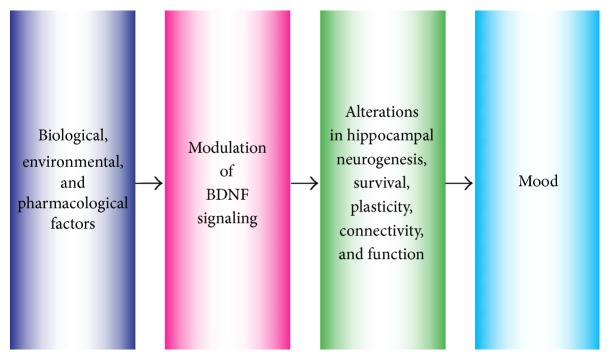
Brain-derived neurotrophic factor (BDNF) is a neurotrophin that is vital to the survival, growth, and maintenance of neurons in key brain circuits involved in emotional and cognitive function. Convergent evidence indicates that neuroplastic mechanisms involving BDNF are deleteriously altered in major depressive disorder (MDD) and animal models of stress. Herein, clinical and preclinical evidence provided that stress-induced depressive pathology contributes to altered BDNF level and function in persons with MDD and, thereby, disruptions in neuroplasticity at the regional and circuit level. Conversely, effective therapeutics that mitigate depressive-related symptoms (e.g., antidepressants and physical activity) optimize BDNF in key brain regions, promote neuronal health and recovery of function in MDD-related circuits, and enhance pharmacotherapeutic response. A greater knowledge of the interrelationship between BDNF, depression, therapeutic mechanisms of action, and neuroplasticity is important as it necessarily precedes the derivation and deployment of more efficacious treatments.
脑源性神经营养因子(BDNF)是一种神经营养因子,对于参与情绪和认知功能的关键大脑回路中神经元的存活、生长和维持至关重要。有汇聚证据表明,涉及 BDNF 的神经可塑性机制在重度抑郁症(MDD)和应激动物模型中受到有害改变。在此,临床和临床前证据表明,应激引起的抑郁病理导致 MDD 患者的 BDNF 水平和功能改变,从而破坏区域和回路水平的神经可塑性。相反,减轻与抑郁相关症状的有效疗法(例如抗抑郁药和体育活动)可优化关键大脑区域的 BDNF,促进 MDD 相关回路中神经元的健康和功能恢复,并增强药物治疗反应。了解 BDNF、抑郁、治疗作用机制和神经可塑性之间的相互关系非常重要,因为它是开发更有效的治疗方法的必要前提。