Jelocnik Martina, Islam Md Mominul, Madden Danielle, Jenkins Cheryl, Branley James, Carver Scott, Polkinghorne Adam
Centre for Animal Health Innovation, University of the Sunshine Coast, Maroochydore, Queensland, Australia.
NSW Department of Primary Industries, Elizabeth Macarthur Agricultural Institute, Menangle, New South Wales, Australia.
PeerJ. 2017 Sep 8;5:e3799. doi: 10.7717/peerj.3799. eCollection 2017.
and are important veterinary pathogens, with the former also being responsible for zoonoses, and the latter adversely affecting koala populations in Australia and livestock globally. The rapid detection of these organisms is still challenging, particularly at the point-of-care (POC). In the present study, we developed and evaluated rapid, sensitive and robust -specific and -specific Loop Mediated Isothermal Amplification (LAMP) assays for detection of these pathogens.
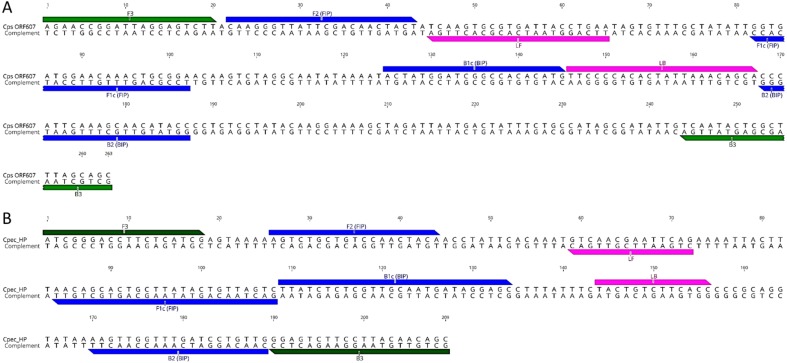
The LAMP assays, performed in a Genie III real-time fluorometer, targeted a 263 bp region of the -specific Cps_0607 gene or a 209 bp region of a -specific conserved gene CpecG_0573, and were evaluated using a range of samples previously screened using species-specific quantitative PCRs (qPCRs). Species-specificity for and LAMP targets was tested against DNA samples from related chlamydial species and a range of other bacteria. In order to evaluate pathogen detection in clinical samples, LAMP was evaluated using a total of 26 DNA extracts from clinical samples from equine and avian hosts, while for LAMP, we tested a total of 63 DNA extracts from clinical samples from koala, sheep and cattle hosts. A subset of 36 samples was also tested in a thermal cycler (instead of a real-time fluorometer) using newly developed LAMP and results were determined as an end point detection. We also evaluated rapid swab processing (without DNA extraction) to assess the robustness of these assays.
Both LAMP assays were demonstrated to species-specific, highly reproducible and to be able to detect as little as 10 genome copy number/reaction, with a mean amplification time of 14 and 24 min for and , respectively. When testing clinical samples, the overall congruence between the newly developed LAMP assays and qPCR was 92.3% for (91.7% sensitivity and 92.9% specificity); and 84.1% for (90.6% sensitivity and 77.4% specificity). For a subset of 36 samples tested in a thermal cycler using newly developed LAMP, we observed 34/36 (94.4%) samples result being congruent between LAMP performed in fluorometer and in thermal cycler. Rapid swab processing method evaluated in this study also allows for chlamydial DNA detection using LAMP.
In this study, we describe the development of novel, rapid and robust -specific and -specific LAMP assays that are able to detect these bacteria in clinical samples in either the laboratory or POC settings. With further development and a focus on the preparation of these assays at the POC, it is anticipated that both tests may fill an important niche in the repertoire of ancillary diagnostic tools available to clinicians.
[病原体名称1]和[病原体名称2]是重要的兽医病原体,前者还可导致人畜共患病,后者对澳大利亚的考拉种群以及全球的家畜产生不利影响。快速检测这些病原体仍然具有挑战性,尤其是在即时检测(POC)方面。在本研究中,我们开发并评估了用于检测这些病原体的快速、灵敏且稳健的[病原体名称1]特异性和[病原体名称2]特异性环介导等温扩增(LAMP)检测方法。
LAMP检测在Genie III实时荧光计中进行,靶向[病原体名称1]特异性Cps_0607基因的263 bp区域或[病原体名称2]特异性保守基因CpecG_0573的209 bp区域,并使用一系列先前通过物种特异性定量PCR(qPCR)筛选的样本进行评估。针对[病原体名称1]和[病原体名称2] LAMP靶点的物种特异性,针对来自相关衣原体物种和一系列其他细菌的DNA样本进行了测试。为了评估临床样本中的病原体检测,使用来自马和禽宿主临床样本的总共26份DNA提取物对[病原体名称1] LAMP进行了评估,而对于[病原体名称2] LAMP,我们测试了来自考拉、绵羊和牛宿主临床样本的总共63份DNA提取物。还使用新开发的LAMP在热循环仪(而非实时荧光计)中对36份[病原体名称1]样本的一个子集进行了测试,并将结果确定为终点检测。我们还评估了快速拭子处理(无需DNA提取)以评估这些检测方法的稳健性。
两种LAMP检测方法均显示具有物种特异性、高度可重复性,并且能够检测低至10个基因组拷贝数/反应,[病原体名称1]和[病原体名称2]的平均扩增时间分别为14分钟和24分钟。在测试临床样本时,新开发的LAMP检测方法与qPCR之间的总体一致性对于[病原体名称1]为92.3%(敏感性为91.7%,特异性为92.9%);对于[病原体名称2]为84.1%(敏感性为90.6%,特异性为77.4%)。对于使用新开发的LAMP在热循环仪中测试的36份[病原体名称1]样本的一个子集,我们观察到荧光计中进行的LAMP与热循环仪中进行的LAMP之间有34/36(94.4%)的样本结果一致。本研究中评估的快速拭子处理方法也允许使用LAMP检测衣原体DNA。
在本研究中,我们描述了新型、快速且稳健的[病原体名称1]特异性和[病原体名称2]特异性LAMP检测方法的开发,这些方法能够在实验室或POC环境中检测临床样本中的这些细菌。随着进一步的开发并专注于在POC处制备这些检测方法,预计这两种检测方法可能在临床医生可用的辅助诊断工具库中占据重要位置。