Reis Zilma Silveira Nogueira, Vitral Gabriela Luiza Nogueira, de Souza Ingrid Michelle Fonseca, Rego Maria Albertina Santiago, Guimaraes Rodney Nascimento
Center of Health Informatics, Faculty of Medicine, Universidade Federal de Minas Gerais, Belo Horizonte, Minas Gerais, Brazil.
Postgraduation Program of Women's Health, Faculty of Medicine, Universidade Federal de Minas Gerais, Belo Horizonte, Minas Gerais, Brazil.
PLoS One. 2017 Sep 20;12(9):e0184734. doi: 10.1371/journal.pone.0184734. eCollection 2017.
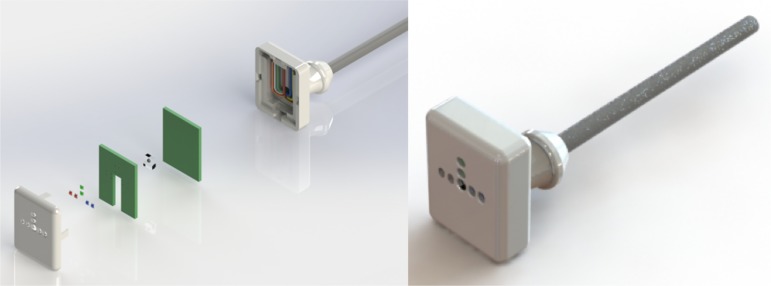
Current methods to assess the gestational age during prenatal care or at birth are a global challenge. Disadvantages, such as low accessibility, high costs, and imprecision of clinical tests and ultrasonography measurements, may compromise health decisions at birth, based on the gestational age. Newborns' organs and tissues can indirectly indicate their physical maturity, and we hypothesized that evolutionary changes in their skin, detected using an optoelectronic device meter, may aid in estimating the gestational age. This study analyzed the feasibility of using newborn skin reflectance to estimate the gestational age at birth noninvasively.
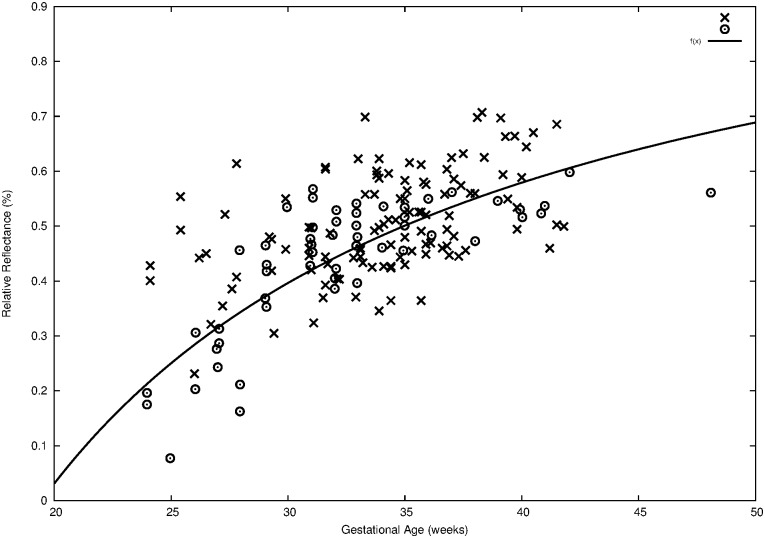
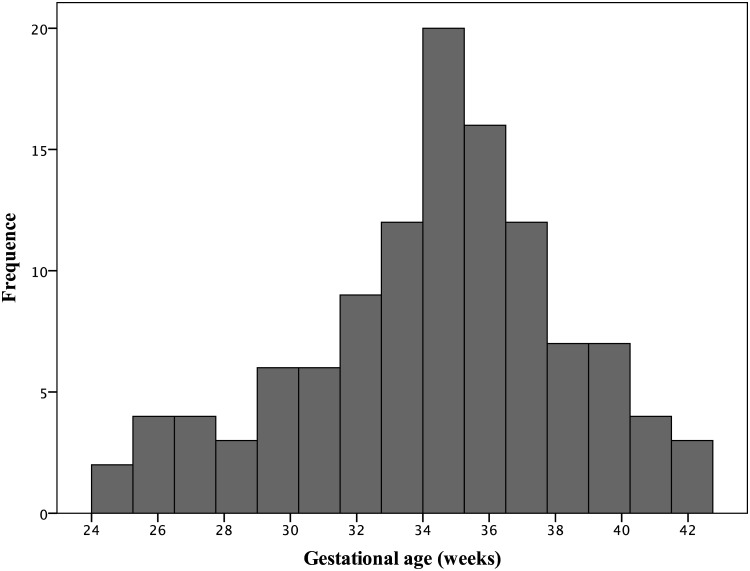
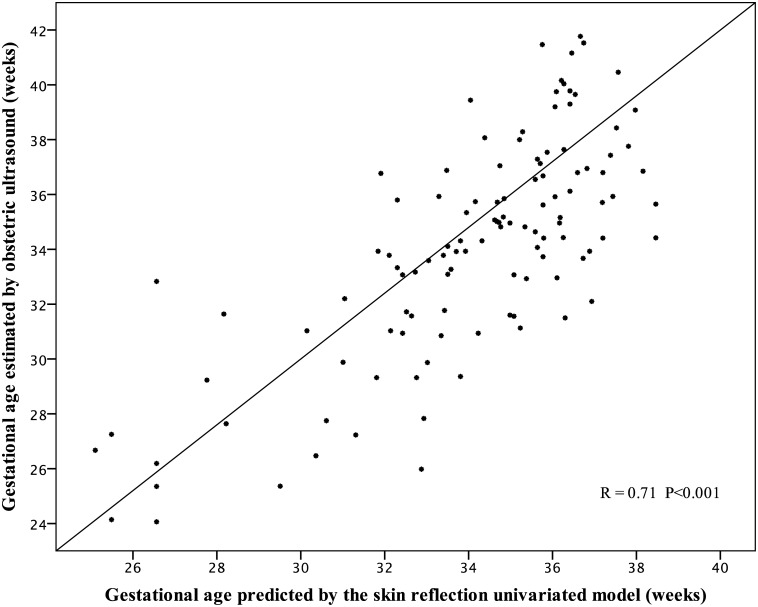
A cross-sectional study evaluated the skin reflectance of selected infants, preferably premature, at birth. The first-trimester ultrasound was the reference for gestational age. A prototype of a new noninvasive optoelectronic device measured the backscattering of light from the skin, using a light emitting diode at wavelengths of 470 nm, 575 nm, and 630 nm. Univariate and multivariate regression analysis models were employed to predict gestational age, combining skin reflectance with clinical variables for gestational age estimation. The gestational age at birth of 115 newborns from 24.1 to 41.8 weeks of gestation correlated with the light at 630 nm wavelength reflectance 3.3 mm/6.5 mm ratio distant of the sensor, at the forearm and sole (Pearson's correlation = 0.505, P < 0.001 and 0.710, P < 0.001, respectively). The best-combined variables to predict the gold standard gestational age at birth was the skin reflectance at wavelengths of 630 nm and 470 nm in combination with birth weight, phototherapy, and adjusted to include incubator stay, and sex (R2 = 0.828, P < 0.001). The main limitation of the study is that it was very specific to the premature population we studied and needs to be studied in a broader spectrum of newborns.
A novel automated skin reflectometer device, in combination with clinical variables, was able to predict the gestational age and could be useful when the information is in doubt or is unknown. Multivariable predictive models associated the skin reflectance with easy to obtain clinical parameters, at the birth scenario. External validation needs to be proven in an actual population with the real incidence of premature infants.
目前在产前检查或出生时评估胎龄的方法是一项全球性挑战。诸如可及性低、成本高以及临床检查和超声测量不准确等缺点,可能会影响基于胎龄做出的出生时的健康决策。新生儿的器官和组织可以间接表明其身体成熟度,我们推测,使用光电设备测量仪检测到的新生儿皮肤的进化变化可能有助于估计胎龄。本研究分析了使用新生儿皮肤反射率无创估计出生时胎龄的可行性。
一项横断面研究评估了选定婴儿(最好是早产儿)出生时的皮肤反射率。孕早期超声检查是胎龄的参考标准。一种新型无创光电设备的原型使用波长为470nm、575nm和630nm的发光二极管测量皮肤的光后向散射。采用单变量和多变量回归分析模型预测胎龄,将皮肤反射率与临床变量相结合以估计胎龄。115名孕周在24.1至41.8周的新生儿出生时的胎龄与前臂和足底距传感器630nm波长反射率3.3mm/6.5mm比值处的光相关(皮尔逊相关系数分别为0.505,P<0.001和0.71, P<0.001)。预测出生时金标准胎龄的最佳组合变量是630nm和470nm波长的皮肤反射率,结合出生体重、光疗,并调整纳入保温箱停留时间和性别(R2 = 0.828,P<0.001)。该研究的主要局限性在于它非常特定于我们所研究的早产人群,需要在更广泛的新生儿群体中进行研究。
一种新型自动皮肤反射仪设备,结合临床变量,能够预测胎龄,并且在信息存疑或未知时可能会有用。多变量预测模型将皮肤反射率与出生时易于获得的临床参数相关联。需要在实际人群中对早产儿的实际发病率进行外部验证。