Melin Eva O, Thunander Maria, Landin-Olsson Mona, Hillman Magnus, Thulesius Hans O
Endocrinology and Diabetes, Department of Clinical Sciences, Lund University, Lund, Sweden.
Department of Research and Development, Region Kronoberg, Box 1223, SE-351 12, Växjö, Sweden.
BMC Psychiatry. 2017 Sep 20;17(1):335. doi: 10.1186/s12888-017-1495-8.
Increased prevalence of depression is found in both type 2 diabetes (T2D) and type 1 diabetes (T1D). Melancholia and atypical depression differ by cortisol secretion and clinical features. The aim was to compare the clinical presentation of T1D and T2D patients in relation to self-reported depression, self-reported anxiety, alexithymia, obesity, and midnight salivary cortisol (MSC).
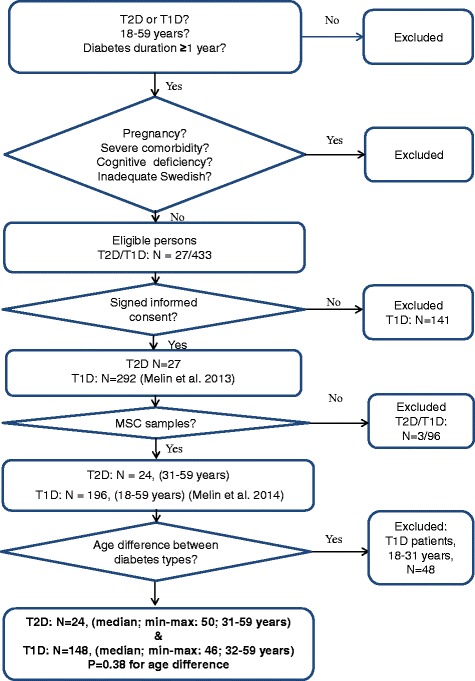
Comparative cross-sectional design. The participants were consecutively recruited from one hospital diabetes outpatient clinic: 24 T2D patients (31-59 years) and 148 T1D patients (32-59 years). Self-reported depression, anxiety and alexithymia were assessed by Hospital Anxiety and Depression scale and Toronto Alexithymia Scale-20. MSC, HbA1c, anthropometrics and data from medical records were collected. Multiple logistic regression analyses were performed.
Comparisons of prevalence between diabetes types showed for T2D/T1D: depression 25%/12% (P = 0.10); high MSC (≥9.3 nmol/L) 38%/22% (P = 0.13); alexithymia 25%/13% (P = 0.12); anxiety 38%/35% (P = 0.82). The prevalence of high MSC did not differ between depressed and non-depressed T2D patients (17% vs. 44%, P = 0.35), but differed between depressed and non-depressed T1D patients (53% vs. 18%, P = 0.003). The alexithymia prevalence differed between depressed and non-depressed T2D patients (67% vs.11%, P = 0.018), and between depressed and non-depressed T1D patients (47% vs. 11%, P < 0.001). The anxiety prevalence did not differ between depressed and non-depressed T2D patients (67% vs. 28%, P = 0.15), but differed between depressed and non-depressed T1D patients (76% vs. 30%, P < 0.001). The obesity prevalence (BMI ≥30 kg/m) was 83% for depressed T2D patients and 6% for depressed T1D patients. In the T2D patients, depression was associated with alexithymia (Adjusted odds ratio (AOR) 15.0). In the T1D patients, depression was associated with anxiety (AOR 11.0), foot complications (AOR 8.5), HbA1C >70 mmol/mol (AOR 6.4), and high MSC (≥9.3 nmol/L) (AOR 4.8).
The depressed T2D patients had traits of atypical depression, without associated high MSC (≥9.3 nmol/L) and anxiety, but the association with alexithymia was strong. The depressed T1D patients had traits of melancholia with associated high MSC and anxiety. The obesity prevalence was high in depressed T2D patients and low in depressed T1D patients.
2型糖尿病(T2D)和1型糖尿病(T1D)患者中抑郁症的患病率均有所上升。忧郁症和非典型抑郁症在皮质醇分泌和临床特征方面存在差异。本研究旨在比较T1D和T2D患者在自我报告的抑郁、焦虑、述情障碍、肥胖和午夜唾液皮质醇(MSC)方面的临床表现。
采用比较性横断面设计。研究对象连续从一家医院的糖尿病门诊招募:24例T2D患者(31 - 59岁)和148例T1D患者(32 - 59岁)。采用医院焦虑抑郁量表和多伦多述情障碍量表 - 20评估自我报告的抑郁、焦虑和述情障碍。收集MSC、糖化血红蛋白(HbA1c)、人体测量数据及病历资料。进行多因素逻辑回归分析。
糖尿病类型之间患病率比较显示,T2D/T1D:抑郁症为25%/12%(P = 0.10);高MSC(≥9.3 nmol/L)为38%/22%(P = 0.13);述情障碍为25%/13%(P = 0.12);焦虑症为38%/35%(P = 0.82)。高MSC患病率在抑郁和非抑郁的T2D患者之间无差异(17%对44%,P = 0.35),但在抑郁和非抑郁的T1D患者之间存在差异(53%对18%,P = 0.003)。述情障碍患病率在抑郁和非抑郁的T2D患者之间存在差异(67%对11%,P = 0.018),在抑郁和非抑郁的T1D患者之间也存在差异(47%对11%,P < 0.001)。焦虑症患病率在抑郁和非抑郁的T2D患者之间无差异(67%对28%,P = 0.15),但在抑郁和非抑郁的T1D患者之间存在差异(76%对30%,P < 0.001)。抑郁的T2D患者肥胖患病率(BMI≥30 kg/m²)为83%,抑郁的T1D患者为6%。在T2D患者中,抑郁与述情障碍相关(调整优势比(AOR)为15.0)。在T1D患者中,抑郁与焦虑(AOR为11.0)、足部并发症(AOR为8.5)、HbA1C>70 mmol/mol(AOR为6.4)和高MSC(≥9.3 nmol/L)(AOR为4.8)相关。
抑郁的T2D患者具有非典型抑郁症的特征,无高MSC(≥9.3 nmol/L)和焦虑相关,但与述情障碍的关联较强。抑郁的T1D患者具有忧郁症特征,伴有高MSC和焦虑。抑郁的T2D患者肥胖患病率高,抑郁的T1D患者肥胖患病率低。