Centre for Bioprocess Engineering Research (CeBER), Department of Chemical Engineering, University of Cape Town, Private Bag X3, Rondebosch, Cape Town, 7701, South Africa.
South African DST-NRF Centre of Excellence in Catalysis, c*change, University of Cape Town, Private Bag, Rondebosch, Cape Town, 7701, South Africa.
Microb Cell Fact. 2017 Sep 20;16(1):156. doi: 10.1186/s12934-017-0763-0.
The regeneration of cofactors and the supply of alkane substrate are key considerations for the biocatalytic activation of hydrocarbons by cytochrome P450s. This study focused on the biotransformation of n-octane to 1-octanol using resting Escherichia coli cells expressing the CYP153A6 operon, which includes the electron transport proteins ferredoxin and ferredoxin reductase. Glycerol dehydrogenase was co-expressed with the CYP153A6 operon to investigate the effects of boosting cofactor regeneration. In order to overcome the alkane supply bottleneck, various chemical and physical approaches to membrane permeabilisation were tested in strains with or without additional dehydrogenase expression.
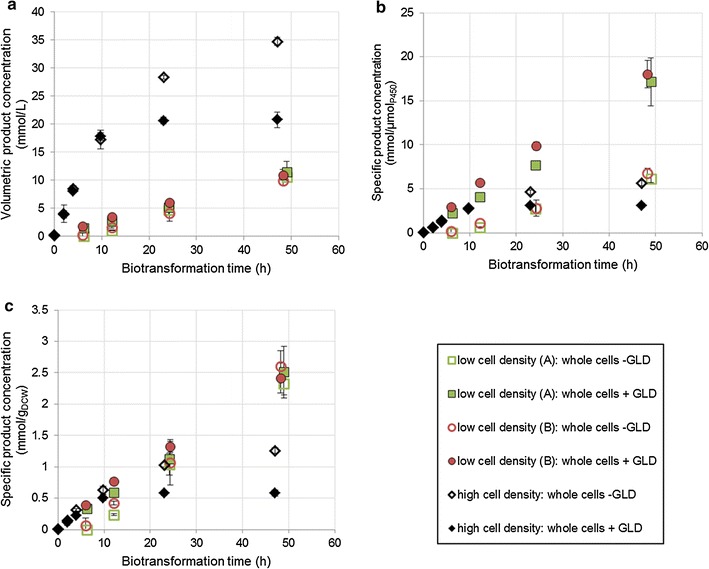
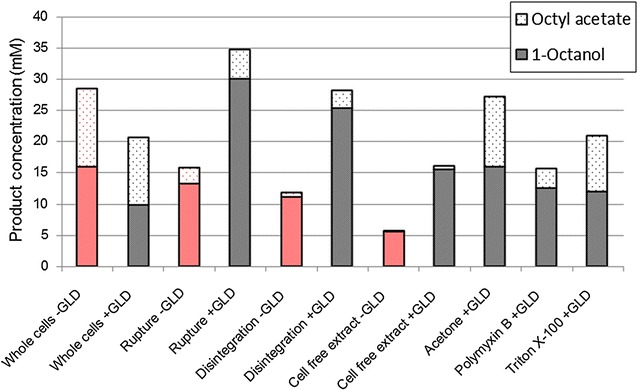
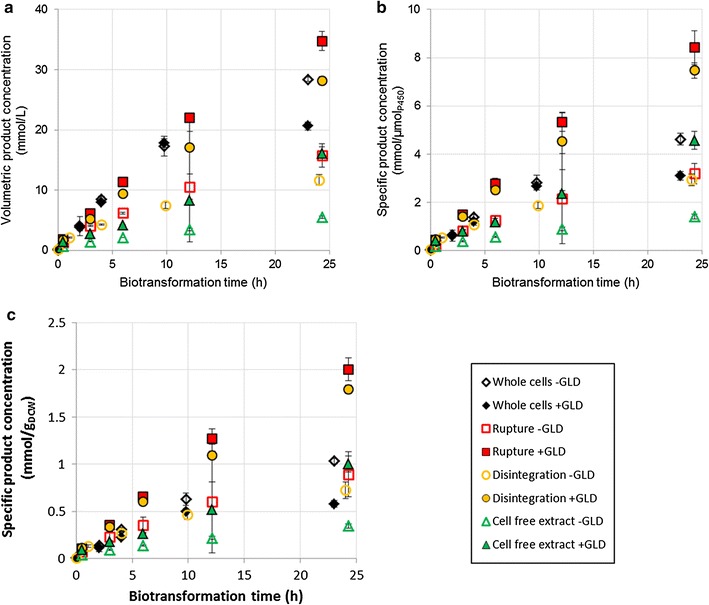
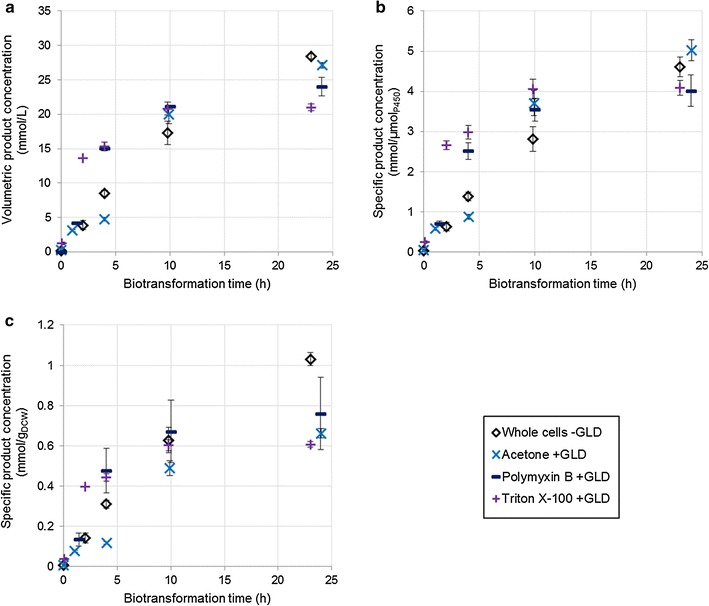
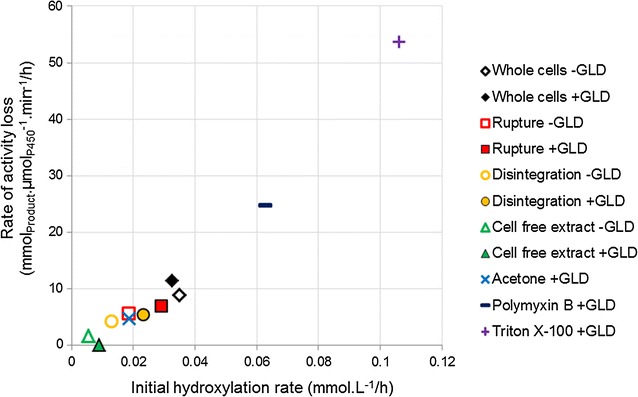
Dehydrogenase co-expression in whole cells did not improve product formation and reduced the stability of the system at high cell densities. Chemical permeabilisation resulted in initial hydroxylation rates that were up to two times higher than the whole cell system, but severely impacted biocatalyst stability. Mechanical cell breakage led to improved enzyme stability, but additional dehydrogenase expression was necessary to improve product formation. The best-performing system (in terms of final titres) consisted of mechanically ruptured cells expressing additional dehydrogenase. This system had an initial activity of 1.67 ± 0.12 U/g (32% improvement on whole cells) and attained a product concentration of 34.8 ± 1.6 mM after 24 h (22% improvement on whole cells). Furthermore, the system was able to maintain activity when biotransformation was extended to 72 h, resulting in a final product titre of 60.9 ± 1.1 mM.
This study suggests that CYP153A6 in whole cells is limited by coupling efficiencies rather than cofactor supply. However, the most significant limitation in the current system is hydrocarbon transport, with substrate import being the main determinant of hydroxylation rates, and product export playing a key role in system stability.
对于细胞色素 P450s 生物催化激活烃类化合物,辅因子的再生和烷烃底物的供应是关键考虑因素。本研究专注于用表达 CYP153A6 操纵子(包含电子传递蛋白铁氧还蛋白和铁氧还蛋白还原酶)的大肠杆菌休止细胞将正辛烷生物转化为 1-辛醇。与 CYP153A6 操纵子共表达甘油脱氢酶,以研究增强辅因子再生的效果。为了克服烷烃供应瓶颈,在具有或不具有额外脱氢酶表达的菌株中测试了各种化学和物理方法的膜通透性。
在整个细胞中表达脱氢酶并没有提高产物形成,反而降低了高细胞密度下系统的稳定性。化学渗透作用导致初始羟化速率比整个细胞系统高 2 倍,但严重影响了生物催化剂的稳定性。机械细胞破碎导致酶稳定性提高,但需要额外的脱氢酶表达来提高产物形成。表现最好的系统(就最终浓度而言)由表达额外脱氢酶的机械破碎细胞组成。该系统的初始活性为 1.67±0.12 U/g(比整个细胞提高 32%),24 h 后达到 34.8±1.6 mM 的产物浓度(比整个细胞提高 22%)。此外,当生物转化延长至 72 h 时,该系统能够保持活性,最终产物浓度为 60.9±1.1 mM。
本研究表明,整个细胞中的 CYP153A6 受到偶联效率的限制,而不是辅因子供应。然而,当前系统的最大限制是烃类化合物的传输,底物的导入是羟化速率的主要决定因素,产物的导出在系统稳定性中起着关键作用。